
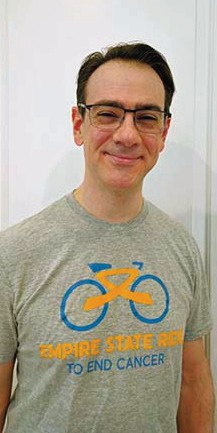

Harry Marenstein is a professional musician and educator. He has been a Professor of Music at SUNY Nassau Community College for 21 years and has served as Music Director and Conductor of the North Shore Symphony Orchestra since 2018.
Marenstein was born and raised in Jamaica, Queens. After leaving the city for seven years to pursue higher education, he and his wife spent several years living in Brooklyn, but his home borough called him back, and they moved to Sunnyside in 2007, where they’ve raised their two boys. When not teaching or performing, he enjoys cycling in and around New York City, cooking, reading about New York City history, and exploring all the amazing cuisine Queens has to offer.
He especially loves the Northwest section of Queens for its diversity of languages, cultures, and landscapes and loves to show the area off to friends who visit from out of town. As the son of two teachers, he is particularly proud to be a product of New York City’s public education system.
This July, Harry will ride his bicycle 600 miles from NYC to Niagara Falls to raise funds for the Empire State Ride to End Cancer. All of his riding begins and ends in Sunnyside, with Queens and its many landmarks serving as one of his main training grounds. Locals see him frequently riding through the area during the cycling season as he prepares for the weeklong ride across the state.
 NB: Other than the amazing diversity, what do you love most about living in Queens (or Queens in general)? How has Queens changed over the years?
HM: I appreciate the variety of landscape of the borough, from the riverfront views of Long Island City to the hilly terrain around Bayside and Douglaston, to the coastal plains of the Rockaways and Jamaica Bay. Queens really has it all and getting to explore it on a bicycle is the best way to experience it.
Queens has changed a lot over the years. When I was a kid, there were all sorts of jokes about Queens, particularly from people living in Brooklyn and Manhattan. We were “the last to get plowed” and the borough you went to only if you had to get to the airport. We were “tunnel and bridge people.” It’s amazing how much Queens has changed, and especially the way perceptions of it have changed over the years. Nowadays it’s the place to be. That would have been unthinkable in the 1980s.
NB: How does Queens inspire you? What are some of your favorite places to be inspired in Queens?
HM: Almost half the population of Queens are people who were born elsewhere, including my wife. On my block alone, we have neighbors born on the Indian sub-continent, Central America, Nepal, China, and Eastern Europe. Interacting with people of different backgrounds and perspectives helps us understand the world better and hopefully helps make us better people. The availability of incredible food that comes with it doesn’t hurt, either!
As for places, I am inspired by the amount of parkland and the number of areas we have that give us opportunities for quiet reflection. I spend a lot of time in Queens parks cycling and training for an annual charity group ride called the Empire State Ride, which starts in NYC and ends in Niagara Falls. My training routes take me through places like Astoria Park, Flushing Meadows, Forest Park, Kissena Park, Cunningham Park, and Alley Pond Park. It’s incredible how much of Queens is green if you only see the dense urbanized western side or the suburban sprawl to the east.
NB: How did you get into cycling? Tell us about the Empire State Ride and how you came to be involved in it.
HM: Eleven years ago, a friend of mine was emptying out his storage unit and he offered me his old French racing bike from the 1980s. It had been many years since I had ridden, but I still remembered how much I enjoyed riding as a kid, the sense of freedom it gave me to adventure far beyond the neighborhood using only my legs. Knowing that I needed to start doing some kind of exercise, I took my friend up on his offer. I quickly fell in love with the sport of cycling, joined a bike club, went on group rides, and by the end of that summer, I completed the New York City Century, a 100-mile ride that began and ended in Central Park.
In 2020, just as the pandemic began, my wife was diagnosed with breast cancer. Through the period of lockdown, she endured 16 weeks of chemotherapy, followed by surgery, and then five weeks of daily radiation treatments, which she finished at the end of December of that year. All the while, I was teaching classes on Zoom from our basement and taking care of our two sons. Like many people, I took to indoor cycling for exercise as well as for a mental break. One day in 2021, I saw a social media ad for the Empire State Ride. I was interested in the challenge of riding over 500 miles across New York State. When I learned that it was to benefit cancer research, that’s all I needed. I started planning for the 2022 ride. I have been back twice more, in 2024 and 2025, and am returning for my fourth ride this summer. Every year I carry the names of cancer patients in whose memory and honor I ride.
Less than two months before I started my first ESR, my mother-in-law was diagnosed with Stage IV ovarian cancer. She endured nearly three years of treatment, surgeries, and emergency hospitalizations before succumbing to the disease in March 2025. It is in her memory and in my wife’s honor as a cancer survivor that I take on this challenge with the hope that one day we will live in a world without cancer.
NB: What advice do you have for people who want to start cycling ? is your advice the same for music?
HM: I am not a gifted athlete by any stretch of the imagination. My natural state is to be sedentary in fact. But I love to ride a bike, and my dedication to raising as much money as I can to fund cancer research is what makes me work as hard as I do to prepare my body and mind to ride the 600 miles from New York City to Niagara Falls. I may not be as fast and strong as some of my fellow riders, but I’ve mentally prepared to push up a hill or through a headwind. Knowing that I’ve done everything I can to prepare for those challenges gives me that extra boost I might otherwise not have when it’s needed.
Some people have naturally better coordination and capacity for muscle strength or endurance. Some people naturally acquire skills faster and with more fluency. Some people seem to “get” music better than others. That’s talent and we can’t control that. However, hard work beats talent when talent doesn’t work hard. Ultimately, someone who is disciplined, dedicated, and who always shows up prepared and ready to do a good job is going to be successful, even if they don’t have as much natural gift as others. Performance anxiety is totally normal. Mental practice and extraordinary preparation are what permit you to cope with it.
NB: How important is personal connection and communication (networking?) in your industry?
HM: In any business or practice that involves interaction with others, communication is important. In my job I have to be clear in how I communicate, direct without being abrasive, and understanding of the needs of my students and the musicians in my orchestra. It can’t be about me and my ego. I also need to be honest. When I make a mistake, and I make plenty, I own up to it. I don’t blame others to cover my tracks. Reputation is everything. It takes a long time to establish a good one and maintaining it is a perpetual effort. But it takes only one moment to tarnish it and it’s hard to fix it once that’s happened.
I’m not a very marketing-savvy person. I just try to be friendly and respectful and to act professionally. I find it hard to ask people for money for the Empire State Ride, but I have to ask and keep asking if I want to reach my fundraising goals for cancer research.
When riding in a group, communication is essential for safety and comfort. You have to discuss pace beforehand, be able to ask for adjustments if some of the riders aren’t sticking to the plan, and make sure you’re calling out hazards to the riders behind you. Clear effective communication makes the miles melt away.
NB: What is the best piece of advice you’ve ever received? What is something you wish you knew a decade or two or three ago?
HM: I’m a very competitive person, but only with myself, not with others. I push myself very hard to outdo my last endeavor, whatever it is, and I can become hyper-focused on my sense of achievement and how I’m measuring it. In 2022, I participated in the Empire State Ride for the first time, and I was very nervous about being able to ride so far and for so long. I had never done anything like it before. I was pushing myself very hard and beating myself up over not going as fast or for as long or far as I felt I should. One of my fellow riders, Steve Mars, who I consider a mentor, told me, “It’s not a race. You’ll get there when you get there, just like everyone else.” I keep telling myself this every time I get out there. Similarly, in classical music, the unrealistic goal of perfection often drags us down and we forget that we’re there to share beautiful, timeless works of art with an audience. But if we’re not enjoying it, how can they? I always tell my fellow musicians before a performance, “Let’s have fun out there.”
NB: Who are some of your favorite musicians, singers, composers, conductors, artists, bikers, and other creatives with a Queens connection?
HM: Well, my mother went to Forest Hills High School with Simon and Garfunkel, so they have to be near the top of my list. I loved the Ramones when I was a kid. “Road to Ruin” was one of my favorite albums. Of course, growing up in Jamaica in the 1980s, the Hip-Hop world was evolving in my part of Queens. Acts like Run-DMC and LL Cool J were local heroes. But the king of them all has to be Louis Armstrong, who made his home in Corona. How cool is that?
NB: What are your favorite restaurants, cafes, theaters, bookstores, exhibits, museums, communities, bike shops, and venues in Queens? Favorite places to play your music? Favorite places to bike?
HM: I could not stay on the road if it weren’t for Jerry and Joanie at Peak Bike Pro in Douglaston. They have been my “local” bike shop for over 10 years. Even though it’s on the other side of Queens from where I live, I always go to them for all of my cycling needs, from tuneups and repairs to accessories.
When we first moved to Sunnyside, one of my friends exclaimed, “Sunnyside is delicious!” and they weren’t kidding. We’re big fans of Riko, a Peruvian restaurant, on Greenpoint Avenue; Doma, a homestyle Korean place on 41st St; and Sotto le Stelle on Queens Blvd. when we have a hankering for brick-oven pizza. Further afield, one of our family favorites is Jaew Hon, an all-you-can-eat Thai Hot Pot place on Roosevelt Ave. And of course, no hot summer day training ride is complete without a stop at the Lemon Ice King of Corona. I don’t care what anyone says. Queens has the best restaurant scene in the City!
My two favorite museums are the Museum of the Moving Image and the Hall of Science.
Any time I’m interested in a book, the first place I check is LIC Book Culture on Jackson Ave.
NB: What do you wish more people knew about being a musician, conductor, professor, and/ or biker? What is something you wish you knew before you became a musician, conductor, professor, and/or biker?
HM: There is no such thing as perfection, only progress.
NB: Do you have any events or projects coming up that you’d like to promote? Your answer to this question helps with our production schedule.
HM: The Empire State Ride goes from July 25-August 1, 2026. Over 300 riders will depart from New York City and cover roughly 80 miles per day for a week. Our longest route, from Albany to Utica, is 100 miles. For every dollar donated to the Empire State Ride, Roswell Park Comprehensive Cancer Center generates $23 in additional grant funding. My personal fundraising page can be found at: http://give.roswellpark.org/goto/HarryM26
NB: If you could choose only one song to represent Queens, what would it be and why?
HM: The Queens born and raised composer, John Zorn, wrote a piece called “Briel”, performed by Yo-Yo Ma’s Silk Road Ensemble. It is an eclectic piece that features musicians and instruments from all over the world, including the Chinese pipa, the Persian lute, clarinet, and a variety of percussion instruments. It’s a musical mash-up of the wild diversity of languages and cultures you encounter in Queens on a daily basis.
NB: What is a typical day like for you?
HM: On work days I wake up at 5 AM and work out for 30 minutes to help me be fit for cycling. I work in Long Island, so I have to get out of the house by 7:30 to sit in traffic. I teach several classes per day, both in the music major program at NCC as well as a liberal arts course for the general student population. Because I’m the one with the car, I also do the grocery shopping. My wife works longer hours than I do, so I usually get home first and make dinner. Once a week, I have an evening rehearsal further out in Long Island with the North Shore Symphony Orchestra, and get home pretty late. On days off, I like to spend 60-90 minutes doing indoor cycling if the weather is bad. When it’s training season, I try to get in a few 20-30 mile rides a week. When the school year ends, I try to get on the road by 7:30 and ride anywhere from 40-80 miles at least twice per week.
NB: Can you tell us more about being “proud to be a product of New York City’s public education system”? What was it like growing up as the son of two teachers? How do these experiences impact the way you raise your children?
HM: Teachers are among the unsung heroes of our community. I spent my childhood witnessing how the proverbial sausage gets made. I saw how exhausted my parents would be every day when they came home. Having to be on your feet, engaging students, giving extra help, grading work, speaking to parents, being on hall or lunch duty, etc. really takes its toll. In addition to watching my parents do their thing, there were several teachers in my life, particularly at Stuyvesant High School, who had a big influence on my life and my own approach to teaching.
NB: What’s a wild story (PG-13) you have about NYC before the times of cell phones or social media? If you weren’t in NYC then, what’s a story you have of NYC past (or the past)?
HM: Let’s just say that I’m grateful there were no cell phones or social media when I was a teen. I had a great time, but I’m glad there’s no record of it, other than my memories. I was a big fan of the 24-hour diner back then, and you used to meet the most fascinating people after midnight.
NB: How do you know when your song (or piece, or any type of art) is “done” (finished editing, complete)? How do you know when you are finished practicing a song? Is there such a thing as being done with practice for a specific song or is practice forever?
HM: Greg LeMond, the only American to win the Tour de France, once said that in cycling, “It doesn’t get easier. You just go faster.” I like applying the same idea to music. “It doesn’t get easier. You just play better music with better musicians.” The reason why you can keep coming back to the same works over many years is because there’s always something new to discover in them, there’s always something you can do better, and there’s always something you can practice more. In cycling, you can climb that hill faster than previously or go further than you did the last time. It’s about embracing challenge. When it comes to the Empire State Ride, there’s always more to raise for cancer research.
NB: Can you tell us more about being the Music Director and Conductor of the North Shore Symphony Orchestra?
HM: The North Shore Symphony Orchestra performs five concerts a year at the Adelphi University Performing Arts Center. We rehearse weekly throughout the season (September to June) and present a variety of works, from contemporary works by living composers to classics of the great masters. We sponsor several events per season, collaborating with young musicians, music educators, and local music schools. Our next concert will be a collaboration with Spot On Entertainment, presenting “Broadway Sings America: 1776-2026” on Saturday, May 16. For more information, visit www.northshoresymphonyorchestra.org.
—Nicollette Barsamian
The Local-Express interview series was originated on July 3, 2013 by Nicollette Barsamian.