
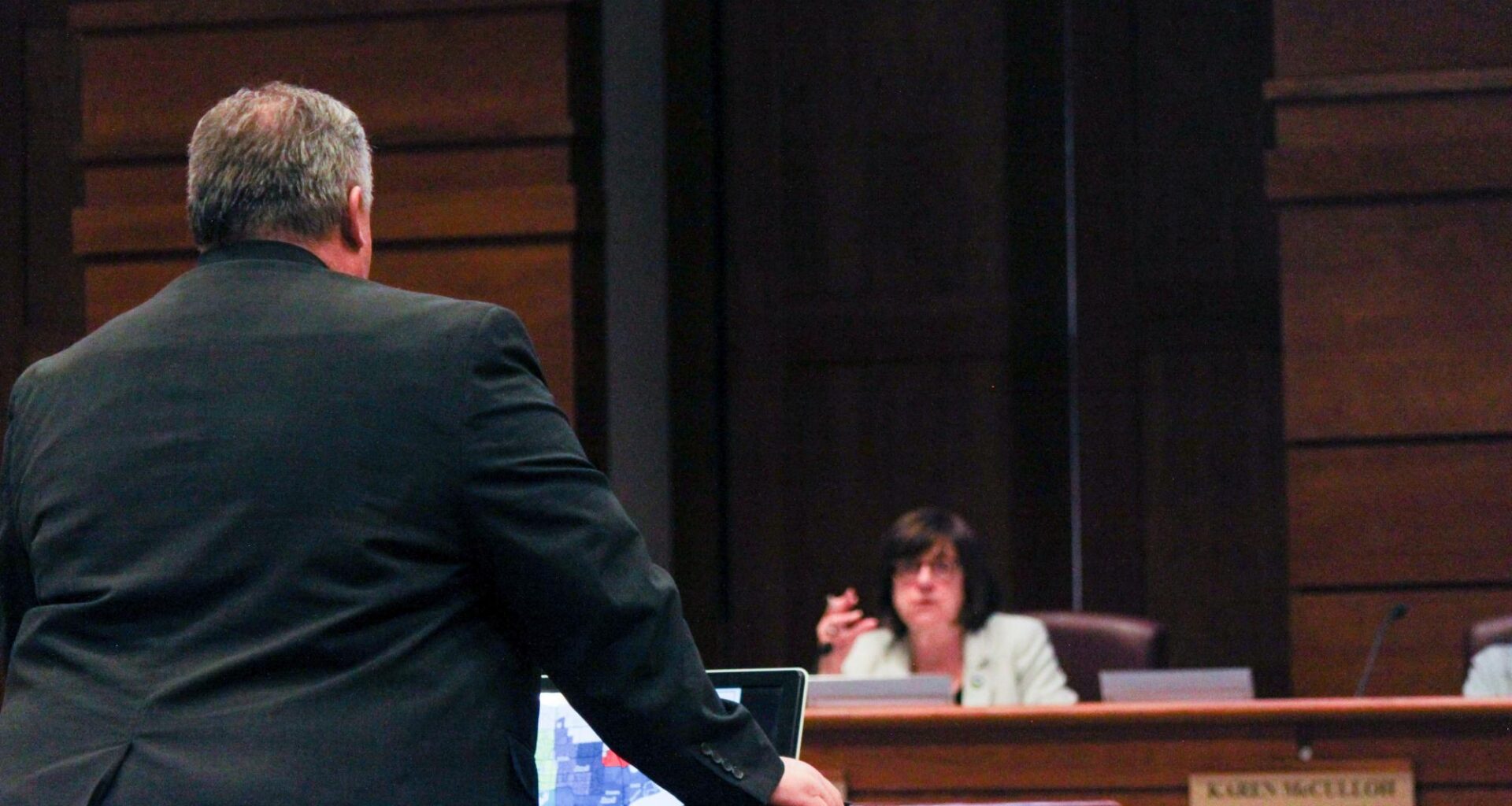
The Manhattan City Commission met Thursday to discuss funding for city roads and to review the 2025 Pavement Condition Index (PCI), which rates city street conditions using a number value system ranging from “failed” to “good.”
Brian Johnson, director of public works, began this section of the meeting by providing background on street funding and gas taxes.
“For decades, federal and state gas tax generated enough revenue to pay for new roadways and maintain the roads we had,” he said. “The first gas was about 1930. It was raised about every five to 10 years. The last time it was raised was 1993 at the federal level and 2004 at the state level.”
Johnson said Kansas drivers’ gas-buying power today is about 60% of what it was in 2004, so many cities turned to sales tax to fund street maintenance. Manhattan currently charges the lowest sales tax for streets out of all Kansas cities, at .2%.
The PCI helps the public works department decide what roads need attention and how to allocate funds. Manhattan’s 2026 PCI report has not been finalized, but Johnson shared findings from the first draft at Tuesday’s meeting.
“The final report indicates somewhere between 6 and 8 million [dollars] per year is what should be spent on the street repair to increase the PCI,” he said.
The PCI breaks road conditions up into 7 categories: failed (0-10), serious (10-25), very poor (25-40), poor (40-55), fair (55-70), satisfactory (70-85) and good (85-100).
“The area that we wanna be in is 70 to 60,” Johnson said. “65-70 would be very good, to be in that range. We’re at about a 60.”
According to the PCI draft, 1% of Manhattan roads fall in the “serious” category, and 17.1% fall under “very poor.” These are categorized as backlog projects, which fall under deferred maintenance.
“These are the roads that you get all the calls about,” Johnson said. “They’re hard to drive down, lots of potholes, we spend lots of time patching them, putting asphalt in them, trying to fix them, keep them passable. This backlog is what really drives a lot of the phone calls and complaints. It’s also very expensive to fix, because it’s a full rebuild.”
The 2025 Post-Rehab Network PCI Analysis found the city would need to spend over $7 million a year to improve its backlog, but Johnson said this model may not account for some factors.
“Historically, the model has underrepresented the cost of what it’s gonna take to repair the streets, and that’s what your backlog is telling you here, because our backlog is growing,” he said. “Even though we’re spending $7 million a year and our PCI is growing, our backlog is getting worse.”
The highest number of roads in Manhattan fall under the “fair” category, at 25.2% as of June 2025.
Johnson said streets rated “fair” typically have “some pitting, some alligator cracking, but overall [are] in decent shape.”
To improve Manhattan’s PCI over the next three years, Johnson suggested a .5% street sales tax, generating roughly $8 million a year. This would allocate $2 million a year for arterial and collector roads, and $6 million for local roads each year over the next three years.
For long-term projects, the .5% split may not sustain the necessary funds. City manager Danielle Dulin said the commission is weighing several ideas to fund street improvements beyond the next three years.
“We can have a dedicated sales tax, which is what we currently have with our .2%, and we send it out to voters for approval and [will have] it sunset in ten years, and right now we’re having the conversation about renewing it for another ten years, potentially,” she said.
Dulin said the commission could also dedicate a mill levy to street improvements.
“That [would be] in place and permanent until another commission decides to make a different policy change.”
Johnson discussed streets selected for maintenance in 2026, which are broken up into five zones. He said the city estimates $3 million in expenditures for road maintenance this year, funded by sales tax.
“We’ve got some work down on Miller Ranch, got some work up on Juliette, 11th Street, as well as Highland and Browning, and then some work up at Butterfield.”
Manhattan Mayor Susan Adamchak recognized Amherst Avenue as an area with especially rough road conditions.
“There’s a lot of work being done on these residential streets off Amherst,” Adamchak said at the meeting. “Amherst itself is in pretty rough condition right now. Is that going to be part of this project?”
Johnson said the city doesn’t currently have plans to re-pave Amherst Avenue because they “don’t have the money to go that far.”
“We’ll patch it and try to band-aid it along,” he said.
The commissioners took no vote on Thursday to advance road improvement funding plans.