
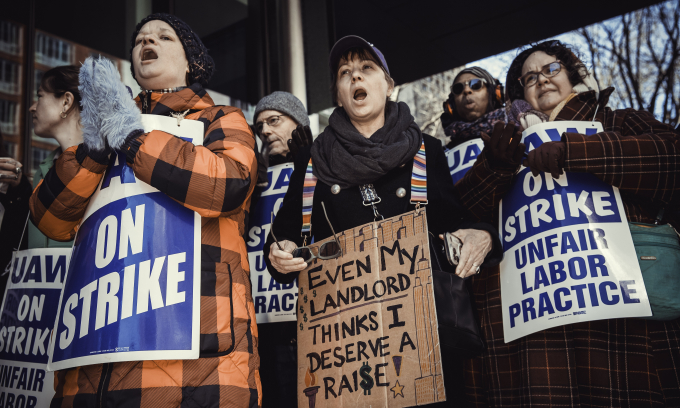
The strike by members of Contract Faculty United-UAW, the largest full-time non-tenure-track faculty union at any private university in the country, began at 11 a.m. as students returned from spring break to find picket lines instead of lectures outside the Paulson Center on Mercer Street in Manhattan.
The union had extended its original 8 a.m. deadline by three hours to allow a final round of overnight talks, but the effort failed.
Contract faculty make up roughly half of NYU’s full-time teaching staff yet earn on average 36% less than their tenured colleagues, according to the union. The pay gap is especially painful in a city where monthly living costs routinely exceed US$5,000 per person and Manhattan’s median rent just hit a record $5,000 in February, the first time the borough has breached that threshold, the Corcoran Group reported.
Maria Hodermarska, a drama therapy professor who has taught at NYU for more than 30 years, said she holds two other jobs outside the university to cover her expenses. She is not an outlier. Contract faculty across NYU have described working multiple positions to stay afloat in one of the world’s most expensive cities.
“NYU is not paying its contract faculty fairly, and it’s not fair for them to balance their budget on the backs of some of the people who are working the hardest and getting paid the least,” economics professor Dawn-Elin Fraser told CBS New York.
NYU Chief Communications Officer Wiley Norvell called the strike “fundamentally unnecessary,” pointing to a package that includes a $90,000 salary minimum for the lowest-ranked contract faculty positions, average raises of $10,000, and health benefits matching those of tenured faculty.
The university says the proposed minimums are the highest of any unionized contract faculty in the country.
The union rejected the offer, countering with a $100,000 minimum and demanding that raises take effect immediately rather than next year, Washington Square News reported. Faculty are also pushing for housing support on the same terms as tenured colleagues, including rental assistance and mortgage programs, a demand NYU says falls outside the scope of mandatory bargaining.
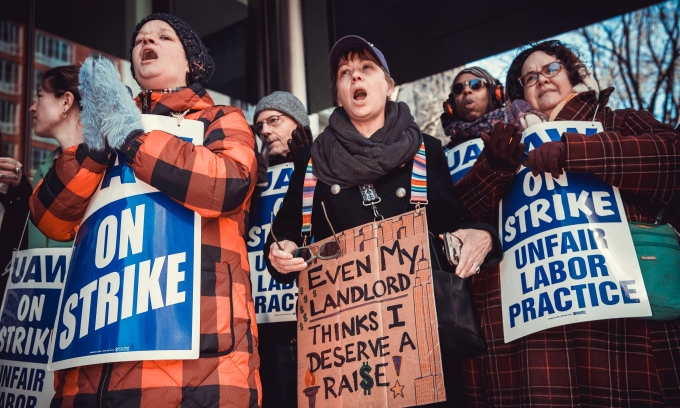
New York University contract faculty chant on a picket line in Manhattan on March 24, 2026. Photo by Reuters
The strike has prompted NYU to advise its more than 19,000 international students to contact the Office of Global Services to ensure they remain in compliance with visa requirements while classes are disrupted. The university said it is deploying substitute instructors, launching online course modules, and reassigning administrators to maintain academic continuity for all students. President Linda G. Mills urged students to attend classes as scheduled.
Faculty worry that substitutes cannot replicate the quality of instruction, especially with thesis submission deadlines approaching in mid-April.
The standoff at NYU is not happening in isolation. Earlier this month, graduate and undergraduate student workers at Columbia University voted 91.5% in favor of authorizing their own strike over demands including higher wages, expanded healthcare, and protections for non-citizen workers.
Together, the two labor actions threaten to disrupt academic life at New York’s most prominent private universities simultaneously.
More than 60 New York elected officials, including Manhattan Borough President Brad Hoylman-Sigal, signed a letter urging NYU leadership to reach a deal quickly.
As of Tuesday evening, the two sides had reached tentative agreements on about 30 issues including job security, academic freedom, and retirement benefits after a 27-hour bargaining marathon. But the core disputes: compensation, research funding and housing, remain unresolved.
New York University, founded in 1831, enrolls more than 57,000 students, including over 19,000 from abroad, and is ranked No. 32 nationally by U.S. News. Its contract faculty are the first at a major private U.S. university to strike for a first contract in recent memory, a precedent labor observers say could ripple across higher education nationwide.