
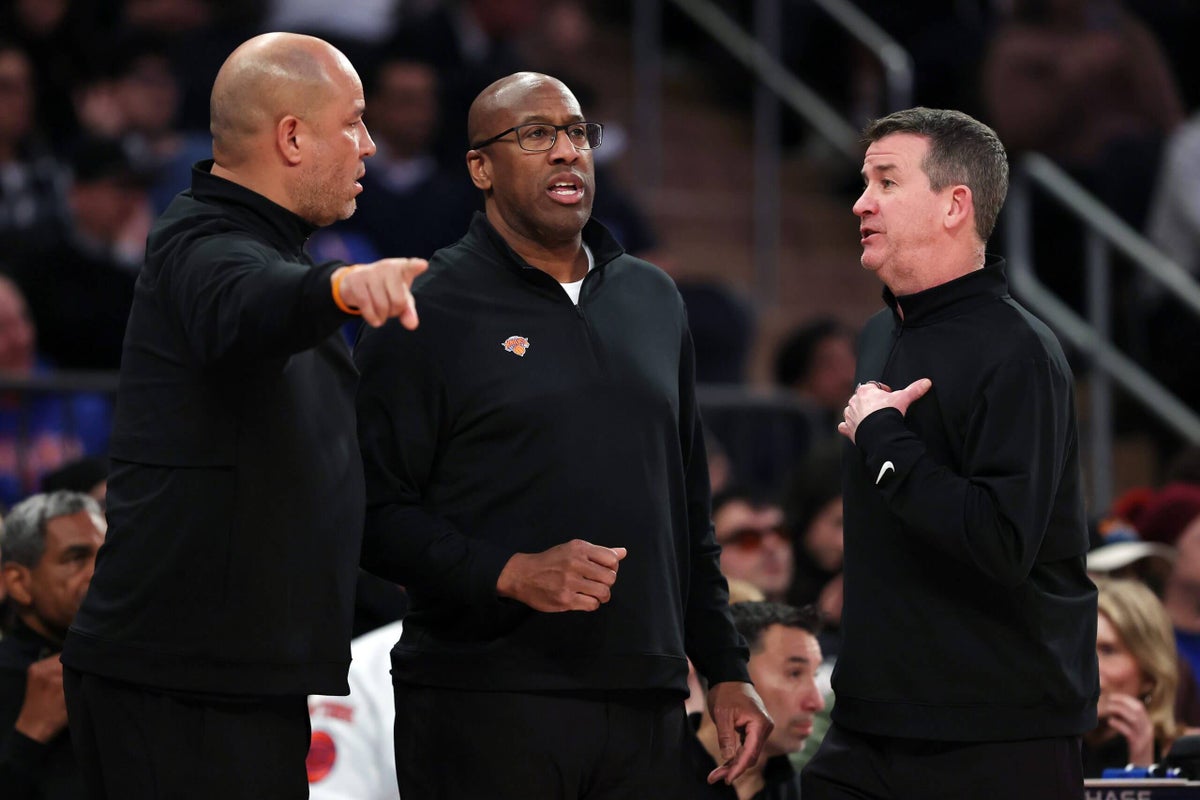
There are times throughout a Knicks game when, if you look closely, head coach Mike Brown can appear to be wandering, both his body and his mind.
It’s only during a timeout, and not every single one. But, sometimes he’ll be outside of the New York huddle, his hands in his pockets, his feet moving in circles and head looking up, thinking. Other times, like in the first quarter of Tuesday’s game against New Orleans, Brown will give a congratulatory clap to his players seated on the bench, take a step back and then hover over the shoulder of one of his assistant coaches as they speak to his team as Brown stands silently.
For Brown, the sporadic nonchalantness serves a strategic purpose and is not just a man needing a break from his job.
“It’s great for the guys to hear different voices,” Brown said earlier this week. “It’s like with your kids, if you’re the one (talking) all the time, sooner or later they tune you out. I have the utmost confidence in all of my assistants. So, for them to have a voice or a presence in what we’re doing, I’m all for it because they handle their business the right way.
“It also gives me an opportunity to save my voice. Maybe when I’m speaking, it can be magnified a little louder if you have that around you. All of my guys on the front of the bench, all of my guys on the back of the bench, I’ll close my eyes and let them coach and be OK with it.”
This is what the Knicks brass wanted when they fired successful coach Tom Thibodeau and hired Mike Brown this past summer. Collaboration was near the top of the job description, and Brown’s willingness to give his staff a voice during critical moments of games is one of several ways the head coach is sharing the wealth.
Brown has a coach who handles his substitutions. He has offensive and defensive coordinators, Chris Jent and Brendan O’Connor, who Brown taps to run the huddle depending on the situation. There are more behind-the-scenes coaches who give input during games.
It’s a tactic that, on a micro level, could appear to have little impact. However, Brown and some of his players see it as a way to set people up for success beyond just a singular moment.
“I feel like it helps us but also helps the coaches,” Jalen Brunson said. “They get more experience and put in positions where they’re leading. I think it’s all-around good for everybody.”
What Brown does with his assistants during some huddles isn’t unique. Other coaches have also deployed this tactic. Saying it’s common, though, wouldn’t be fair either. But it’s more common than Thibodeau’s approach. The former man in charge would rarely consult with his coaches during timeouts. Now, it is rare to see the coach not have a conversation with his assistants before sitting down to talk to his team.
That’s not to say Thibodeau’s approach didn’t work. He helped make the Knicks relevant again on the basketball court. He got them back to the Eastern Conference finals for the first time in 25 years. Thibodeau has won a lot of games everywhere he’s gone. His approach worked for him.
Yet, New York wanted someone more willing to let others have input. Before becoming coach of the Sacramento Kings, which was Brown’s most recent stop before getting the Knicks job, he was an assistant with the Golden State Warriors, and head coach Steve Kerr. Kerr was known for his collaboration. There were instances where he’d not only let his assistants give input to the players during huddles, but he even let players run the huddles sometimes.
This approach, in theory, could backfire, though. A coach can set himself up to look weak in a scenario where he hands a clipboard to an assistant during a big spot in a game. Some players might question the head coach’s leadership. Furthermore, maybe the assistants don’t have the same respect in the locker room that a head coach perceives they do. There’s a lot that could go wrong with an approach like Browns.
However, so far, Brown has appeared to strike a good balance between deploying his voice and knowing when someone else should speak. He also seems to have found assistants who the players believe in.
In New York, everyone feels involved in the team’s success.
“Sometimes it’s good to hear different voices,” Josh Hart said. “I think there is a sweet spot because you don’t want to hear too many different voices, but I think he does a good job of holding guys accountable but letting other coaches have our attention and mixing in other voices.”