
In her 2024 memoir Health and Safety, journalist and The New Yorker staff writer Emily Witt wrote:
“In the depth and clarity of the tangle of sounds emerging from the speakers that night, I began to understand I was experiencing something of a higher order. It wasn’t that I hadn’t been paying attention to the music before, when I’d gone to Berghain or danced at Bossa [Nova Civic Club], but maybe I was initially drawn to the scene for other reasons. Now the speakers held every detail, the dancers were locked in to a communal current, and my brain chemistry was primed for a flood of pure sound. It could have happened somewhere else, or with another DJ, and probably most people who have felt it could say where it happened to them, but this was the first time that I understood.”
Emily’s book recounts one story after another involving techno, sex, drugs, and clubs. It’s tough to put down, but above all, this passage stood out. The words feel regrettably true – regrettable because of how impossible it is to explain what great club music feels like to someone who has never experienced it.
The conditions have to be right. Funktion-One speakers aren’t a strict requirement, but sound and acoustics matter. The DJ matters. The music matters. You have to be in the right headspace. And the people around you matter too.
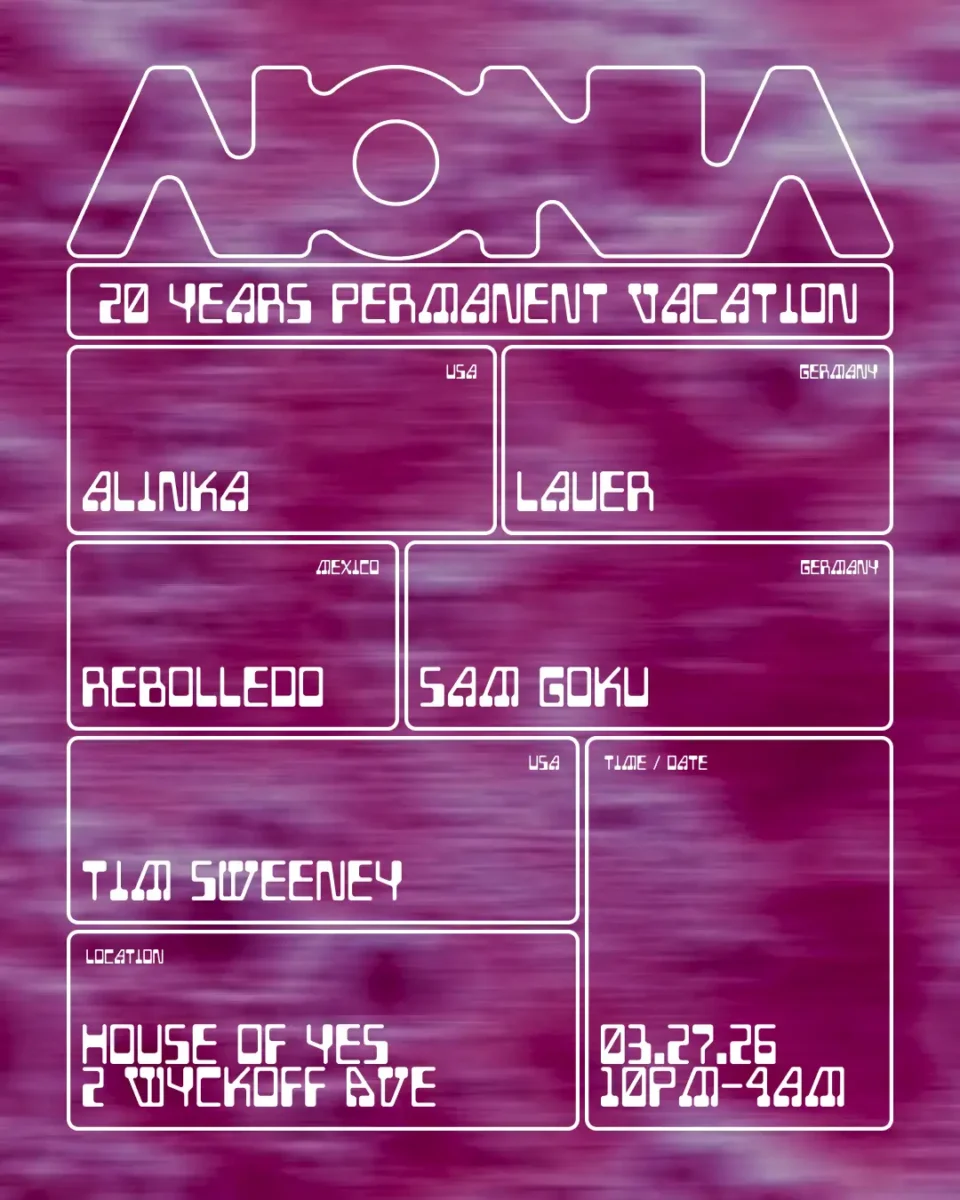
Right now, the best clubs in New York tend to cluster across Brooklyn and Queens, within an area designated by city planners as the North Brooklyn Industrial Business Zone (IBZ). Some parts are zoned for heavy manufacturing, others for light – and, somehow, clubs fall into the latter. A symbiotic relationship between nightlife and industry has led to the repurposing of these old, durable buildings. Aionia’s upcoming 20 Years Of Permanent Vacation showcase takes place at House of Yes, once an industrial ice warehouse.
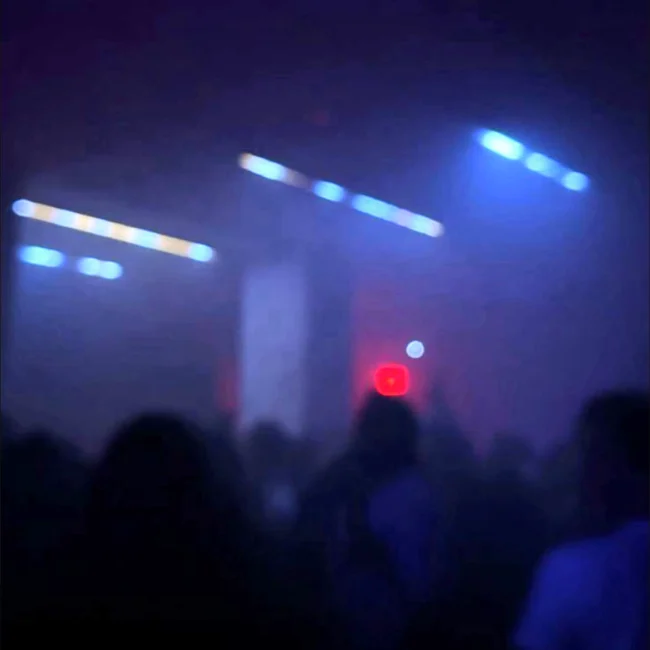
H0L0 is another such space, where Aionia’s Kein Klub series recently hosted Mor Elian, Fabrizio Mammarella, Giulia Gutterer, and Facets. H0L0 is dungeon-like – an underground catacomb. The booth sits at the centre of the room, encircled by four stone columns, with space to move fully around the DJ. Speakers anchor each corner. We started at the front, but eventually drifted behind the booth, drawn to the blinking lights of the CDJs.
At Kein Klub, phone use is prohibited – we didn’t bring ours. People were locked in. Brooklyn isn’t shy about dancing, but that night felt different. It reached that level Emily Witt describes: where low frequencies move through your body, guiding your steps, and a genuine connection forms between strangers. It’s difficult to explain. You had to be there.
We spoke with Alexis, founder of Aionia and the Kein Klub series, ahead of their Permanent Vacation showcase at House of Yes, to find out more about what makes them tick.
Interview by Ryan Pivovar
“Brooklyn rave culture came out of risk, weirdness, freedom, and real
DIY spirit. Parts of it are more polished and more visible now, which has
pros and cons. Aionia sits somewhere between club culture and rave culture.”
Hello, Alexis. Thank you for speaking with us. What is Aionia and Kein Club? Where do you feel like this fits within the nightlife ecosystem here in NYC?
Aionia is the umbrella, the wider platform and vision. Music-first parties, strong curation, long sets, less phones, and a real focus on atmosphere, flow, and crowd. Sonically, it leans more house, disco, melodic, and left-of-center club music. But more than genre, it is about taste and building a full night properly.
Kein Klub started as one of our party concepts, but over time it grew into something with its own very clear identity. Darker, rawer, more stripped back, more experimental, more no compromise. The no phones side is stricter, too. So it still sits under Aionia, but it is becoming its own brand within that world. We are not trying to please everyone. We are building distinct worlds with a clear point of view.
You’ve managed to secure a few US debuts for artists and labels. Congrats on that. It’s nice for the US, and more specifically for New York City. Are US debuts something you seek out? Whose debut performances have you managed to help facilitate?
Thank you. We do not chase debuts just for the headline. But if an artist or label feels really right for what we are building, then of course it is exciting to help make that happen. For me the point is to bring something meaningful to New York, not just something new.
Permanent Vacation’s first US showcase/debut is a big one. It has been one of my favourite labels since I can remember, so to me it is kind of mind blowing that nobody had brought them for a proper US showcase before. I am very happy we get to do that.
Some other debuts I was excited to help facilitate were DC Salas, Hardt Antoine, Belaria, Miura, and soon Istanbul Ghetto Club from Berlin, who mix techno with Anatolian and Turkish influences, and a theatrical side too.
Is there anything you wish you would see more of at clubs in NYC, or things that you wish were more part of our local culture? Is there anything that you hear from labels, artists, and DJs traveling to NYC that they wish we had more of here?
I think Brooklyn is in a pretty good moment right now. There has been a bit of a renaissance. A few venues that opened, or really sharpened up in the last year or two, are doing real work and helping shape a better culture for the new generation of clubbers. Less phones, less talking on the dancefloor, more experimentation.
What artists from Europe still say, though, is that they want more spaces that really commit to sound, long sets, and nights built around flow rather than hype. I think BK is moving in the right direction, and I am happy to be part of that.
What do you think makes a club great in Brooklyn?
Sound, space, crowd, programming, and mainly people behind it who actually care. You feel it straight away when a place is run with care and when it is not. The great clubs are the ones that make people behave differently the moment they walk in.
How has Aionia evolved since you’ve been hosting shows?
It has become much more defined. In the beginning we were exploring more. Now the identity is sharper. The music, the crowd, the visual language, the pacing of the nights, all of it is more intentional now. That being said, we’re still evolving and changing all the time, as this is the nature of the industry.
“Less phones, less talking on the dancefloor, more experimentation.”
What do you feel makes Aionia special within the NYC club scene?
Taste and consistency. We care about the full night, not just throwing names on a flyer and hoping people come. It is also very Brooklyn, but there is definitely a European influence in how we think about sound, flow, and curation. I think that mix is part of what makes it special.
What are your favourite clubs in Brooklyn right now? What makes them unique?
H0L0 for the rawness and freedom. Nowadays for its dancefloor culture and integrity. Basement for its consistency and no nonsense crowd. I also have a lot of love for House of Yes and Elsewhere. I have been a fan of both since I moved to the city nearly ten years ago, so I am very happy we have a number of shows there this year.
How far in advance are you typically planning lineups? Has that timeline changed as Aionia has grown?
Usually months ahead. The bigger the show, the earlier. As Aionia has grown, that timeline has stretched, because better artists, better routing, and better planning all need more lead time.
When you think of rave culture in Brooklyn, what do you think of it? Has it evolved? Where does Aionia fit into all this?
For me, Brooklyn rave culture came out of risk, weirdness, freedom, and real DIY spirit. Parts of it are more polished and more visible now, which has pros and cons. Aionia sits somewhere between club culture and rave culture.
We are not trying to fake some warehouse myth. We are very much against table service culture and VIP logic. On the dancefloor, everyone should feel equal. That is also why we try to keep entry accessible wherever we can.
Congrats on the Kein Klub show with Mor Elian. It was great! H0L0 is a really special space. How do you feel like it went?
Thank you. H0L0 is probably my favourite venue in New York, so I feel very lucky that Kein Klub has a residency there. And that night really felt like one of those nights where everything clicked. Mor Elian was incredible, but so was the rest of the lineup. The room was fully with it, the energy was there from early on, and it kept building properly. But that has been the case with all Kein Klub shows to date, which I am grateful for.
What I love about those nights, beyond the sound, is that H0L0 gives people options. Two rooms and the outdoor space mean you can move with your mood. Stay locked into one artist, drift into the other room, or step outside for a minute and reset. That makes a huge difference to me. One room spaces can be great, but they can also feel flat. H0L0 gives the night more life.
The Permanent Vacation show will be their NYC debut. That’s amazing. How did that all come about?
It grew organically. I have admired the label for a long time, and over time the conversation with one of the founders, Benjamin Frohlich, became real. I think they saw that we care about similar things, musical depth, atmosphere, and nights that actually have shape. So when the moment was right, it came together.
What else are you all working on for the coming year?
More Aionia shows, more Kein Klub, and more long term world-building around both. We are thinking beyond one-off nights and focusing more on building things with real identity that can last.
Who are some artists, musicians or otherwise, who are really inspiring to you lately?
The ones with real identity. Artists who do not sound over-optimised or overly polished. People like Lena Willikens, Intergalactic Gary, and DJ Pete, and many more.
Aionia Kein Klub
Aionia Kein Klub 6
LabelPermanent VacationGenreElectronicHouseTechnoPartnersAionia