
Congressman Goldman Seeks $15 Million in Federal Funds for Museum at African Burial Ground
Congressman Dan Goldman is pushing to allocate $15 million to expand Lower Manhattan’s African Burial Ground National Monument (a National Park Service site on Duane Street between Broadway and Elk Street) with a new memorial museum and educational center.
Mr. Goldman is seeking to include the $15 million in an appropriations bill for fiscal year 2027, which is currently being negotiated in Congress. On March 20, he wrote to Congressman Mike Simpson, who sits on the House Appropriations Committee and chairs its Interior, Environment, and Related Agencies Subcommittee (which oversees the National Park Service), noting, “the African Burial Ground is an important part of New York City’s history, serving as a permanent tribute to the enslaved and free African men and women who lived in and helped build the foundations of New York. Establishing a permanent museum would ensure that our city and nation never forget the important historic contributions that people of African descent have made to the establishment of New York City and the United States of America.”
Supporters of the proposed memorial museum and educational center hope to locate the expansion in the building at 22 Reade Street (at the corner of Elk Street), which dates from 1875. Directly adjacent to African Burial Ground National Monument, 22 Reade was used in recent decades as office space for various City agencies, but has been mostly empty since 2015, when the Department of City Planning moved out. Since then, the City Council has blocked sales to real estate developers, hoping that the structure will instead become home to the museum expansion that Mr. Goldman is seeking to fund. A year ago, the City’s Department of Design and Construction completed a rehabilitation of the streetscape at 22 Reade, stabilizing an underground sidewalk vault.
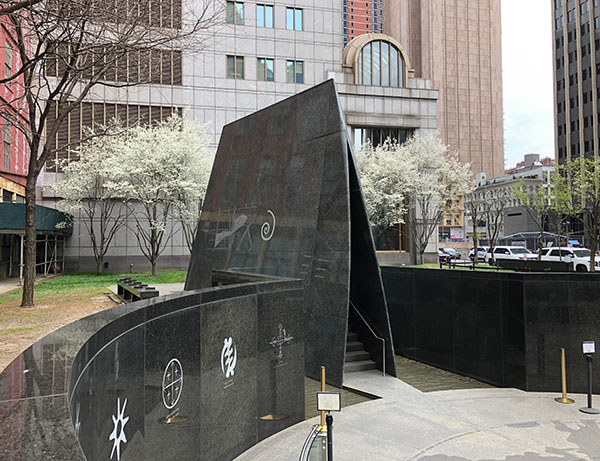
The African Burial Ground National Monument is the oldest and largest known historic burial ground in North America for free and enslaved Africans. The site became a National Historic Landmark in 1993 and was designated as a National Monument in 2006.
Enslaved Africans first arrived in what was then called New Amsterdam in the 1620s. By 1741, they comprised nearly one-fourth of New York’s population, and the City’s headcount of Black men and women in bondage was second only to that of Charleston, South Carolina. This site, located on what is now Duane Street, appears to have been chosen as a burial ground in the 17th century because it was at the outskirts of the settled area of Lower Manhattan. Decades later, it became a target of grave-robbing physicians, for whom research cadavers were in short supply. By the late 1700s, the urban core had begun to expand northward, and the small valley that marked the site was filled in, burying the cemetery. When the newly raised and leveled land was commercially developed soon after, the fact that a graveyard for New York’s earliest Black residents had once been located there was forgotten for centuries.
In the 1990s, as construction workers began excavating the foundation for a new federal office building at 290 Broadway (between Reade and Duane Streets), they came upon dozens, then hundreds, and later thousands of intact human remains – many of them buried with artifacts related to African tribal religions.
The new federal office building was redesigned to leave space for a memorial, and human remains that had been disinterred during construction were reburied with honor and ceremony. Today, visitors may pay their respects at an outdoor memorial and learn more about the African Burial Ground at an indoor interpretive center and research library.