
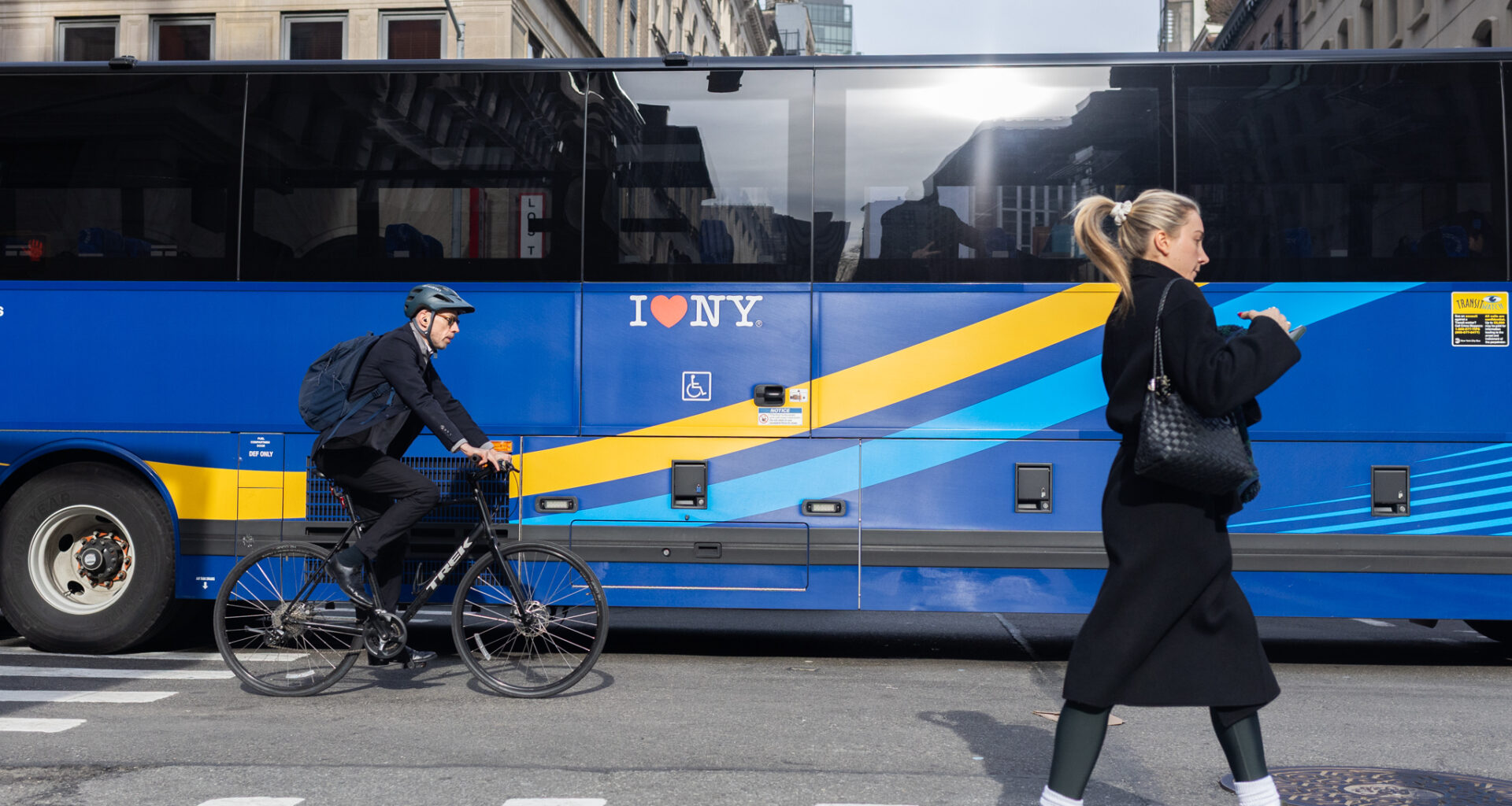
The MTA is aiming to boost the reliability of express bus lifts that are essential for wheelchair users who often encounter mechanical glitches and drivers who don’t know how they work.
The head of New York City Transit said Wednesday that the agency is upping the frequency of training for bus operators on how to work the hydraulic devices that raise and lower riders with disabilities.
Bus operators are trained on how to use them upon being hired, then have mandatory twice-a-year retraining, according to the MTA.
“We’re looking at giving them three times the amount of training that they are currently receiving,” said Demetrius Crichlow, president of New York City Transit. “We’re also including information within the bus itself that will give them additional information on the operation of that specific equipment for that specific bus.”
Even with an express bus fleet that is fully accessible to people with disabilities, the MTA has, for years, faced criticism over the lifts installed on each of the 1,100 buses that carry commuters between the boroughs and Manhattan.
Unlike the 4,886 buses on local and Select Bus Service routes — which are low-floor rides equipped with surface-level wheelchair ramps — the larger, high-floor express coaches have more intricate hydraulic lifts.
The MTA’s data shows all of those devices have, over a 12-month average, been deployed more than 112,000 times. But the statistics do not distinguish between the ramps on local routes and the lifts on express buses.
THE CITY reported in 2023 on how some wheelchair users avoid the express routes out of fear of being unable to board or exit, or of riding with bus operators who are not schooled on how to properly use the lifts.
“The bus drivers say, ‘I don’t know, I have no idea what to do, I haven’t been trained,’” said Jean Ryan, a motorized wheelchair user and head of Disabled in Action, an advocacy organization.
Representatives for New Yorkers with disabilities said those obstacles discourage people who rely on wheelchairs from riding the express routes, which make fewer stops while carrying an average of 60,000 riders daily between the boroughs and Manhattan.
“It’s not something that should take 10 to 15 minutes and delay a bus that’s supposed to be express,” said Jose Hernandez, a wheelchair user and president of the United Spinal Association’s New York City chapter.
Then there’s the hostility riders with disabilities can face from fellow commuters who grow frustrated by service slowdowns when a bus operator steps away from the wheel to board someone via a lift.
“I’m not doing it anymore — I will not use an express bus because the abuse from other riders was ridiculous,” said Debra Greif, a 67-year-old Brooklyn woman who uses a walker after previously relying on a wheelchair. “People would say, ‘Why don’t you use Access-A-Ride?’”
A survey last year of express bus riders from the office of the city comptroller found that wheelchair users were unable to board nearly 25% of the time — with that number doubling on Staten Island.
The 2025 report from then-Comptroller Brad Lander encouraged the MTA to consider testing and then potentially shifting to buses with low-floor entryways once older coaches are retired.
“Until they develop a strategy where the loading and unloading can be equally as fast as it is for our able-bodied counterparts, the maintenance and the training of bus drivers are still going to lead to longer load times and delays,” Hernandez said.
Dustin Jones, a wheelchair user who regularly uses express buses to travel to relatives’ homes in Far Rockaway and Sheepshead Bay, said it’s “refreshing” when he is given a boost onto the bus by operators who are familiar with the loading equipment.
But he said that is “very rare.”
“Some of them will be honest and tell you, ‘I haven’t done this in a while, so just give me a minute,’” said Jones, who lives in Manhattan. “The only reason why it ends up working out is because I have to tell the driver step by step what to do.”
The MTA has previously said that fewer than 5% of calls from operators about mechanical issues on buses are centered around express bus lifts. Crichlow said Wednesday that, at least anecdotally, the figure may be closer to 1%.
“It is an important population that we need to address,” he said. “And we want to make sure that this fleet — the great, accessible fleet that we have — is available to everyone to use.”
But a Transport Workers Union Local 100 official who represents bus operators on the express routes said he has received at least three calls in the last week about drivers struggling to help passengers in wheelchairs.
“I have operators complaining to the union that they’re not trained, that they don’t know how to use them,” said Mike Capocci, the union’s division chair for MTA Bus Company operators. “They couldn’t load up a wheelchair customer.”
The union official said the level of instruction to bus operators on how to work the lifts has been lacking.
“Handing out a pamphlet is not training,” Capocci said, adding that buses also have QR codes that can be scanned before offering step-by-step instructions for operating the lifts. “I’ve never seen training like that.”
Jones, the wheelchair user from Manhattan, said he feels for bus operators who struggle with the lifts.
“I do understand that if you’re an express bus driver, the odds of you seeing a wheelchair passenger are very slim — there’s not enough of us who ride the bus on a daily basis versus on the local bus,” he said. “However, that should not matter.”
Frank Farrell, executive vice president of buses at the MTA, sounded a similar note at this week’s transportation authority committee meetings.
“Accessibility is not a feature, it is a fundamental expectation,” he said. “Our bus system is fully accessible — when the lifts or the ramps fail, we fail the customer. That is unacceptable.”
Related