
SARATOGA COUNTY, N.Y. (WRGB) — In Mechanicville, the name Ellsworth seems to be everywhere — on street signs, historical markers, and towering memorials. Most people drive right by, unaware that the name once belonged to the most famous man in America, synonymous with an act of bravery that helped save the nation.
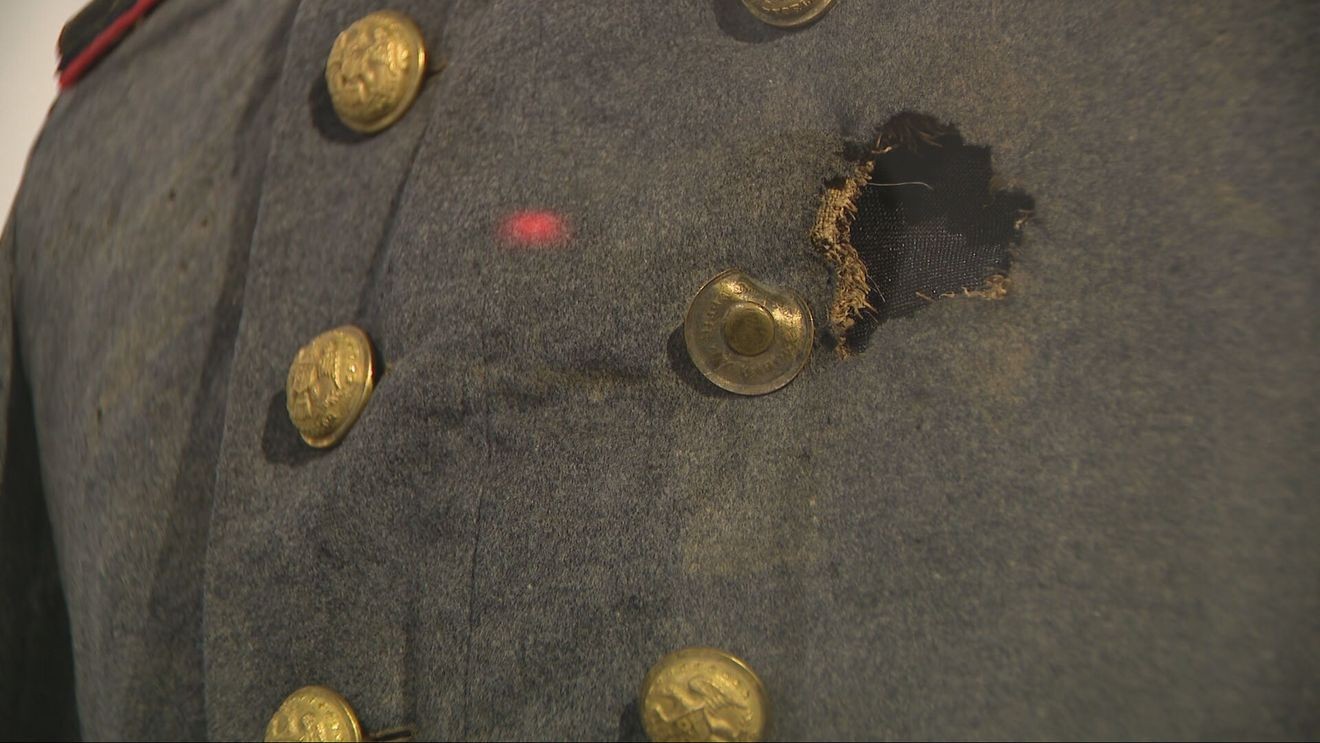
Today, that story lives on at the New York State Military Museum in Saratoga Springs. Among its more than 25,000 artifacts documenting the state’s military past is a frock coat once worn by Elmer Ellsworth.
“This was the frock coat of Elmer Ellsworth, who was born in Malta, New York, raised in Mechanicville,” said Chris Morton, Associate Curator of the New York State Military Museum. “His father was a tailor, not a wealthy man. His mother ran a boarding house. A young guy, ‘What am I going to do? I want to make something of myself.’”
And he did.
In 1854, Ellsworth went west to Illinois to study law and military science. Just six years later, he rocketed to fame as the leader of a celebrated military drill team that toured the nation.
“He did this throughout the summer of 1860,” Morton said. “Arguably, he was the greatest, most well-known celebrity in that summer of 1860.”
Ellsworth’s rise soon put him alongside another name etched into history.
“He went to work at the law office of Abraham Lincoln, and he helped Abraham Lincoln during his campaign for presidency,” Morton said.
But the real reason Elmer Ellsworth is now remembered on street signs and memorials came at the dawn of the Civil War.
In May 1861, while commanding Union troops around Washington, D.C., Ellsworth spotted a massive Confederate flag flying atop a hotel across the Potomac River in Virginia. Acting on his own, he climbed the building and cut it down.
“Ellsworth decided to take it upon himself and climbed to the top and cut down the flag,” Morton said.
But on his way out, the hotel’s owner was waiting with a shotgun.
“Ellsworth is shot point blank in the chest,” Morton said.
He died on the spot, wearing the very coat now preserved at the museum.
“He is arguably the first Union officer to die and the first conspicuous casualty of the war,” Morton said.
Ellsworth’s death made headlines across the country.
“If you cracked open your newspaper and you saw the headline ‘Ellsworth Slain,’ you were like, ‘Oh my God, that’s the guy I saw last summer doing his little drill competition,’” Morton said.
But it also became a rallying cry, heard loudest in his home region.
“Small communities like in southern Saratoga County rallied to the cause,” Morton said.
In the summer of 1861, those recruits soon formed the New York 44th Infantry, dedicated to the memory of Elmer Ellsworth.
“They identified themselves by putting P E R on their hats right in the front, standing for People’s Ellsworth Regiment,” Morton said.
The 44th served with distinction at battles like Antietam and Chancellorsville, but their defining moment came at the Civil War’s most decisive battle — Gettysburg.
“The 44th found themselves at the crucible of the battle,” Morton said.
On July 2, 1863, elements of the regiment were rushed to defend two hills from a furious Confederate attack. Had they failed, the Rebels could have won the battle — and perhaps the war. Casualties mounted, ammunition dwindled, but the 44th held fast.
“Ultimately, the battle had ended with the Union victory and the Confederates on the run back down to the South,” Morton said. “It’s the turning point of the entire war effort.”
Today at Gettysburg, the 44th New York is honored with an imposing monument on the hill they once defended. And in Mechanicville, weathered markers stand as enduring witnesses to the brave man who inspired them.