
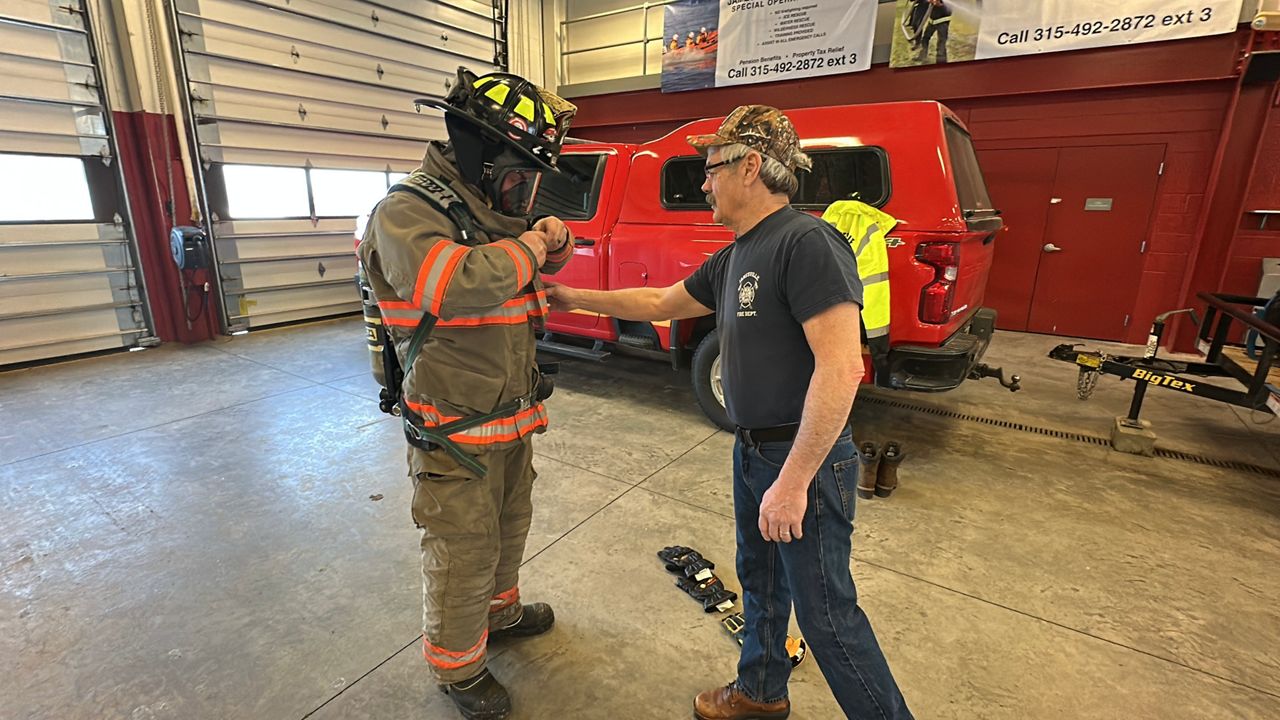
Many volunteer fire departments across the state are trying to attract more people to help. Jamesville, in Central New York, is taking a slightly different approach.
Jamesville Fire Chief Glenn Gilberg says that, over the years, calls for help have gone up, but the number of people willing to help has gone down. And his approach isn’t to train everyone to fight fires, but rather find a place where they fit in the department and train them on select skills.
“One of the best decisions I made was joining,” said Jeremy Tily, who has been volunteering at Jamesville Fire Department for two years.
Tily is now training to go inside buildings during a fire.
What You Need To Know
Fire departments across the state are looking for more volunteers
A new bill at the state legislature would allow volunteers to be paid stipends for helping their local department
One department’s approach is training volunteers on specialized positions, rather than training everyone to fight fires
“[I] wanted to kind of help protect the community and help out the best I could. And this is the one biggest option that you can go to is your local fire department,” said Tily.
Fire departments across the state are looking for more people like Tily. According to FEMA, New York has 1,649 fire departments, and 90% are completely volunteer.
Gilberg has spent 45 years with fire departments.
“When you reach the firehouse, if you weren’t one of the first six or seven people, you didn’t get a truck, you didn’t get to respond to the call. The situation today is significantly different,” said Gilberg.
Gilberg says one of the challenges for volunteers is the training required.
“A class that used to be an introduction to firefighting would be eight two-hour sessions now spreads out to three nights a week for four months, and it’s very demanding,” said Gilberg.
Assemblyman Anil Beephan has introduced a bill that would allow towns and cities to pay a stipend to their volunteer firefighters.
“I don’t envision this as being like a fixed hourly wage employee type situation. I envision this as maybe a couple hundred dollars for folks weekly, or even monthly, just to kind of compensate the time and expenses that they pay,” said Beephan.
Beephan said he used to be a volunteer and gas money or compensation would have made a difference.
“If someone is a working professional that has a night job or a late shift, I can tell you that they would have to give up that source of revenue and income in order just to sit for the mandatory training,” said Beephan.
But in the meantime, Gilberg has a different approach for attracting volunteers.
“Let’s look at what people really want and then see if we can match that. A lot of people would like to be involved with the volunteer fire service, doing community service, but don’t want to be a firefighter,” said Gilberg.
He wants to train people on what interests them, like driving a truck and operating the pump, or water and ice rescue. He’s also starting a youth program.
“From the Canadian border right down to the southern shore of Long Island, it’s all the same. The numbers may be different, but the needs are the same. And recruitment and retention are critical to the livelihood of each individual fire district. That’s not going to change. So, finding a solution to address that is the way to go,” said Gilberg.
According to a 2023 study commissioned by the Firefighters Association of New York, FASNY estimates that, excluding New York City, volunteer firefighters save taxpayers $3.8 billion in salaries and benefits versus an all-paid model. Plus, FASNY estimated property taxes would need to rise statewide by 28.4% if the state chose to utilize all paid firefighters.
At the state level, there’s already a stipend program in place for firefighters who take specific training courses and municipalities can already have their own fire training stipend programs, if approved locally.
The state assembly bill that would allow stipends for volunteer firefighters is still being discussed in the local governments committee.