
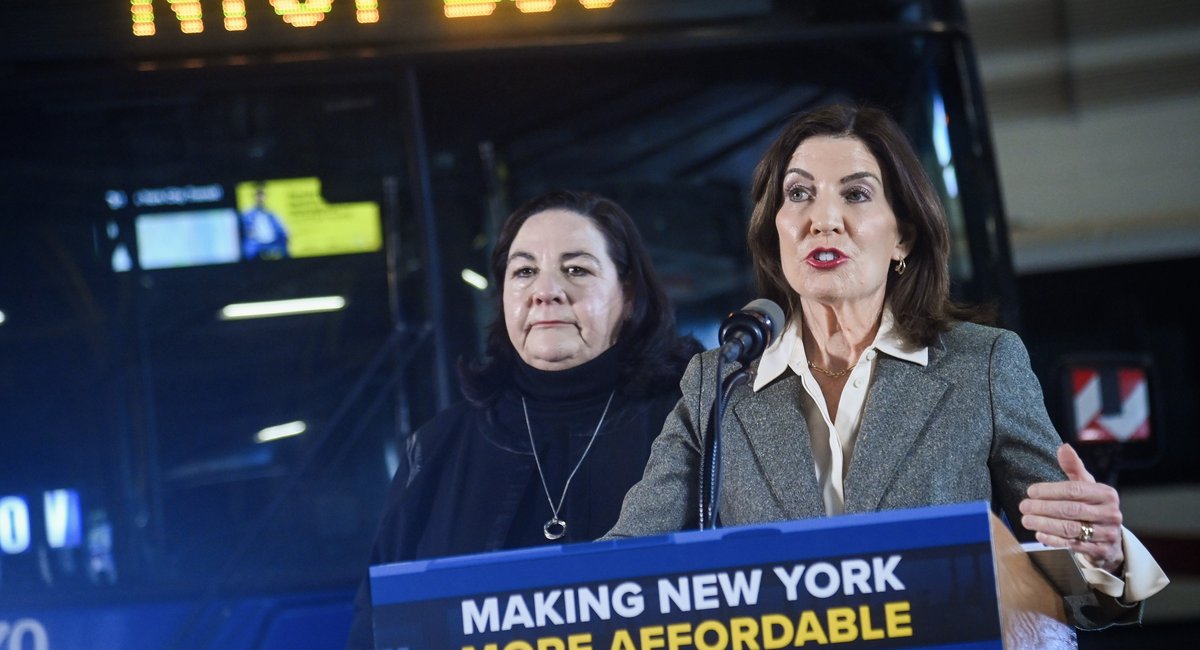
Supporters of New York City Mayor Zohran Mamdani’s vision for fare-free buses are hoping to convince Gov. Kathy Hochul to get on board by thinking smaller, at least for now.
Democrats in the state Senate and Assembly are pushing plans to revive a dormant pilot program Mamdani helped pass as a lawmaker three years ago, when the MTA was required to eliminate the fare for one bus per borough. The nearly yearlong program ended in August 2024.
Mamdani’s ultimate goal is to eliminate bus fares, which he says would be a boon for working-class New Yorkers who rely on public transit.
But the lawmakers’ strategy of pushing ahead with something comparatively smaller is aimed squarely at garnering Hochul’s the support. The governor has been skeptical of giving up fare revenue, and her backing is necessary to get any free-bus program off the ground.
“We have good support for reopening this conversation,” said state Senate Deputy Majority Leader Michael Gianaris, a Democrat from Queens. “And hopefully we’ll get the governor there before we’re done.”
Mamdani, a democratic socialist, was the architect of the 2023 pilot program, which he and Gianaris pushed into the state budget that year. Mamdani made it a central tenet of his 2025 mayoral campaign, pledging to make all buses “fast and free.”
Now, the future of his plan is tied up in ongoing negotiations over the next state budget, which is due April 1.
Hochul has echoed concerns from the MTA that giving up hundreds of millions of dollars in bus fare revenue each year would be unwise.
Yet the governor has never completely closed the door on the idea in the future, giving lawmakers hope they can get her on board with another pilot program.
“There’s upwards of a billion dollars that would be lost if we did it the way [Mamdani’s] proposing right now,” Hochul said in January on NY1’s “Inside City Hall.” “But again, anything can be scaled up.”
Democrats who control the Senate and Assembly signaled their support for a bus pilot, in some form, as part of their chambers’ budget proposals earlier this month.
The Assembly version would renew the prior program with one free route per borough for another year. The Senate didn’t include a specific proposal, but drafted a statement of support, calling for a “revival and expansion” of the previous pilot.
MTA data shows ridership increased on all five fare-free routes — the BX18A/B, M116, B60, S46/96 and Q4 — during the last pilot program, including a 40% jump during the summer months.
The MTA estimated the pilot cost about $16.5 million, a mix of foregone fare revenue and other operational costs. The Assembly set aside $15 million in its budget proposal for another pilot.
Gianaris said he believes the Senate supports bumping the program up to three routes per borough.
“We’ve already done one per borough,” he said. “We know it’s effective. Why repeat that experience? Let’s go bigger.”
The Citizens Budget Commission, a nonpartisan think tank focused on New York state and city budgetary issues, opposes the concept of free buses. That includes the idea of reupping or expanding the prior pilot program, said Ana Champeny, the group’s vice president for research.
“There really aren’t free buses,” Champeny said. “Someone will pay. And so if it’s not the riders who are paying, it’s going to be the taxpayers who are paying. The service doesn’t become free. It still has a cost.”
Mamdani has said the benefits of eliminating the bus fare far outweigh the costs. He said he wants to replace fare revenue by implementing another major plank of his campaign platform: raising taxes on wealthy New Yorkers and corporations, which Hochul opposes.
Jeremy Edwards, a spokesperson for the mayor, said Mamdani is “committed to working with our partners at the state and local level to make buses fast and free.”
“We will continue to use every tool at our disposal to make commutes faster and our transit system more affordable for all New Yorkers,” he said in a statement.
Riders Alliance, a group that advocates for New York City’s public transit riders, said it doesn’t think the legislative proposals for a pilot program go far enough.
Danny Pearlstein, a spokesperson for the group, said the Senate’s vision is a step in the right direction. But he said lawmakers should go further than that, pointing to a proposal — reportedly floated by the mayor’s office — to pause the fare for all city buses during the five-week run of the upcoming World Cup soccer tournament.
”Three [routes per borough] is certainly a different ballgame from one,” Pearlstein said. “At a certain point, though, to see what it looks like citywide, we need to go beyond that.”
Among the state lawmakers on board with renewing the pilot program are Sen. John Liu, a Democrat from Queens, who said free buses are “something that we should aim toward as a good public policy.”
”I don’t think anybody envisions it happening overnight, but it should be a public policy goal,” he said.
Assemblymember Emerita Torres, a Democrat from the Bronx, echoed that sentiment.
“I do really believe that making buses free can be a sort of economic equalizer when we are in an affordability crisis,” she said.
Champeny said lawmakers should instead consider bolstering the city’s Fair Fares program, which subsidizes transit costs for those with low incomes.
“It’s better to target and direct your resources to provide relief and benefits to the individuals who need it most, rather than doing universal programs like free buses,” she said.
Hochul’s January comments, meanwhile, continue to give free-bus supporters a glimmer of hope.
“It’s not a ‘no,’” she said then. “It’s just ‘not right now.’”
Hochul and legislative leaders met Thursday morning to continue budget negotiations. They’re likely to miss the April 1 budget deadline and pass a short-term extension instead.