
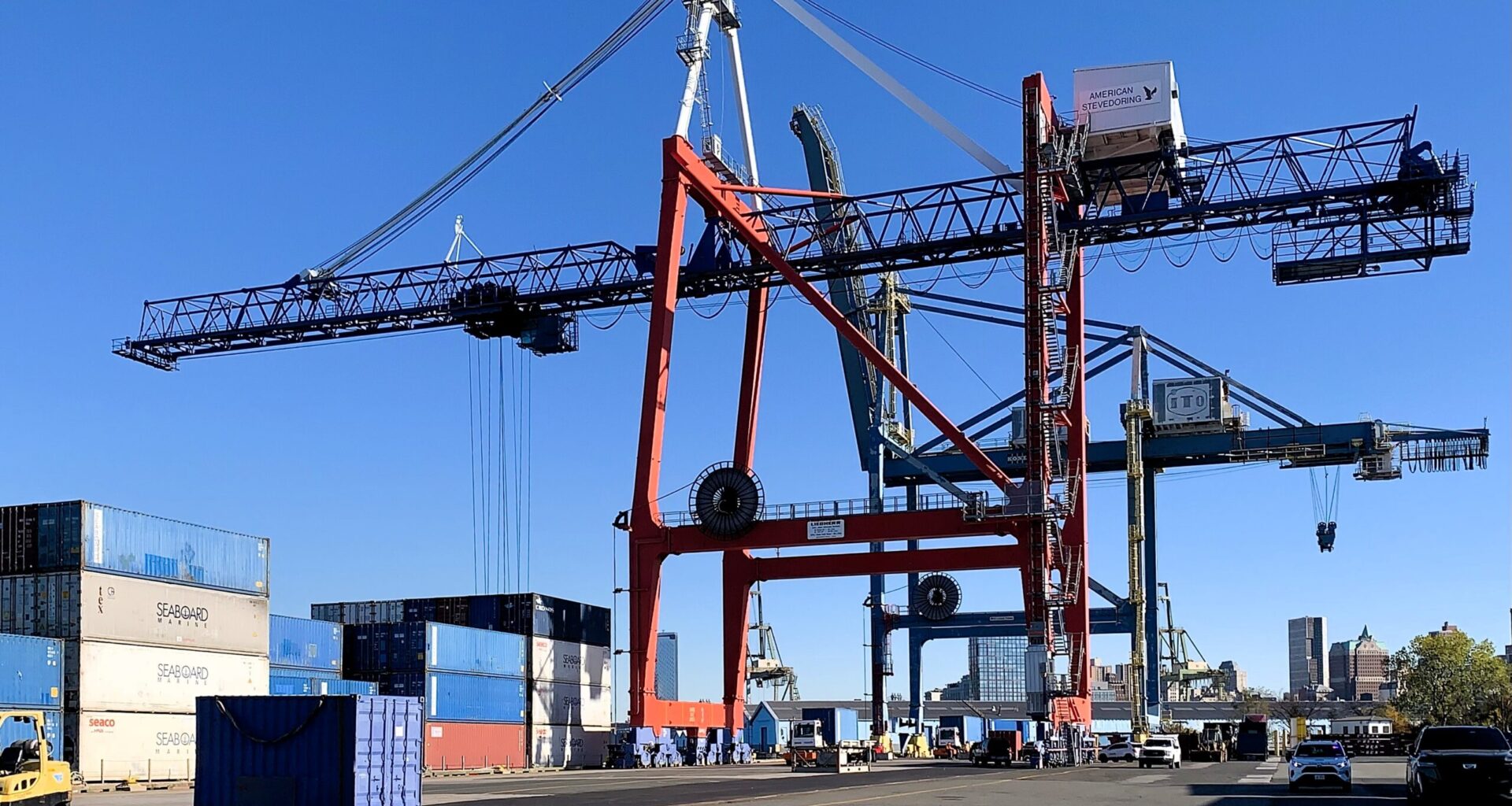
COLUMBIA STREET WATERFRONT DISTRICT — The New York City Economic Development Corporation on Tuesday and Wednesday presented an overview of 25 responses to its “Request for Expressions of Interest” to solicit ideas for how the Brooklyn Marine Terminal could be better used for maritime/industrial uses.
The 122-acre BMT site stretches from Atlantic Avenue to Red Hook on the East River, and includes a container port, the Brooklyn Cruise Terminal, and other maritime and industrial tenants.
Elected officials and stakeholders, however, say the release of the RFEI responses is too little, too late — coming just days before the Tuesday, March 31 deadline to submit written testimony on the $3.4 billion BMT Vision Plan’s Draft Scope of Work — and are asking for an extension.
An RFEI is typically used to gauge interest and gather innovative ideas from vendors before a project is fully defined (unlike a Request for Proposals, which invites formal bids).
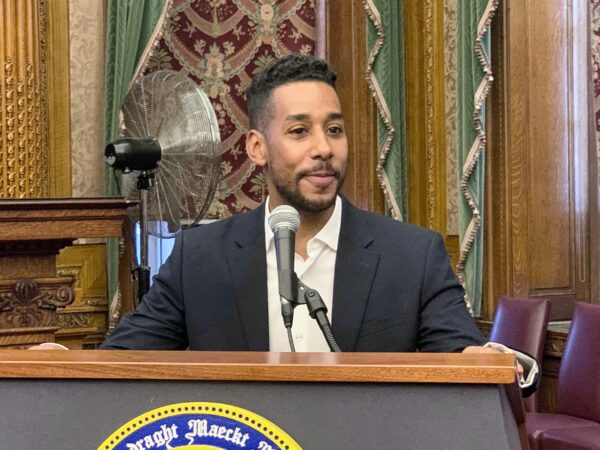 Borough President Antonio Reynoso holds a hearing about the Brooklyn Marine Terminal Project. Photo: Mary Frost/Brooklyn Eagle
In this case, however, EDC issued the RFEI in December 2025 — after the agency had already gained approval in September 2025 for its controversial plan. The approved plan, heavily favored by EDC, includes 6,000 majority market-rate housing units on more than half of the acreage, leaving just 60 acres for maritime uses.
The vote had been postponed five times amid controversies over the loss of scarce maritime acreage, the lack of a plan to handle already-congested streets, and the potential effects of roughly 18,000 new residents in an area with failing infrastructure in a flood plain, among other issues.
Brooklyn Borough President Antonio Reynoso in September 2025 had dropped his original opposition to the EDC’s plan, however, after the agency agreed to issue the RFEI.
While the logic of issuing an RFEI after a full plan was already approved seemed convoluted, “What the RFEI is doing is giving us an opportunity to showcase to the city, to EDC and the administration, there are viable alternatives to a 60-acre port,” Reynoso said at the time.
The responses to the RFEI were meant to allow the maritime ideas to be considered and incorporated into the Vision Plan’s “Draft Scope of Work” before it enters environmental review. (A DSOW is used to develop a project’s Environmental Impact Statement.) The responses could theoretically be used to form the basis for alternate uses of the entire BMT site.
Given that the 25 maritime-centered responses were shared by EDC just this week, and only in cursory form, however, local elected officials say that’s not nearly enough time for the public to examine and evaluate them before the deadline.
Residents and stakeholders have been attending online seminars and nighttime cram sessions — like one in Carroll Gardens on Nov. 17 attended by 200 people — on how to craft their testimony. This last-minute data drop on possible alternatives may require wholesale revisions of their testimony before Tuesday.
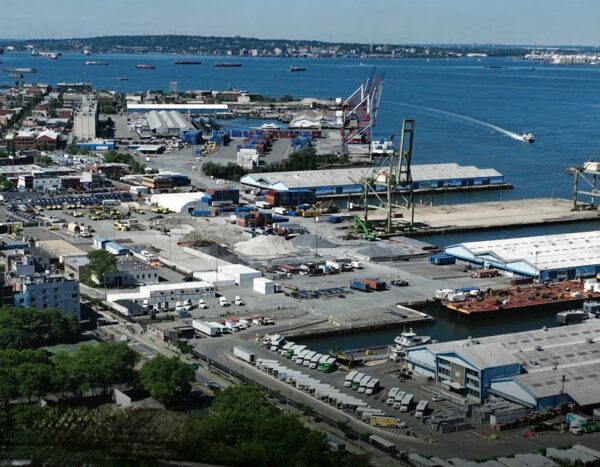 The 122-acre Brooklyn Marine Terminal site stretches along the East River from Atlantic Avenue to Red Hook. Photo: NYCEDC
Brooklyn officials: Extend deadline, convene watchdog groups
Assemblymembers Jo Anne Simon and Marcela Mitaynes, and Councilmembers Alexia Avilés and Shahana Hanif on Monday sent a letter to Deputy Mayor for Economic Justice Julie Su and the EDC requesting that the city extend the public comment period by 30 days to allow the community time to review the RFEIs, Simon’s office told the Brooklyn Eagle.
In their letter, the officials, who had all served on the EDC’s original BMT Task Force, urged the agency to host two in-person public meetings on the RFEI submissions. The officials said they are “concerned about a lack of communication” on the submissions, which EDC has had since December.
“The proposals were supposed to inform the basis of possible adjustments to the Draft Scope of Work before the BMT Vision Plan moves into the meat of the environmental review. It was further understood that RFEI submissions might form the basis of additional uses of the BMT site as alternatives to be assessed in the Draft Environmental Review Statement,” the officials wrote.
Apart from EDC sharing “cursory information as to the number and broad categories of the submissions,” no further communication has been shared, officials noted. They pointed to port-centered plans submitted by PortSide New York and The City Club’s Tom Fox as examples of alternate ideas needing to be fully studied in the environmental review.
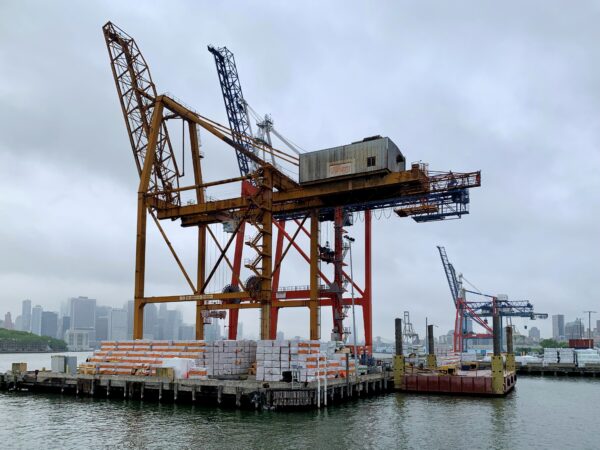 Cranes at Atlantic Basin within the Brooklyn Marine Terminal site. Photo: Mary Frost/Brooklyn Eagle
Advisory bodies not meeting
The approved Vision Plan not only required the issuance of the RFEI, but also included an agreement to form a BMT Development Corporation and BMT Advisory Task Force. These two bodies were meant to “guide and advise the BMT project, ensuring it remained on track, and to inform the local elected officials, government agencies, and the impacted communities about the project’s status,” the elected officials wrote.
However, the two groups held only “pro-forma” initial set-up meetings, and the second Advisory Task Force meeting, scheduled for January, was skipped altogether. “There has been little communication provided from the EDC or the consultants about the delayed timelines, upcoming meetings, and next steps,” officials said.
EDC says, however, that new ideas from the RFEI responses or other sources can still be incorporated into the plan, even past the scoping deadline.
“The primary goal of the RFEI was to test the market and hear from port operators, developers, and maritime businesses on what’s possible at Brooklyn Marine Terminal — and we’re glad to have received strong interest,” an EDC spokesperson told the Eagle on Friday. “The closure of the public comment period for scoping does not prevent us, or the BMTDC, from reviewing or incorporating new ideas from the RFEI responses or other reasonable alternatives as we move forward.
“EDC committed to continuing its robust public engagement on this project, and ensuring that the community will have meaningful opportunities to engage throughout the summer and well into the environmental review.”
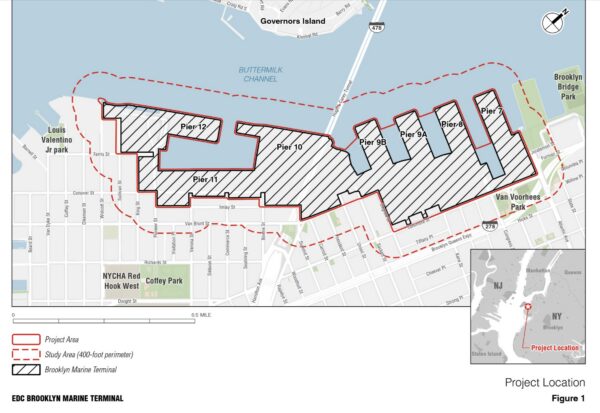 Schematic overview of the 122-acre Brooklyn Marine Terminal site. Diagram: NYCEDC
EDC presentation sketches broad overview but short on details
In its presentation, EDC representatives said 254 professionals had accessed the RFEI; 220 companies evaluated the opportunity; more than 80 attended an October 2025 information session; and 25 formally responded. Responses came in from domestic and international port operators, developers and maritime industrial businesses.
Among these were port operators Carrix (SSA Marine), Ports America, RHCT and Seaboard Marine, Prologis, RealTerm Transportation and Cintra (Ferrovial SE), plus current tenants, cruise operators and service providers.
Proposers could decide to use all of the current 122 acres for maritime and industrial purposes, or fit the marine infrastructure within the 60-acre footprint favored by the EDC.
The majority of the final proposals kept within that 60-acre footprint, and “densified” the marine infrastructure. They also agreed with EDC’s decision to eliminate the “finger piers,” which jut out into Buttermilk Channel, and replace them with a “marginal” pier, which runs along the edge of the waterfront.
While an overview was presented for each proposal, details were not provided.
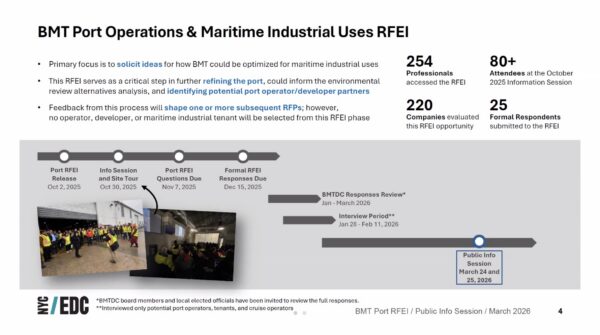 Slide from the NYCEDC’s presentation on responses to its “Request for Expressions of Interest” to solicit ideas for how the Brooklyn Marine Terminal could be better used for maritime/industrial uses. Graphic: NYCEDC
EDC also listed Fox’s all-maritime proposal in the presentation, though he did not respond to the RFEI. Fox, co-founder of New York Water Taxi, the precursor to NYC Ferry Service, and trustee of The City Club of New York, told the Eagle that it was natural that the majority of responders to the RFEI (with the exception of Prologis) would work within the parameters preset by the BMT Vision Plan as more or less a done deal.
Fox feels that several of these decisions, such as removing the finger piers and filling in 11 acres of Buttermilk Channel, were driven by real-estate considerations rather than maritime necessities, and said they were likely to face delays by numerous federal and state environmental and regulatory agencies.
“Wharfage around the finger piers is critical” for the city’s maritime needs, he said, while a marginal pier, with room for just “one big container ship,” would change the hydrology of Buttermilk Channel and create a bottleneck. “But they’re basing their whole plan on filling in Buttermilk Channel.”
The RFEI should have gone out before the Task Force voted on the BMT Vision plan, Fox concluded. “If they sent the RFEI out two years ago, it would have informed the entire planning process,” he said. “They made a decision first, and then they went to the market, instead of going to the market first and getting an idea of what was viable, and planning around that.”