
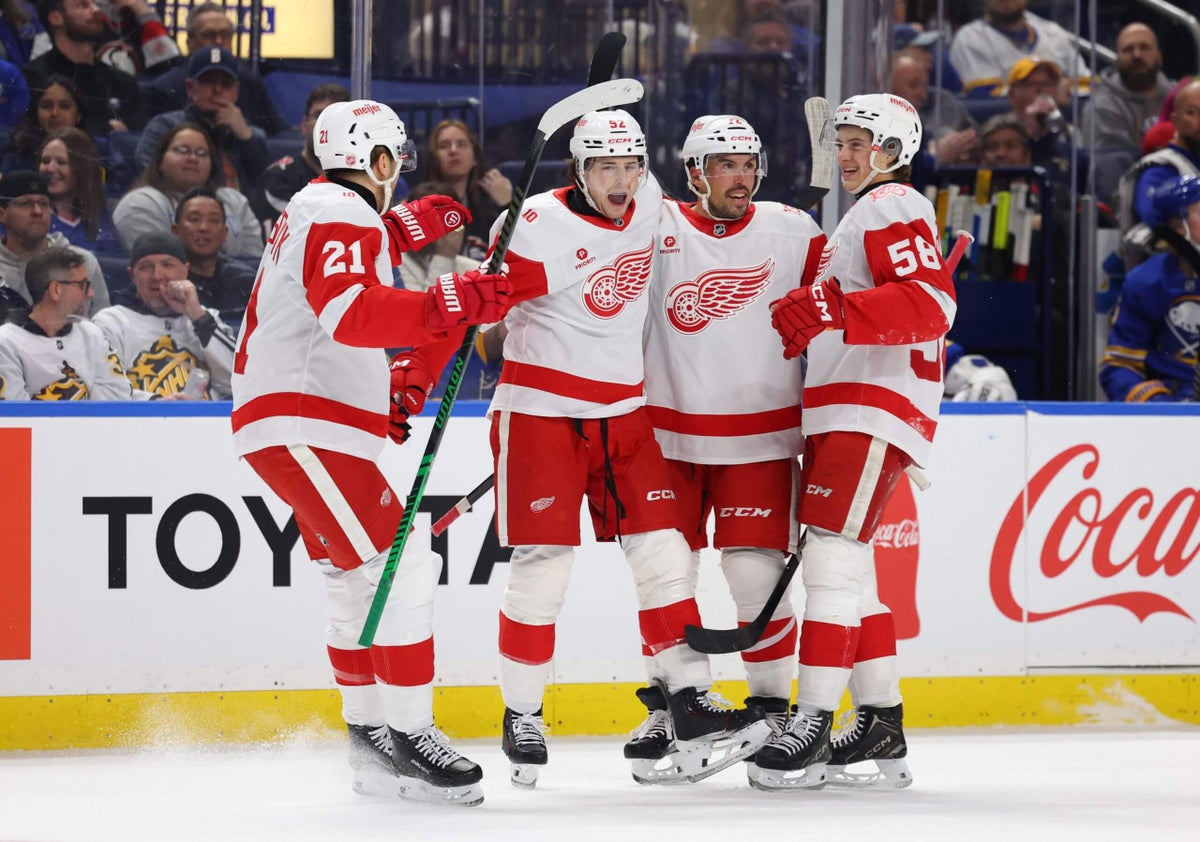
BUFFALO, N.Y. — When Patrick Kane raised his gloved index finger to his mouth late Friday night, shushing a Buffalo Sabres crowd that spent much of the last two periods of the game — and really, the last few months — in rowdy anticipation, he celebrated a dagger goal in a 5-2 victory.
But the way that win came together also quieted some of the loudest questions around this Detroit Red Wings team — for a night, at least.
Those slow starts that have plagued the Red Wings over the last month? Detroit racked up three first-period goals. A power play that has struggled to kick into gear since the start of the new year? Two of those three early tallies came on the man advantage. And a penalty kill that had dipped of late? They went 3 for 3, including some high-leverage ones late in periods.
None of that changes the substance of the last five weeks, of course, as the Red Wings have slipped down the standings and out of a playoff spot through another March slide. But on a night the Red Wings badly needed a win, coming off two painful home losses, they rose to the challenge and knocked off the division-leading Sabres.
“Big team win,” Kane said. “Coming into Buffalo against a good team, we should feel good about that one. But, got to get right back to it tomorrow.”
There’s no doubt about that, as the high-stakes games aren’t slowing down in this home stretch. The Red Wings will be back in action Saturday at home, against a Philadelphia Flyers team that has won seven of its last 10 to resurrect its own postseason hopes.
You can only play one game at a time, though, and Detroit took care of an important piece of business Friday. Here are five thoughts on how it happened and where the team stands.
1. Kane said the Red Wings were “really focused on the start” in Friday’s game, and for good reason. Detroit last scored a first-period goal on March 8, against the New Jersey Devils, and has struggled all season to produce in the opening frame.
The Red Wings entered Friday with 40 first-period goals all season (71 games), by far the fewest in the NHL and 11 goals behind 31st-place Seattle.
The three-goal outpouring was much needed on multiple levels. It addressed a long-standing flaw in their game, and it staked them to a three-goal head start that proved necessary as the game progressed.
“We caught (the Sabres) maybe a little bit flat, and you could see when they took it up in the second, then it was a different game,” Detroit coach Todd McLellan said. “But the lead was something that we needed. They have a tendency: Once they get rolling and scoring, they don’t give up leads. So, it was real important.”
The obvious question: What was the key to it?
“We just tried to keep it real simple,” Moritz Seider said. “We tried to force their D in uncomfortable situations, and I thought that worked really well.
“They really like a run-and-gun game, and we made sure they had to stop in the D-zone, and then once they break out, we had numbers in the neutral zone and covered it well. I think that was a recipe for success.”
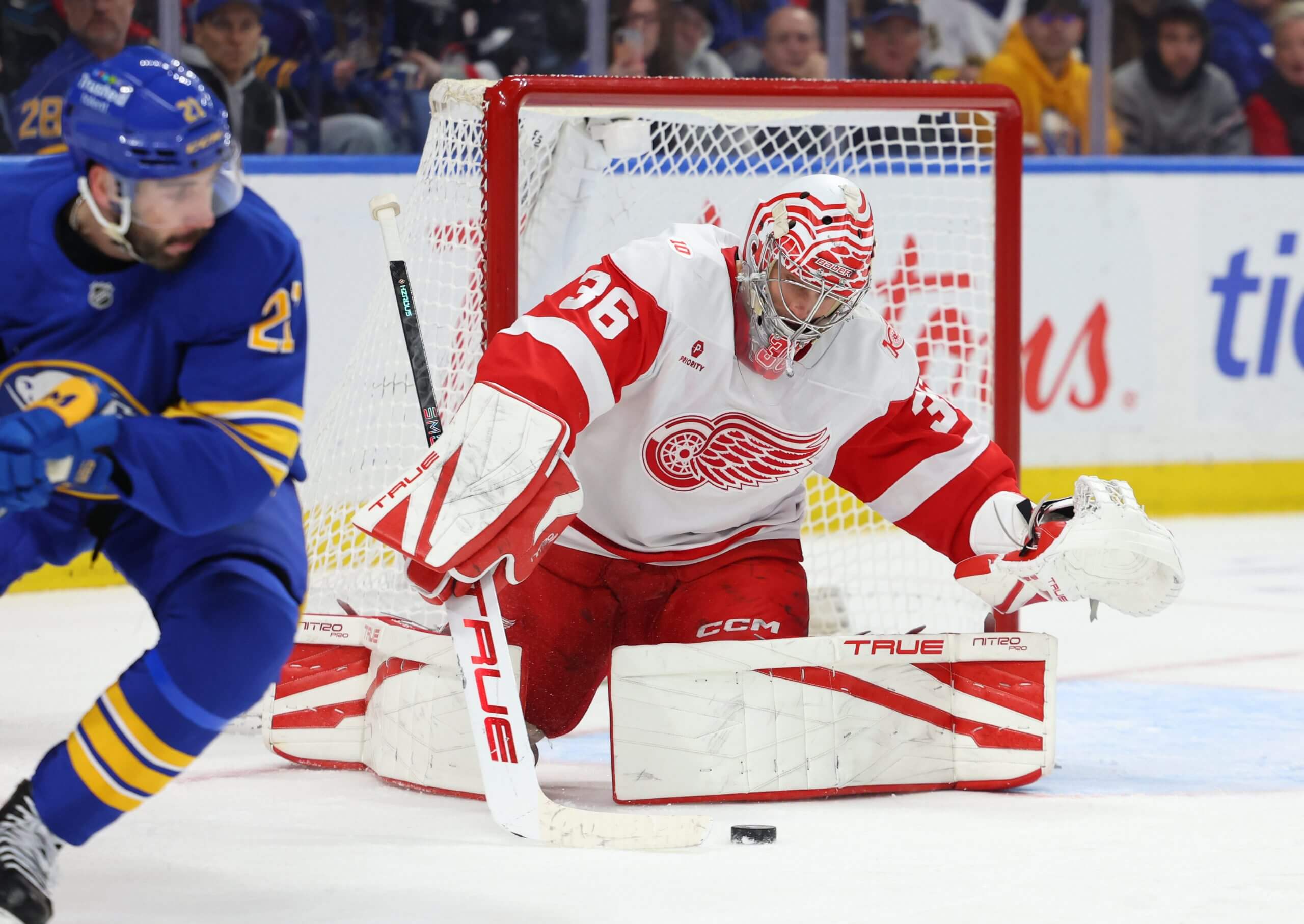
Veteran goaltender John Gibson has carried the Red Wings for long stretches of the season, especially in games where the shot volume is high. (Timothy T. Ludwig / Imagn Images)
2. That said, Buffalo still had all kinds of looks in this one.
The Sabres outshot the Red Wings 30-20, and that’s after an 11-10 total in the first period. In other words, Buffalo doubled up Detroit over the second two periods, and it came with some long, extended shifts where the Sabres looked highly dangerous.
“We knew it was going to happen occasionally,” defenseman Jacob Bernard-Docker said. “That team is extremely skilled, and when they get buzzing and feeling good about themselves, it’s not easy to defend. (Goaltender John Gibson) came up huge for us when we needed him, and guys kind of stuck to our structure, blocked a lot of shots and just made hard plays when we needed to.”
They did, but Gibson was again the key. He stopped 28 of those 30 shots, including a spectacular one in the first where he was down in the crease, looking vulnerable, only to make a beautiful pad stack, with a leg kick, to keep the game 2-0 early.
The veteran goaltender has carried the Red Wings for long stretches of the season, but he has been especially good in games like this one, where the volume is high and the Red Wings are leaning on him.
3. In some ways, special teams told the story of this game. That’s not unusual, but for the Red Wings, it’s meaningful to come out on the right side of it, especially recently.
The power play has been one of the Red Wings’ core strengths in recent years, but heading into Friday’s game they were ranked 27th in the NHL with a 17.5 percent penalty conversion rate since Jan. 1.
They scored in each of the past two games, so it was starting to get going. But for a team that doesn’t score enough generally, the power play will need to be a consistent source of offense down the stretch. It was a big deal that when the Sabres took a pair of penalties in the first 10 minutes, the Red Wings cashed in, with Alex DeBrincat and Lucas Raymond scoring.
The Detroit power play wasn’t nearly as effective late in the game, with three third-period opportunities going by rather uneventfully. But by that point, the minutes off the clock were just as valuable, and a 2-for-6 night is usually enough to win.
The Red Wings shutting down the Sabres’ power play in all three attempts was equally important. Detroit’s penalty kill was one of the team’s most improved elements early in the season, but as with the power play, it has struggled in 2026. Entering Friday, it sat at 74 percent since Jan. 1, ranking 29th in the league. When asked about the trend Friday morning, McLellan said they were “coming in different forms” and not about the overall structure.
Failed clears have been a noticeable theme, however, and not just on the kill. Seeing Dylan Larkin poke one out to middle ice was encouraging.
Detroit had to kill off a penalty twice in the final three minutes of a period, which can be a momentum-swinging proposition one way or another. Both times, they stood tall.
4. I could do a note on Seider in virtually every game story, as Detroit’s No. 1 defenseman continues a Norris Trophy-caliber season. On Friday, he set a new career high with 51 points, with assists on both early power-play tallies.
Running a top power-play unit was one of the few questions that remained about Seider as recently as a couple of years ago, and while he’s still not Cale Makar or Evan Bouchard up top, he makes the right play nearly every time. Seider made a pair of excellent keeps at the offensive blue line, including one to set up Detroit’s second goal, reaching up to knock down a clearing attempt, then scooping it up and finding Raymond for the tally.
It can be easy to take Seider for granted, and his impact isn’t always as flashy as some top Norris contenders, but he can do it all. The point totals should merely help him get noticed.
5. For all the questions Detroit’s win answered Friday — the start, the special teams, even closing out a late lead (as the Red Wings have given up the NHL’s sixth-most third-period goals this season) — the most important is still out there: Can they find a way into this playoff field, after nine years outside it?
Yes, they made it harder on themselves by once again slumping through March. But the path is still there, now only one point back of the cut line, with a game in hand on the New York Islanders.
All year, the Red Wings have responded as they did Friday, with their backs against the wall. It’s the single biggest difference between this group and the ones of years past.
Whether their back has needed to be against the wall so frequently is a fair question, but save it for the offseason. Right now, it’s about breaking that nine-year postseason drought. That’s the only way to put all the anxious chatter around the Red Wings to rest.
Friday’s first period offered a window into what it will take to get there. But Detroit will need to repeat it, and not for one period per game. The Red Wings have won back-to-back contests only once since Jan. 21.
If they’re going to find a way through this historically tough playoff race, that has to change, starting Saturday against the Flyers.