
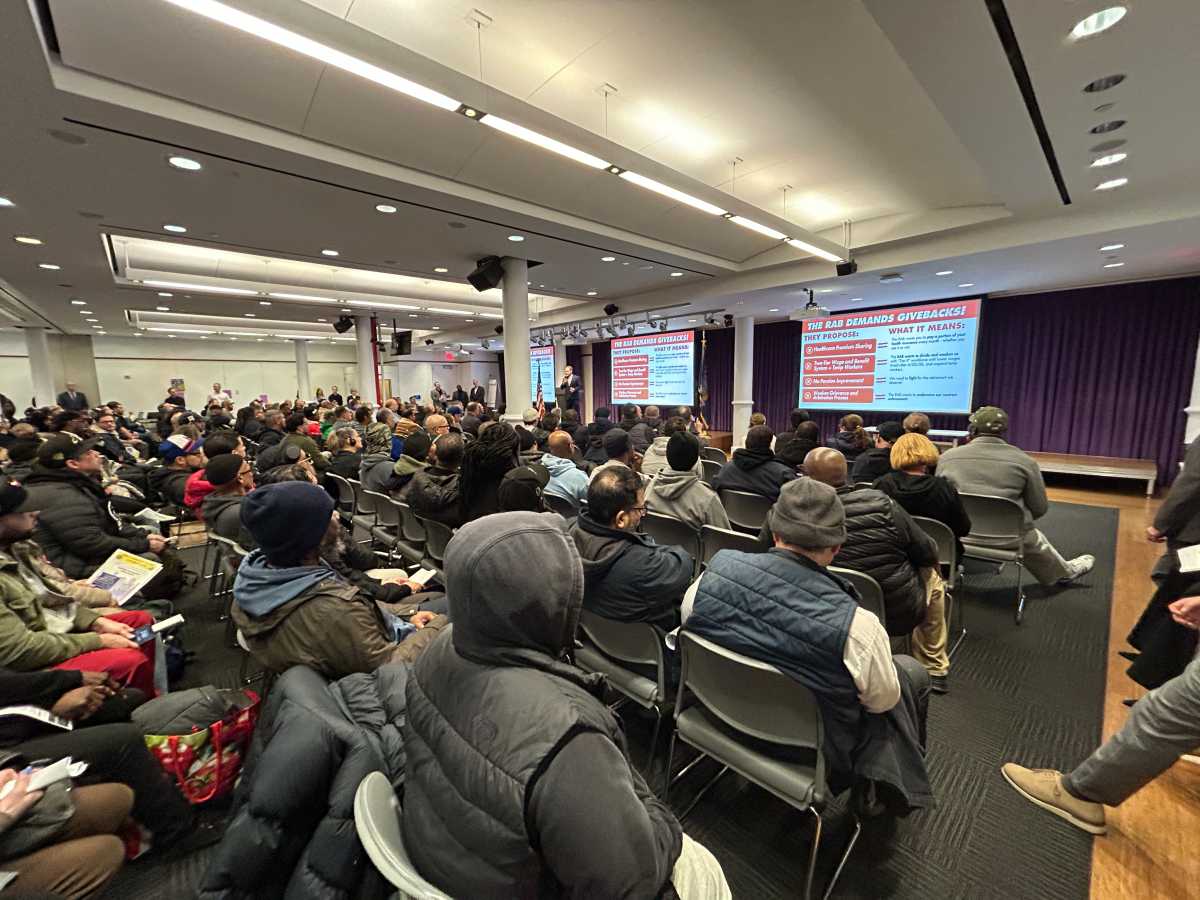
Hundreds of 32BJ SEIU members set April 15 as a date for a vote on a potential strike amid ongoing contract negotiations. Photo via 32BJ SEIU.
Thousands of residential building service workers, including doorpersons, superintendents and porters, will vote to strike in April ahead of the expiration of a contract between services union 32BJ SEIU and the Realty Advisory Board on Labor Relations (RAB), which represents the city’s residential real estate industry.
The current four-year industry-wide labor agreement between RAB and 32BJ SEIU, which represents over 34,000 residential service workers in the city, is set to expire on April 20.
On April 15, five days before that expiration, doorpersons, handypersons, superintendents, porters and resident managers will gather on Park Avenue to take a formal vote on strike authorization.
The move comes after 32BJ SEIU accused RAB of making “dramatic and insulting changes” to the industry-wide labor agreement, adding that the changes represented a “fundamental attack” on the labor contract.
Those changes allegedly include measures that would shift the cost of healthcare onto workers via healthcare premium sharing and the introduction of a “Tier II” workforce that would be paid less, 32BJ SEIU said.
Other changes include the expansion of temporary workers, the weakening of labor contract enforcement procedures and a lack of a commitment to pension improvements, the union added.
More than 2,000 union members met Thursday, setting April 15 as the date for a strike vote amid the ongoing negotiations. Meanwhile, over 1,400 strike captains across the city are mobilizing and preparing for a potential strike.
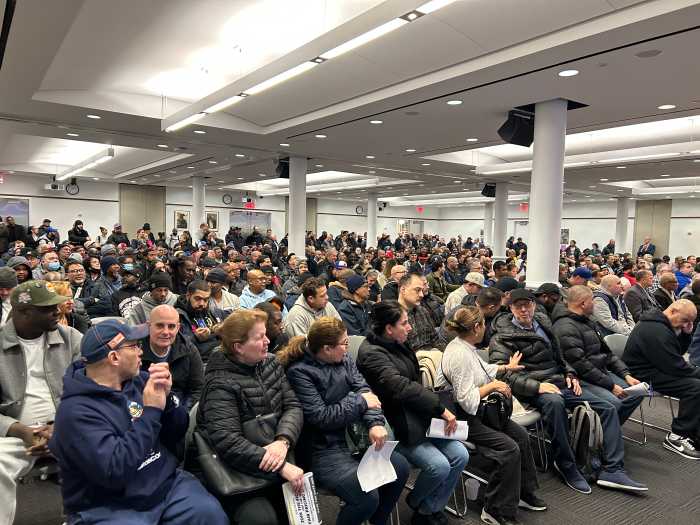 Photo via 32BJ SEIU.
Manny Pastreich, president of 32BJ SEIU, said the proposed changes would cause health care costs to rise and jeopardize retirement security.
“In the wake of this week’s disappointing and insulting proposals from the real estate industry, 32BJ has set a formal strike vote and rally for April 15,” Pastreich said in a statement. “We won’t let the thriving real estate industry raise health care costs, jeopardize retirement security, and undermine the core fabric of a labor contract that thousands of working families depend on.”
The union states that its members serve around 600,000 New York City households across 3,500 co-ops, condos and apartments buildings.
RAB President Howard Rothschild said the realty group will continue to negotiate with 32BJ SEIU over the next month to achieve a fair contract, adding that he recognizes the union’s right to hold a strike.
Rothschild also called on the union to recognize the realities facing the industry at present, including the imposition of 0% rent increases in roughly one million rent-stabilized apartments if Mayor Zohran Mamdani successfully implements a rent freeze, which was one of his core campaign promises.
“While we look forward to working with 32BJ to achieve a fair contract over the next month, we respect their right to authorize a strike and all our members are preparing for that possibility,” Rothschild said in a statement.
“We are hopeful both sides will recognize and confront the realities facing the industry. These include a likely imposition of 0% rent increases on 1 million rent stabilized NYC apartments and individuals living in coops and condos struggling with high tax burdens and increased common charges.”
RAB officials also noted that strike authorization happens every four years and does not mean that a strike will occur. Officials further stated that it simply allows the union the option to strike if both sides cannot reach an agreement.
However, union members have stated that they are ready to “defend” their contract in the face of “insulting” changes proposed by RAB.
Maria Silva, a concierge at a Downtown Brooklyn apartment building, said her current health care coverage had allowed her to undergo surgery as part of her treatment for cancer ten years ago. She accused RAB of attempting to pass the cost of health care onto workers with the new contract.
“Thanks to our union health care, I was able to get the treatment and care I needed without going into debt. Now, the RAB wants to shift the cost of healthcare onto us, the workers who maintain this industry? That’s straight up insulting,” Silva said.
Felix Figueroa, a concierge at an Upper West Side co-op building and a member of the 32BJ SEIU bargaining committee, said he had served his building for 39 years, offering a “lifeline” to residents during the Covid-19 pandemic.
“All that I’m asking for is a fair contract so that I can keep up with my bills now and when I eventually retire,” Figueroa said. “We need our pensions to keep up with inflation and the cost of living.”