
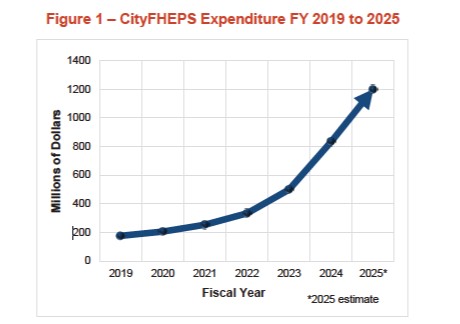
CityFHEPS expenses increased from $176 million to $834 million, as shown in Figure 1. In fiscal year 2025, the program’s projected cost was $1.2 billion.
NYC
When the de Blasio administration first launched CityFHEPS (Fighting Homelessness and Eviction Prevention Supplement) in 2019, it only budgeted $25 million for the well-intentioned program providing financial assistance to low-income New Yorkers to remain in their homes.
Six years later, however, CityFHEPS has grown into one of the biggest financial albatrosses around City Hall’s neck. In the current fiscal year, it is expected to cost up to $1.7 billion.
For those keeping score at home, CityFHEPS costs have grown to 68 times the $25 million initially earmarked for the program six years ago. Sixty-eight times! In the same period, average rents grew 30% citywide, according to the city’s Economic Development Corporation.
No wonder the Mamdani administration, as it looks to close a $5.9 billion budget deficit by June, opted last week to continue fighting an ongoing lawsuit to expand CityFHEPS that the City Council brought against the late Adams administration in 2023.
Homelessness and housing advocates lambasted Mayor Zohran Mamdani last week for the decision, noting that he broke a campaign promise in choosing to fight the program’s expansion rather than give in and expand it. To be sure, he did break that promise.
On the campaign trail, Mamdani had indeed promised to expand CityFHEPS, pursuant to an appellate court ruling in the City Council’s favor. But Mamdani is the mayor now, with a financial and legal responsibility to the city taxpayers to balance the budget every year. Campaign promises, as they often do, go by the wayside when confronted with that reality.
Advocates say that CityFHEPS works; it is currently keeping up to 70,000 families in New York City in their homes and off the streets. Of course, the program is working. But the program’s mission is not the problem here; the problem is the exponential cost overrun that is crippling the city.
The $1.7 billion the city is currently spending on CityFHEPS in the current fiscal year is equal to 28.8% of the $5.9 billion of red ink in which the city now finds itself drowning. And advocates want the city to spend more to expand CityFHEPS, even though the city can barely afford to keep it going now?
Mayor Mamdani and the City Council, as they hammer out a plan to close the budget deficit, must come up with a way to pay for CityFHEPS and control the costs before even thinking about expanding. The program’s mission to prevent homelessness is essential, but it cannot continue at the unsustainable level at which it currently operates.
What will it take to bring the costs down? Cutting whatever bureaucracy and red tape in the program that may contribute to the overruns. Creating partnerships or fees in which developers contribute to a dedicated CityFHEPS fund. And working with the state and federal governments on building new funding streams that ensure the program won’t be solely funded by city taxpayers.
That is the only path toward solving the billion-dollar problem that CityFHEPS has become.