
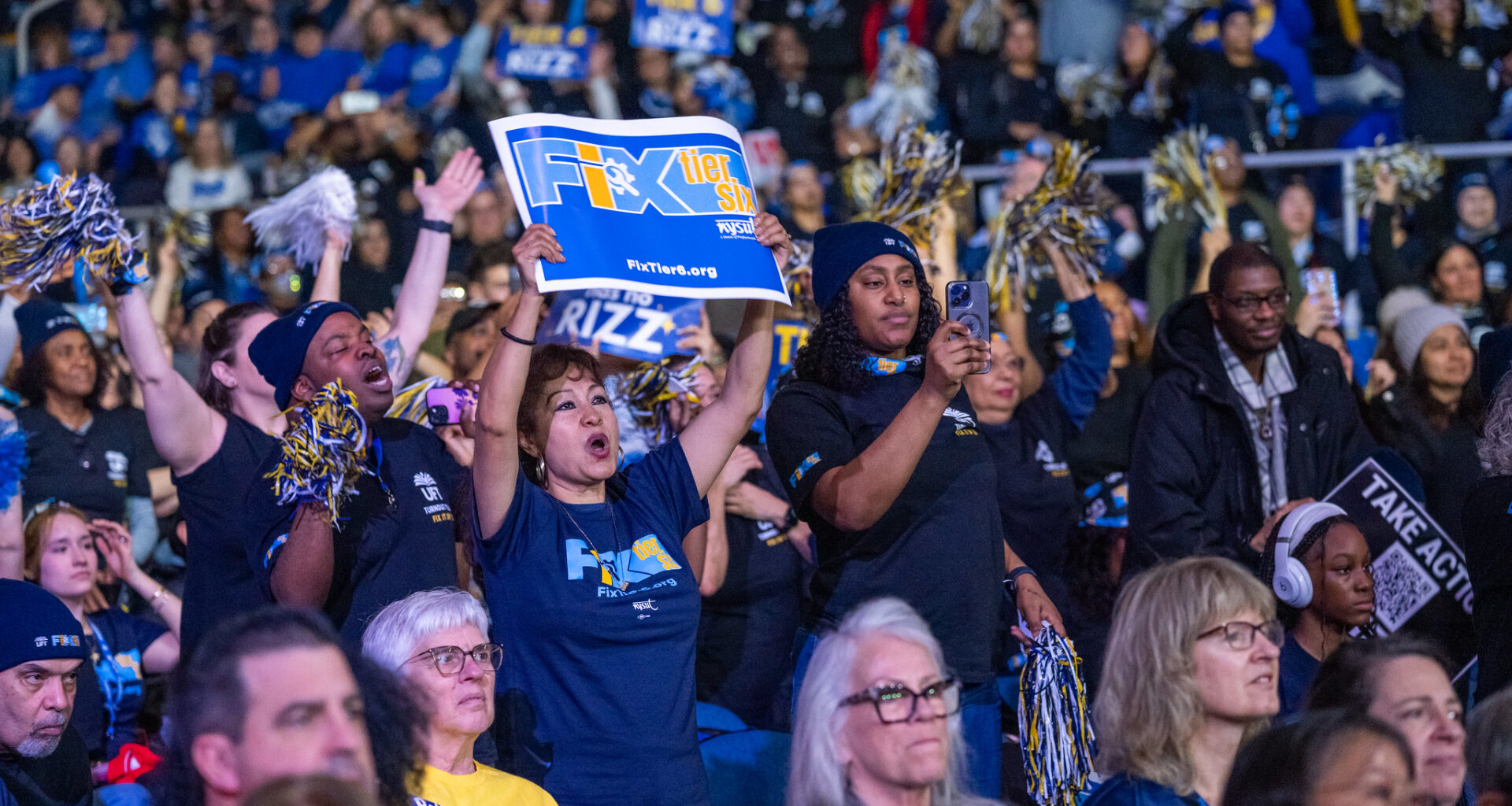
Union members at a Public Employees Union Rally for Tier 6 changes in March.
Darren McGee/Darren McGee/ Office of Governor
ALBANY — With a call to “fix the six,” Albany’s mayor stood shoulder to shoulder with public employee union workers this month, framing costly proposals to sweeten the state’s retirement system as a fight for New York’s workforce and the capital city’s residents.

But weeks after the rally, Mayor Dorcey Applyrs delivered a sobering prognosis: Albany is staring down a $15 million budget gap that could grow to $22 million. Applyrs ordered a hiring freeze and other belt-tightening measures.
Article continues below this ad
The situation in Albany, where retirement costs account for about 9% of the city’s budget, underscores a reality for many cash-strapped local governments across New York. And the dire financial outlooks are in place as state lawmakers weigh whether to address changes to the Tier 6 state pension system.
Rochester, for example, is facing a budget gap of $131 million, the largest in the city’s history. Rochester’s largest expenditure is its increasing pension and health care costs. Those projected pension costs for the next fiscal year are $74 million. Health care costs for active and retired employees have escalated to $108 million.
“This budgetary framework is simply not sustainable,” Mayor Malik D. Evans told a state legislative panel last month. “And it threatens the
incredible momentum we’re making toward violence reduction, job creation, workforce development, affordable housing, home ownership, economic
mobility and so much more.”
Make the Times Union a Preferred Source on Google to see more of our journalism when you search.
Add Preferred Source
Tier 6 accounts for over 486,698 employees hired after 2012. It has has less generous benefits than other plans and requires more years of work to qualify for benefits.
Article continues below this ad
While it’s unclear what changes lawmakers hope to make, and how much it would cost, any changes will have an immediate impact on local budgets, many county leaders say.
When lawmakers made Tier 6 enhancements a few years ago, it cost state and local governments $438 million annually, according to the Citizens Budget Commission, a nonpartisan civic think tank.
‘We really haven’t heard that’
At the center of the pitch by unions to reform Tier 6 is that they say it will help the public service sector recruit and retain skilled workers. Proponents also cite the state’s workforce shortage as another reason to make changes.
Article continues below this ad
But New York has almost rebounded to pre-pandemic levels, after cratering to just over 200,000 full-time employees in 2022.
While some sectors of the state’s public workforce, such as the agency that runs state prisons, still struggle to fill jobs, the state now employs about 1,115 fewer full-time employees than it did in 2019.
Research has revealed that retirement benefits aren’t the factor young people weigh most heavily when considering whether to take a government job.
Instead, younger workers are looking for job security, work-life balance and health insurance, according to a 2023 national survey from MissionSquare Research Institute, a leading provider of public sector workforce research and insights.
Article continues below this ad
“I think that when individuals start to get into state government and talk to colleagues, that’s when the Tier 6-type conversations come up,” Timothy Hughes, commissioner of the state Department of Civil Service, said at a budget hearing last month. “But we really haven’t heard that when they make that decision to come in.”
Saratoga County Administrator Steve Bulger, at left, said that a full repeal of Tier 6 changes will bring a rapid rise to the county’s budget.
Wendy Liberatore / Times Union
It’s the same in local government, said Saratoga County Administrator Steve Bulger. The county’s hiring environment has improved significantly since the pandemic. Bulger said that young workers, particularly in their 20s and 30s, are more interested in salary, time off, remote work flexibility and health insurance.
At the budget hearing in February, Hughes, the civil service commissioner, said that the state addressed staffing issues by implementing an emergency placement program called New York Helps.
Article continues below this ad
That resulted in more than 52,000 appointments across state and local government, roughly the equivalent of the population of the city of Troy. About 10,000 open positions remain.
‘Worked almost to death’
Rob Merrill, a spokesman for the Public Employees Federation, which represents over 50,000 state government workers, said that worker shortages are most acute in state prisons, which are facing an ongoing staffing crisis with thousands of vacancies. That gap was exacerbated by the 22-day “wildcat” strike that resulted in 2,000 guards being fired last year, although many returned to work.
Gov. Kathy Hochul’s proposed budget includes $535 million to keep National Guard troops deployed in the state prison system. That’s on top of the $700 million the state is spending on the deployment through the end of this month.
Article continues below this ad
In sectors like correctional settings, staff are “worked almost to death” with 12-hour shifts and restricted vacations because there aren’t enough employees, said state Sen. Robert Jackson, the chair of the upper chamber’s Civil Service and Pensions Committee. Jackson said that if the state doesn’t improve the pension system, staffing shortages will worsen, and overtime costs will continue to skyrocket, costing the state more than the overhaul itself.
Meanwhile, Jackson contends that the “goodness” of the job has eroded, making it hard to attract skilled workers in a competitive market.
Stephen Acquario, executive director of the New York State Association of Counties, made a sharp distinction between how pension changes affect new hires versus current employees.
He said that there is “some merit” in regard to retention. Since the majority of the workforce is in Tier 6, improving the tier could incentivize current employees to stay rather than leaving for the private sector.
Article continues below this ad
Acquario said that counties and the state should explore other modern benefits to stay competitive. That includes a 401(k)-style plan or defined contribution plans that allow workers to move their retirement savings between the public and private sectors.
State Assemblyman John T. McDonald III, whose district covers parts of Albany Rensselaer and Saratoga counties, emphasizes that the pension system is the primary tool for keeping experienced public workers, including police officers, firefighters and teachers, for 20 to 30 years. McDonald was mayor of Cohoes for 13 years.
‘Not really fair’
Fourteen years ago, lawmakers approved a measure to cut retirement benefits for future public employees across New York after an all-night session that saw Senate Democrats walk out over a vote over redistricting.
Article continues below this ad
Now with Democrats in charge, and Gov. Kathy Hochul and leadership in the Assembly and Senate on board, it’s likely that New York may roll back some of those changes.
It’s unclear what Hochul and legislative majority leaders intend to do, although a source familiar with the discussions said there have been some low-level talks during budget negotiations. The source said those conversations are expected to heat up closer to Wednesday’s budget deadline.
Gov. Kathy Hochul rallied with unions on March 8 for changes to the Tier 6 pension system.
Darren McGee/Darren McGee/ Office of Governor
Assembly Speaker Carl E. Heastie said during a Tier 6 rally earlier this month that he opposed that plan from the beginning. He said he wants to repeal it, noting that “this is the year we need to blow that sh– away.”
Article continues below this ad
Bulger, the Saratoga County administrator, said that reverting Tier 6 employees to pre-2012 levels would increase the county’s annual pension contribution from about $8 million to $12 million. It could also include millions in unbudgeted liabilities. It would impact about 1,300 county employees across dozens of departments.
The $4 million increase is more than double what the county is allowed to raise through property taxes under the state’s 2% tax cap. Bulger said a mandate would likely force local governments to break the cap.
Bulger emphasizes that the money can only come from property taxes. He highlighted that the county has the lowest property and sales tax rates in the state, and the lowest per capita spending. He fears any state-imposed costs will jeopardize that efficiency.
He views the current proposals as “knocking the balance out of whack,” and has shared his concerns with area lawmakers.
Article continues below this ad
McDonald received the memo and isn’t so sure about Bulger’s estimates.
“Everything is going to be predicated on what the cost is going to be, not only for the state but also the cost for local governments,” McDonald said.
McDonald said that while pension increases are expensive, there is a large hidden cost in constantly retraining new staff and losing the “intrinsic value” of veteran employees who know how to run a city.
Officials with labor unions contacted by the Times Union did not offer cost estimates, and one likely won’t come from the state comptroller until legislative leaders disclose the details of any proposal.
Article continues below this ad
State Comptroller Thomas P. DiNapoli, the sole trustee and administrator of the New York State Common Retirement Fund and the New York State and Local Retirement System, spoke in favor of changes to the state’s pension system at a rally earlier this month.
DiNapoli said that the state’s public pensions — estimated at nearly $300 billion — are in a strong financial condition.
“And because we are well funded, we can do more to fix Tier 6,” DiNapoli said. “ Whatever changes to Tier 6, you win. I can guarantee you this, the money will be there to pay for your pensions.”
Article continues below this ad
With the budget deadline approaching this week — though not likely to be met — Acquario expressed frustration that no formal proposal has been shared.
“That’s not fair to employers and that’s not really fair to really anybody,”Acquario said. “I would hate for this thing to be introduced in the 11th hour and pass before anybody had a chance to read it, understand it.”