
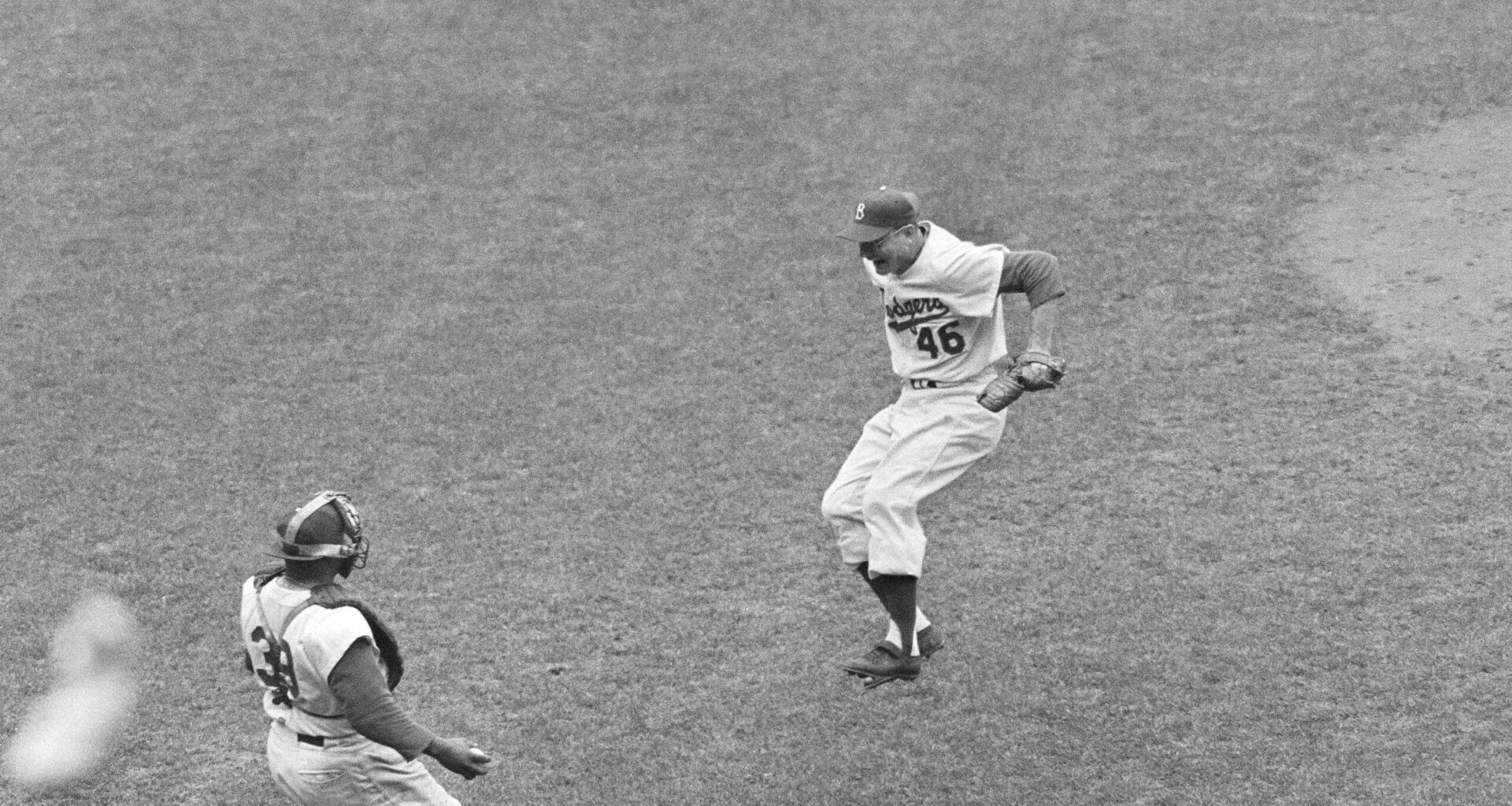
If you were a Brooklyn Dodgers fan in the ’50s and ’60s, you remember Carl Furillo, aka “Skoonj” or “The Reading Rifle,” but do you remember Don Bessent, “The Weasel?” I remembered the name, which popped out at me when I was looking for March “birthday babies” on the roster, as did Furillo’s, but I didn’t remember the Bessent story. Likely, you don’t either. It’s a story of high highs and low lows, ultimately tragic and fatal.
Like many ball players of that era, Bessant was a small-town boy from a big, hardworking, low-earning country family. Fred Donald Bessent was born on March 13, 1931, in Jacksonville, Florida, the eighth and last child of Callas Leonard Bessent and Donnie Lee (Tillis) Bessent. Dad was a railroad engineer, mom a homemaker.
According to Society for American Baseball Research, Bessent was a crackerjack athlete. He was captain and quarterback of his high school football team and the ace of the school’s baseball team. At 6 feet, 175 pounds, he pitched for a Florida American Legion team that had won seven state championships. He graduated in 1950 and quickly signed a contract with the New York Yankees. His bonus was $4,500.
Bessent was christened Fred Donald Bessent. Everyone called him Don. My bet is that, as a teenager, given the chance to choose between Fred and Don, he chose Don. Yet there were some strict constructionists in his life who called him Fred. Roger Craig was one.
You’d need an atlas and a large notebook to recount Bessent’s minor league roles, some of which were the stuff of budding stardom. I’m not going to do that. Rather than recount his history as a ballplayer, let me share his highs and lows. They will help you understand the end.
Highs
Bessent is remembered as one of two rookies called up mid-season in 1955 who saved the Dodgers from a summer collapse. Craig was the other. Bessent was, at times, unhittable.
His fastball was so fast and so hard that, given the choice, catchers didn’t want to catch him because they couldn’t protect their hands from the impact.
He went 8-1 in 1955 in his rookie year with a 2.70 ERA. He also pitched 3 1⁄3 scoreless innings in the 1955 World Series championship year.
Bessent pitched just as well in 1956, going 4-3 with nine saves and a 2.50 ERA. He won game two of the series. He pitched the final seven innings of what one writer called “a 13-8 slugfest” after both teams’ starting pitchers were knocked out in the second inning.
Don Newcombe remembered Bessent as the guy “who saved my 27th victory.”
Along with Clem Labine and Ed Roebuck, Bessent was remembered as part of the best relief trio in baseball.
He was well-liked and well-respected in the clubhouse.
Lows
One teammate remembered him as “a scotch drinker on a beer drinking team.”
He was paralyzed from the waist down from two separated discs, spending 6 1/2 weeks in a rigid body cast. He came back too soon from that injury.
Bessent tipped off his curveball, allowing his pitch to be stolen and flashed to the opposing hitters. It eventually destroyed his ERA. His third-year ERA went from 2.50 to 4.70.
While playing winter ball in Cuba, he got beaned and missed the rest of that winter season making him less effective when he returned for the major league season.
Bessent had arm trouble that he tried to pitch through, which probably shortened his career.
He also had back trouble. The arm and back issues weighed on him and undoubtedly contributed to his drinking
While he played 12 years of professional ball, most were in the minors. Like many ball players of that period, he lost two promising years in the military. His last two years in the majors, he got pounded. His last two years in the minors were worse. The zip was gone from his fastball, his curve ball was nothing to write home about. His ERA rose to 5.77, then to 6.98.
Finally, there was this. He played on a team full of future Hall of Famers, keeping him in the shadows. The Dodger players were famous at every place on the diamond. This writer’s guess is that Bessent couldn’t get the attention from fans or writers that so often is key to a ball player gaining and maintaining confidence. Again, possibly why he was the scotch drinker, not the beer drinker.
One question remains unanswered here. Why the nickname, “The Weasel?” Clubhouses being clubhouses, anyone of consequence in the clubhouse got called something. Someone decided Bessent’s face looked like a weasel — and there you have it.
It ended badly. Bessent was found dead in his car outside of a Wendy’s in his hometown of Jacksonville. He died of alcohol poisoning and cirrhosis of the liver. His luck had run out. He could have been saved. Two employees noticed him in his car and reported it to the assistant manager. The manager said he would fire them if they told the police, who happened to be in the parking lot. That is exactly what happened. Ultimately, the employees were reinstated, the assistant manager was fired, and Bessent’s death became a footnote to a career that went from high highs to low lows.
He died divorced and alone, the father of three, on July 7, 1990, at age 59, in Jacksonville where he is buried in Oaklawn Cemetery.
RIP Weasel. As Marlon Brando famously said in “On the Waterfront,” you “could’ve been a contender.”