
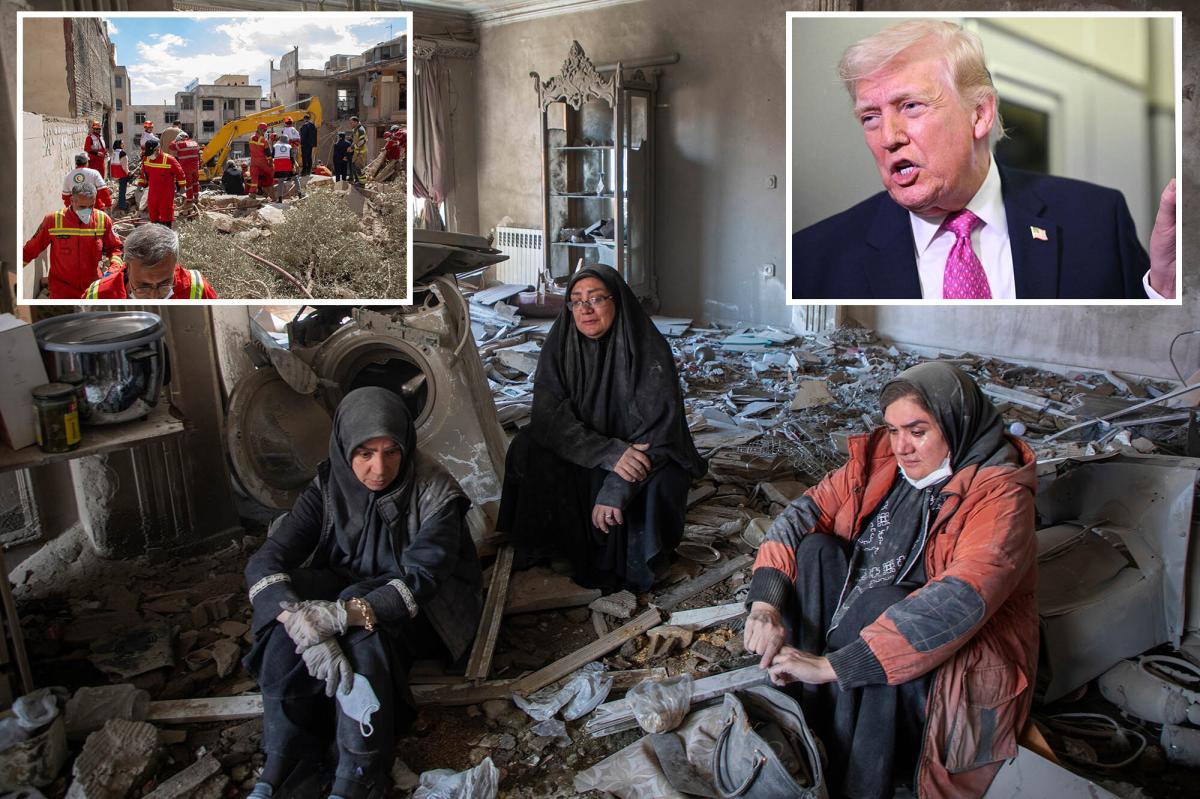
President Trump said Monday that a deal with Iran was “probably” close to winding down the conflict — but warned the US would obliterate the regime’s power plants, oil wells, and its main export hub, Kharg Island, if negotiations fell through.
Trump noted, however, that a deal was “probably” close.
“The United States of America is in serious discussions with A NEW, AND MORE REASONABLE, REGIME to end our Military Operations in Iran,” Trump wrote on Truth Social.
President Trump said that a deal with Iran was “probably” close to winding down the conflict, but warned the US would obliterate the regime’s oil wells and its main export hub if negotiations fell through. AFP via Getty Images
“Great progress has been made but, if for any reason a deal is not shortly reached, which it probably will be, and if the Hormuz Strait is not immediately ‘Open for Business,’ we will conclude our lovely ‘stay’ in Iran by blowing up and completely obliterating all of their Electric Generating Plants, Oil Wells and Kharg Island.”
Kharg Island is Iran’s main export hub.
Trump said the US purposefully hadn’t touched the sites after having previously given an April 6 deadline to Iran.
“This will be in retribution for our many soldiers, and others, that Iran has butchered and killed over the old Regime’s 47 year ‘Reign of Terror’,” he said.
The renewed threat came just hours after Trump said late Sunday that the US was negotiating “directly and indirectly” with Iran.
“The United States of America is in serious discussions with A NEW, AND MORE REASONABLE, REGIME to end our Military Operations in Iran,” Trump wrote on Truth Social. Getty Images
He flagged the possibility, too, of taking Iran’s oil — a move that would require seizing Kharg Island, the terminal through which nearly all of Iran’s oil exports pass.
“Maybe we take Kharg Island, maybe we don’t,” Trump told the Financial Times, noting that any US presence “would also mean we had to be in there for a while.”
“We have a lot of options,” he said, boasting that the US could “easily” take the island.
A plume of smoke rises from the site of a strike in Tehran on March 29, 2026. AFP via Getty Images
Trump added that the US had about 3,000 targets it would still like to hit in Iran — after having “bombed 13,000 targets” since Feb. 28 — but insisted: “A deal could be made fairly quickly.”
The president gave Tehran a 10-day deadline to reopen the Strait of Hormuz after its closure caused oil prices to spike as much as 50%.
Tehran allowed 10 Pakistan-flagged oil tankers through the strait last week as a “present” to the White House, Trump said in his Financial Times interview, but it has since allowed 10 more, bringing the total number exiting the bottlenecked channel to 20.
On Friday, 3,500 US Marines and sailors also arrived in the Middle East on the USS Tripoli, amid a broader Pentagon order to deploy 10,000 troops to the region.
Trump has said the forces could be dispatched to secure the Strait as well as Iranian nuclear facilities.
Secretary of State Marco Rubio also said on ABC News’ “Good Morning America” Monday: “They are making threats about controlling the Hormuz Strait in perpetuity, creating a tolling system and the like. That’s not going to be allowed to happen.”
“Over time, the US is going to retake control of the straits,” Treasury Secretary Scott Bessent noted on Fox News. “And there will be freedom of navigation, whether it is through US escorts or a multinational escort.”
Rubio emphasized that the US was “going to achieve our objectives in a matter of weeks, not months.”
The Trump administration has engaged in mediated talks with Iran, and has seen its hardline parliament speaker, Mohammad-Bagher Ghalibaf, as a potentially useful negotiating partner.
“He’s the one who authorized the ships to me,” Trump revealed to the Financial Times. “Remember I said they’re giving me a present? And everyone said: ‘What’s the present? Bulls–t.’ When they heard about that they kept their mouth shut and the negotiations are going very well.”
But Ghalibaf publicly denounced the US on Monday, according to Iranian state media outlet IRNA, saying: “The enemy, openly, sends messages of negotiation and dialogue, but secretly is planning a ground attack.”
Destruction was seen near the offices of the Doha-headquartered news network Al Araby TV following a missile strike in Tehran on March 29, 2026. AFP via Getty Images
Ghalibaf threatened the US that its officials were “unaware that our men are waiting for American soldiers to enter on the ground so they can set them ablaze and punish their regional partners forever.”
Officials in Egypt, Saudi Arabia, Turkey, and Pakistan have primarily mediated talks with the US — foreign ministers from each nation met in Islamabad on Sunday.
On Monday, Egyptian President Abdel Fattah el-Sisi pleaded with Trump to “help us stop this war.”
“I speak to you on behalf of myself, humanity, and lovers of peace — and you, Mr. President, are a lover of peace,” el-Sisi said during an international energy conference in Cairo, according to the New York Times.