
Sign up for Chalkbeat New York’s free daily newsletter to get essential news about NYC’s public schools delivered to your inbox.
Dylan Lopez Contreras sat waiting for a copy of his class schedule in a sunny fourth-floor room of his Bronx high school as his counselor walked in, wearing a “Free Dylan” button attached to the strap of his messenger bag.
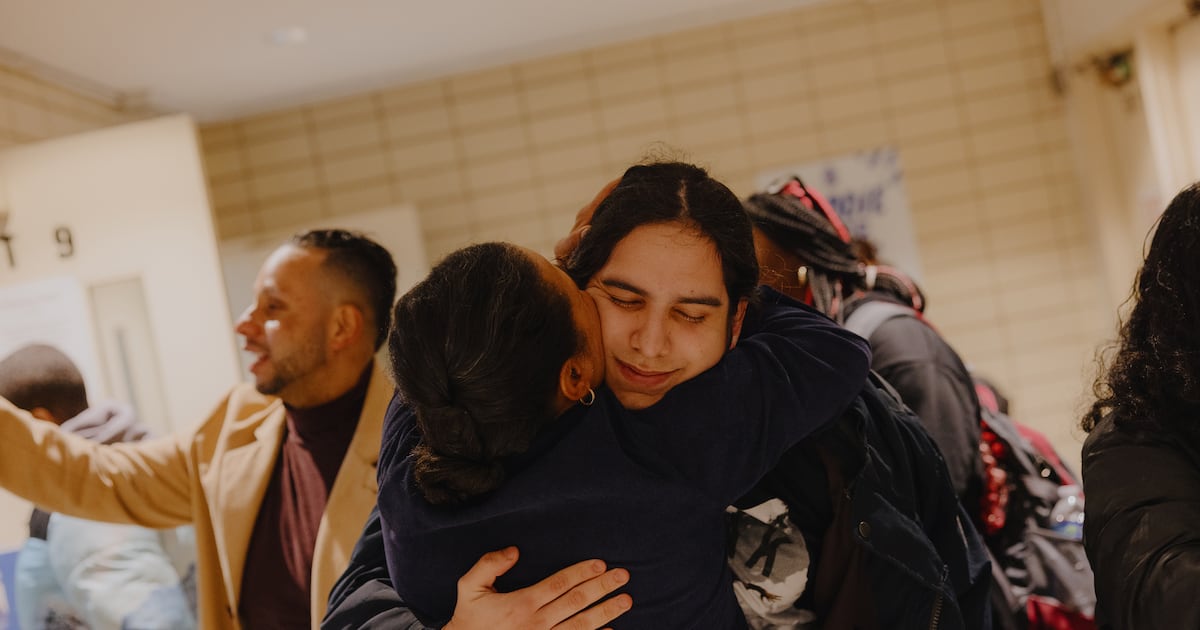
Dylan stood, and Hedin Bernard lifted Dylan’s more-than-6-foot frame off the floor in a tight bear hug.
It had been more than 10 months since Dylan set foot in ELLIS Preparatory Academy, a high school geared toward older, newly arrived immigrant students. The last time the two had seen each other, Dylan’s hair was dyed purple and just covered his ears. Now, it fell below the 21-year-old’s shoulders and the purple dye had faded to yellow.
 Dylan Lopez Contreras, center, listens as school counselor Janeen Padilla, left, goes over his new schedule in her office on his first day of school after spending close to 10 months in immigration custody. (José A. Alvarado Jr. for Chalkbeat)
Last May, federal immigration officials arrested Dylan in a Manhattan courthouse after his asylum hearing, making him the first known New York City public school student detained during President Donald Trump’s second term. The Venezuelan native became the public face of an aggressive new phase of the government’s mass deportation campaign, remaining in custody until his release last week.
After Dylan’s arrest, his mom Raiza’s first call was to Bernard. Ever since then, Bernard has, along with ELLIS founding Principal Norma Vega, led the school’s efforts to rally behind Dylan — which included helping to put Raiza in touch with lawyers and advocates, organizing a student letter-writing campaign, and supporting a fundraiser for the family. With Dylan’s return to ELLIS, they hope he can focus on “what will happen, not what did happen,” Vega said.
But the jubilation of Dylan’s return has been mixed with frequent reminders of the looming threat of immigration enforcement facing him and other ELLIS students.
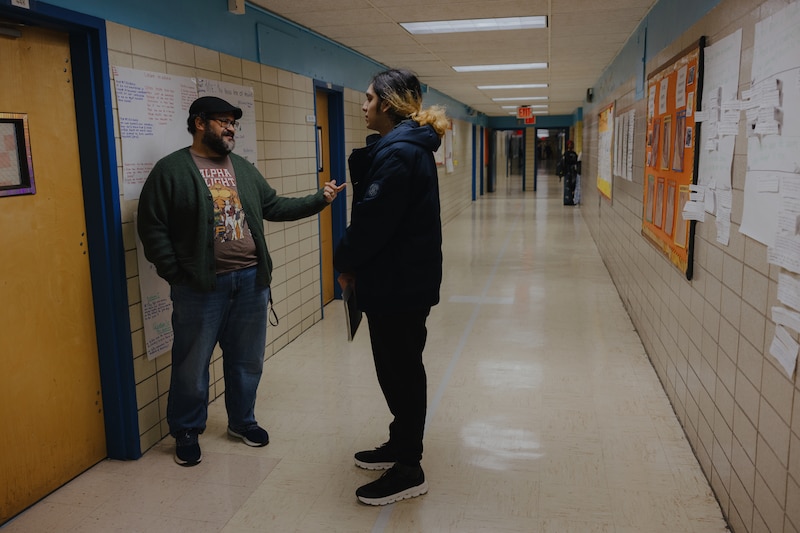 Dylan catches up with school counselor, Hedin Bernard, left, in the halls of ELLIS on his first day back at school. (José A. Alvarado Jr. for Chalkbeat)
Immigration and Customs Enforcement, or ICE, released Dylan while he awaits a decision on an appeal in his asylum case. An immigration judge rejected his claim last year, and the appeals process could take years, according to his lawyers from the New York Legal Assistance Group. But ICE has the ability to take him back into custody at any time and requires regular check-ins, his lawyers said.
Shortly after Bernard reunited with Dylan Tuesday morning, as Dylan scarfed down a donut and drank coffee poured from Bernard’s thermos, the counselor invited him to join a college trip that week.
ELLIS staffers believe that preparing immigrant students for college is the surest path out of poverty. The trip would visit three colleges in upstate New York.
Dylan glanced down at his leg, where a black ankle monitor had been attached as a condition of his release. With his travel restrictions, Dylan knew he likely couldn’t attend.
But that didn’t slow down the ELLIS staffers for long. Later that morning, Bernard asked a colleague to invite college representatives to ELLIS, so Dylan wouldn’t have to leave school to meet them.
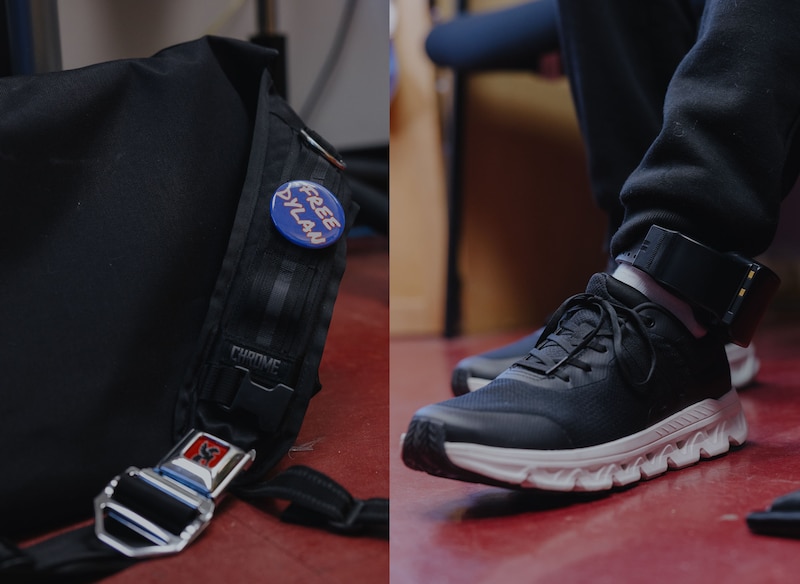 Left, a pin dedicated to Dylan Lopez Contreras hangs on a bag belonging to counselor Hedin Bernard at his office. And right, Dylan Lopez Contreras now wears an ankle monitor after his release from ICE detention. (José A. Alvarado Jr. for Chalkbeat) Dylan’s detention still lingers
The swiftness of the changes over the past two weeks has been hard for Dylan to comprehend.
 Dylan, center, sits for a portrait in the cafeteria at ELLIS. (José A. Alvarado Jr. for Chalkbeat)
After months in Moshannon Valley Processing Center, a Western Pennsylvania detention facility, Dylan had stood at a crowded press conference, flanked by Gov. Kathy Hochul and Mayor Zohran Mamdani, thanking his supporters in Spanish from under the blue brim of a New York Knicks hat.
He had been sleeping on a paper thin cot in a cell with more than 70 men. Now he was in his own bed, cuddled with his younger siblings, ages 8 and 10, who had asked to sleep next to him. And after losing about 30 pounds in detention because he often couldn’t stomach the food, Dylan had a phalanx of adults at ELLIS showering him with food, free school supplies, and affection.
“It’s a big contrast, to go through so much mistreatment, and then come back to people who love and support you,” he said in Spanish.
Still, his thoughts drift back to a friend in detention nicknamed “El Mayor,” or the elder, who has already called Dylan to let him know how happy he was to hear about his release and to ask if he could use his public profile to advocate for the release of others. (Dylan did exactly that at his press conference.) As long as those men remain in detention, Moshannon Valley is “not going to feel very far away,” he said.
A spokesperson for the Department of Homeland Security didn’t respond to questions about the conditions in Moshannon.
We’re on a need-to-know basis.
Every weekday morning, Chalkbeat New York is bringing thousands of subscribers the news on public schools and education policy that they need to start their day. Sign up for our free newsletter to join them.
ELLIS staffers said reintegrating Dylan into school will mean helping him catch up on all he missed over the past 10 months, while also processing the ongoing trauma of his detention.
While Dylan was incarcerated, his classmates had gone to Washington, D.C., prepared for or taken Regents exams they needed for graduation, and kept up with the guitar lessons Dylan enjoyed before his arrest.
Letters from his classmates helped sustain him as his detention stretched from days to months, and his optimism for a quick release faded. He watched new detainees — including grandparents and young kids — come and go while he remained locked up.
Dylan had no formal education in detention. But he was determined to do what he could to keep up with his English.
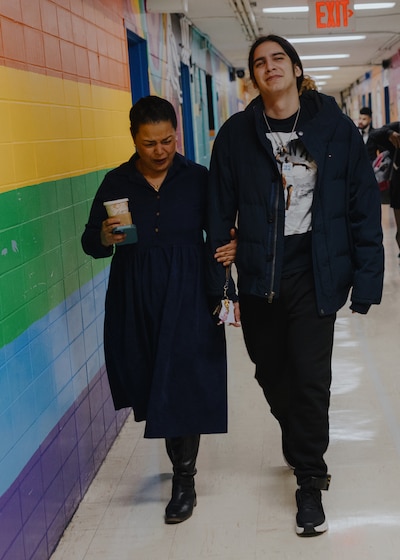 Dylan Lopez Contreras, 21, center, walks with Norma Vega, founding principal at ELLIS, left, to his counselor’s office to prepare a class schedule on his first day of school after having spent close to 10 months in immigration custody. (José A. Alvarado Jr. for Chalkbeat)
He practiced speaking with cellmates from places like China and the United Kingdom and to advocate for better treatment from the guards.
He devoured Manga and Marvel comics donated by the advocacy group ROCC NYC, which played a critical role in supporting his family and keeping public attention on his case. He scoured an English dictionary from the facility’s library to learn new vocabulary but had no one to check his pronunciation. And he tried to read some classics, such as Mary Shelley’s “Frankenstein” and “Chronicle of a Death Foretold” by Colombian author Gabriel García Márquez.
When he returned to ELLIS last week, Vega stopped him in the hallway to hand him a gift from a staffer in her district office: a copy of Dante’s “Divine Comedy,” another classic Dylan had asked to read but couldn’t get a copy of.
Dylan, who had fled Venezuelan dictator Nicolas Maduro’s repressive regime, had been kidnapped by a Mexican cartel on his journey to the U.S., and spent 10 months in ICE custody, had said he wanted to understand Dante’s nine circles of hell.
ELLIS gears up to help Dylan adjust
Staffers at ELLIS are accustomed to helping students navigate all kinds of trauma, but they’d never had a student return from long-term incarceration, Bernard said.
Dylan’s counselors at ELLIS plan to refer him to a Spanish-speaking therapist through a mental health clinic located on the first floor of ELLIS’ building, Bernard said. And staffers will watch for any signs that he is struggling.
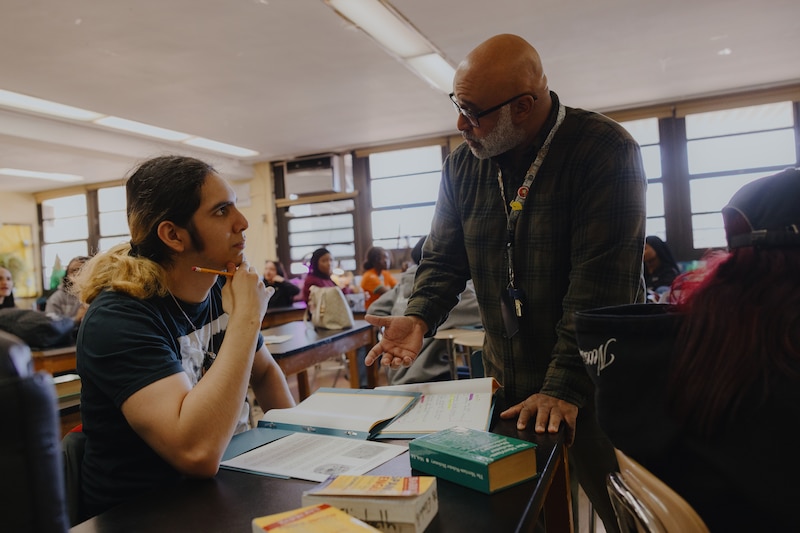 Dylan, left, goes over notes during a biology class with Hugo Ortega at ELLIS Prep in the Bronx. (José A. Alvarado Jr. for Chalkbeat)
They’re also hoping to give Dylan chances to enjoy himself outside academic courses, though his ankle monitor is complicating those plans. His counselor enrolled Dylan in a swim class, but Dylan worried about getting the device wet.
Schools in New York are required to continue enrolling students through age 21 — but state law doesn’t stop them from staying longer if the school agrees, Vega said.
ELLIS staffers don’t want to keep Dylan in high school longer than necessary, but are encouraging him to stay for two years so he can master English before applying to college.
In the meantime, he is eager to earn money to help his mom and siblings with rent. He hopes to take a bartending course so he can work at night without interfering with his school schedule.
Dylan worked long hours as a delivery driver before his arrest, and Bernard remains concerned about how long he’ll want to stay in school.
Staffers at ELLIS are working on finding him an internship that allows him to make money while learning new skills and burnishing his college resume.
Dylan said he’s willing to stay at ELLIS “as long as it takes.”
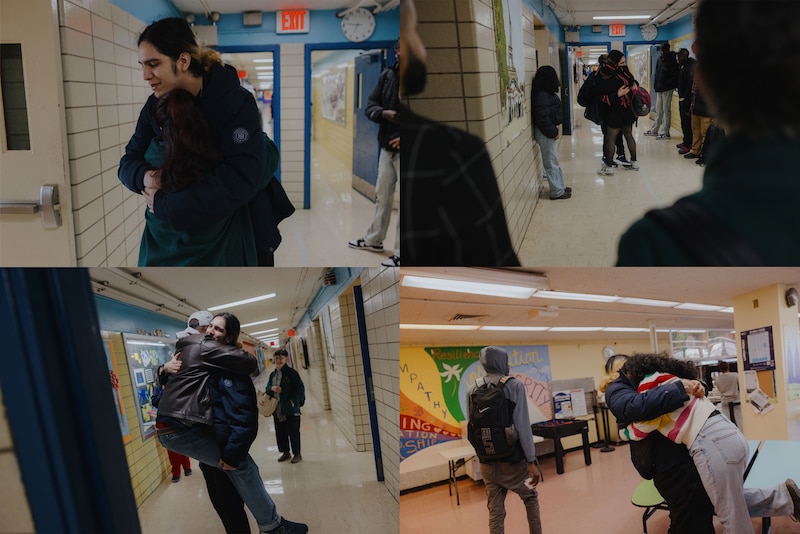 Dylan, center, arrives in the cafeteria at ELLIS to hugs and jubilation on his first day back at school after his release from immigration detention. (José A. Alvarado Jr. for Chalkbeat) Dylan and ELLIS face an uncertain future
Dylan’s arrest, and the aggressive escalation in immigration enforcement it represented, cast a long shadow over ELLIS over the past 10 months, reaching into every aspect of its work.
Students had begun to talk more openly about self-deportation. Pressure to abandon school for work grew as students confronted their diminished prospects for building a future in the U.S. And ELLIS’ enrollment, like that at immigrant-heavy schools across the city, has declined as border crossings slowed to a trickle.
Many of the ELLIS students who greeted Dylan Tuesday with tearful hugs and exclamations like “bienvenidos, loco!” (welcome back, crazy!) had endured their own brushes with immigration enforcement.
Dylan saw a friend whose mother was deported while he was in detention, leaving her without a way to pay rent or look after her toddler during school hours. Dylan’s friend Bridget is considering returning to Ecuador in part because of the fear of ICE. Another student saw Dylan’s ankle monitor and asked a staff member what the device did, adding that her dad had one too, Bernard said.
 Dylan eats lunch with friends in the cafeteria at ELLIS. (José A. Alvarado Jr. for Chalkbeat)
And when Dylan greeted two fellow Venezuelan students, one asked if he’d had to sleep on the floor — noting that’s where he’d slept after being detained while crossing the border. “I know the floor,” Dylan responded with a wry smile.
During lunch time, Dylan settled into a booth with friends and munched on mozzarella sticks. He had a newfound appreciation for school cafeteria food.
His friendships were what Dylan missed most about ELLIS, and there was lots to catch up on. The conversation soon turned to an ordinary high school concern: Dylan had to figure out what color to dye his hair next.
Michael Elsen-Rooney is a reporter for Chalkbeat New York, covering NYC public schools. Contact Michael at melsen-rooney@chalkbeat.org