
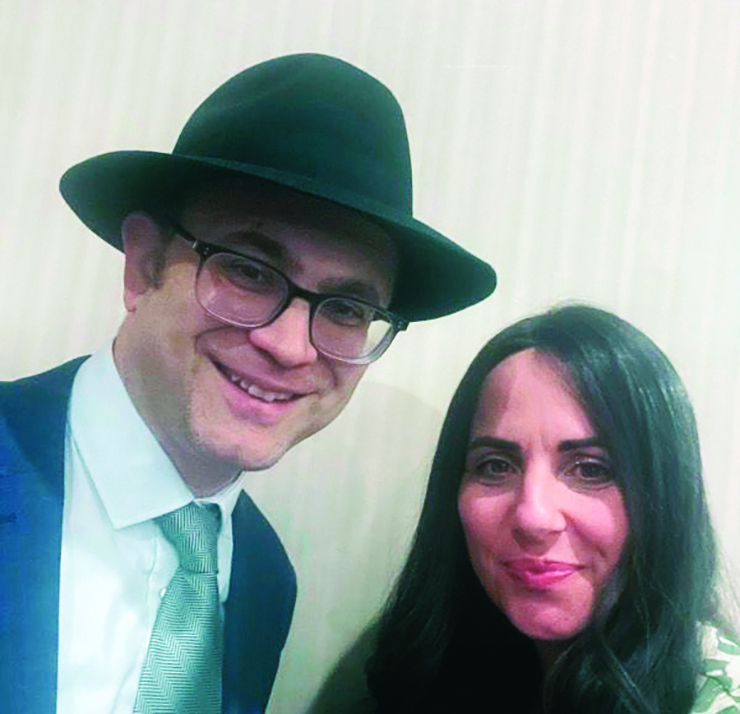
 Rabbi Anthony and Rebbetzin
Miriam Knopf (Credit: Elmora Avenue Shul)
Rabbi Anthony and Rebbetzin Miriam Knopf stepped into the leadership roles at the Elmora Avenue Shul in September 2025. Rabbi Avrohom and Rebbetzin Rivky Herman have now advanced to the emeritus role after having been honored last June for their years of dedicated service. The new youth directors, Adena Muskin and Dovid Dobin, bring an abundance of experience and creativity to the youth department.
Rabbi Knopf grew up in Manchester, England, and from a young age was involved in the community, guiding young children, organizing programs and supporting communal initiatives. There, he said, “I developed a deep appreciation for community life and the importance of contributing to something larger than oneself,” which shaped his commitment to Jewish communal leadership and building strong, caring communities.
After spending several years learning in yeshivot in Israel and in kollel in London, studying concurrently at Cambridge University, Rabbi Knopf brings years of experience in communal service to his role as rav of the Elmora Avenue Shul. He was privileged to serve in many communities, including as the community director and associate rabbi at Hampstead Garden Suburb Synagogue in London, and as a congregational rabbi in Cape Town, South Africa. “Recently, I spent nearly a decade in Montreal involved in education, community development and Torah programming, leading a city-wide middot initiative,” he said.
A lifelong influence on Rabbi Knopf is a household name, even in America. “A major influence on me growing up was Rabbi Lord Jonathan Sacks, zt”l, who was chief rabbi of the United Kingdom. His passion for Torah, and his ability to show how Jewish ideas speak to real life, to our personal lives, our communities and the world around us made a strong impression on me,” said Rabbi Knopf. “He helped me see that Torah is not only something we study, but something we try to live, and that building strong, thoughtful, caring communities is one of the ways those values become real.
“I realized that the role of a congregational rabbi brings together many of the things that inspire me most: teaching Torah, building community, supporting people in their personal journeys, and helping create an environment where Judaism feels alive, meaningful and full of warmth.”
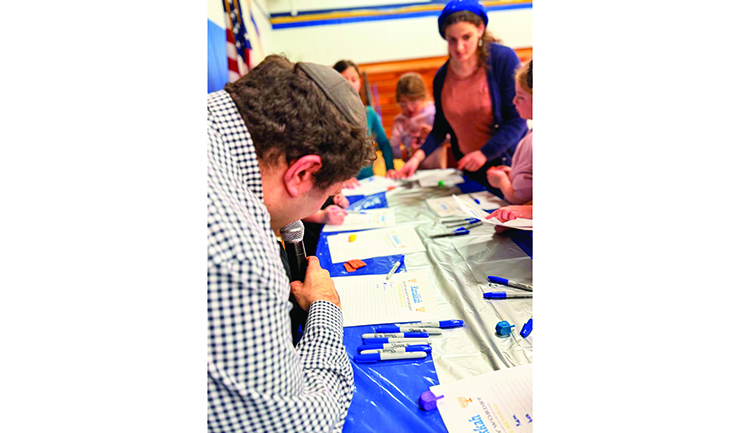 Youth Directors Adena Muskin (background) and Dovid Dobin (foreground) during an activity at the recent Chanukah chagiga.
(Credit: Adena Muskin)
Asked what means the most to him about serving as a congregational rabbi, Rabbi Knopf responded: “Helping people grow in Torah, middot, and their relationship with Hashem in the context of a real, caring community. For me, rabbanut is not only about teaching, but about helping create an environment where Judaism feels alive, thoughtful and deeply meaningful.” Ultimately he feels that Torah should also serve as a vehicle connecting to both the mind and the neshama.
Rabbi Knopf finds it especially meaningful when people participate in a shiur, ask questions, share ideas and learn from one another. “When that happens, Torah belongs to the whole community, not just something coming from the front of the room. I once heard my predecessor, Rabbi Herman, say that Torah is ultimately about relationships, our relationship with Hashem and our relationship with other people, and that idea stayed with me. A healthy community is one where people feel seen, valued and cared for and where we take responsibility for one another.”
Rabbi Knopf also finds inspiration from past rabbinic leaders of Elizabeth. “One of the things that drew me to Elizabeth is its remarkable history as a Torah community, shaped by generations of distinguished rabbinic leadership: Rav Pinchas Teitz, zt”l and Rav Elazar Meir Teitz, zt”l. It is inspiring to come to a kehilla that has such deep roots, where Torah has always been at the center of the community. Rav Pinchas Teitz encouraged the kehilla to be engaged with the broader world while remaining firmly anchored in Torah, and I feel that this is a very powerful model.
“Baruch Hashem, there is already a strong sense of community in Elizabeth. One of my main hopes is to build on that strength while continuing to deepen the Torah learning and spiritual life of the shul.”
Rabbi Knopf would like to create more opportunities for people to encounter Torah on a regular basis, through classic shiurim in Gemara and halacha, and also through approaches that highlight how Torah speaks directly to the challenges and questions of everyday life. “Torah should not feel distant, but something that inspires us to grow as people and to become more connected to Hashem.”
The shul’s new youth directors, married couple Adena Muskin and Dovid Dobin, shared their thoughts as well. Muskin said: “I have spent my career building enriching Jewish programs for children of all ages. Since my teen years I’ve been involved in Jewish experiential leadership, spanning the gamut of Jewish education from toddlers to adults.” She has served in early childhood education as a Sunday school teacher, with elementary students as a classroom teacher, with teenagers as youth group director, and with college students. “No matter the age or background, I enjoy bringing Judaism to life. I am now very excited to work as youth director on a community level.”
Dobin said: “I was a leader in the youth department of Ohav Emeth in Highland Park for many years, starting as a gabbai in the teen minyan. I ran the teen minyan for nearly two decades, helping hundreds of kids to find their place in their eventual community.” He added that members of that minyan have gone on to become gabbaim, baalei kriah and tefillah, and board members in their respective shuls. He has also tutored many bar mitzvah boys.
Dobin has a history of familial community service. “My grandparents set the standard, helping to build the Young Israel of Wavecrest and Bayswater in the 1950s. My grandfather taught me early on that when a gabbai asks you to daven or lein, ‘no’ is not an option. We all have our God-given abilities, and whatever they are, you owe them to your shul and community. I grew up helping my father clear siddurim from the benches every Saturday night, and saw how he and my mother dedicated their time to all the needs of the shul, in capacities both official and otherwise.” He added that receiving a leadership award in December 2024 from Ohav Emeth felt as if he was simply living up to their examples.
Muskin added: “I firmly believe in the importance of experiential education and informal learning. As Benjamin Franklin put it, ‘Tell me and I forget; teach me and I learn; involve me and I remember.’ Shul is completely experiential by nature: We sing the tefillot, we listen to the Torah, we are inspired by the sight of the beautiful sanctuary; we taste and smell the delicious kiddush food, and we enjoy the company of our community members.”
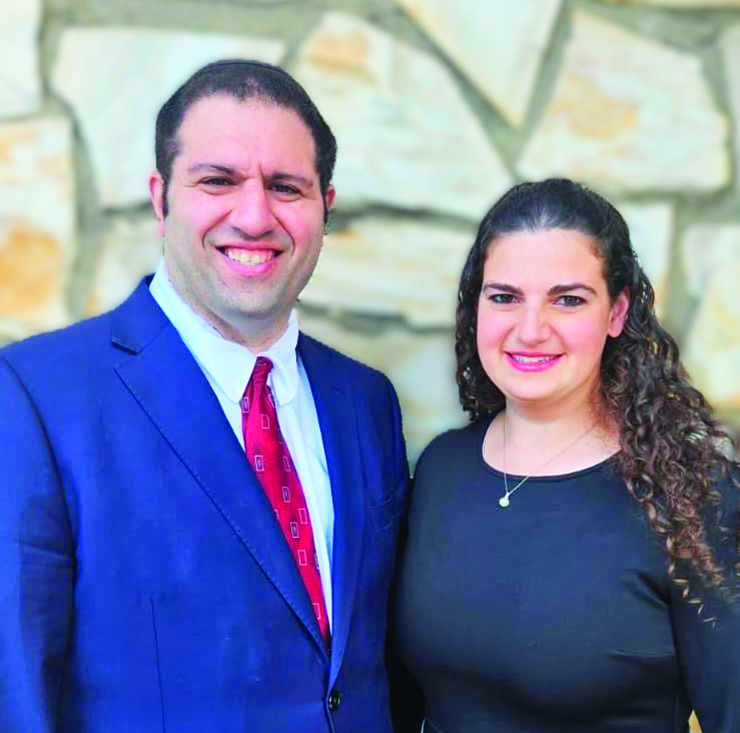 Dovid Dobin and Adena Muskin
(Credit: Adena Muskin)
Both Muskin and Dobin believe that the future of any community is its youth. “A shul’s youth program molds tomorrow’s leaders. Our mission is to instill a love of Torah and Judaism in each child, and foster a sense of belonging in the shul community. From games and stories for younger ages, to exhilarating parsha debates for older children, our programming brings Judaism to life. Weekly Shabbat groups make shul a fun and exciting place for kids. Holiday programming keeps them engaged throughout the year. In a successful youth program, children who started coming to Shabbat groups as toddlers graduate high school willing and able to contribute to their community.”
Muskin and Dobin have found the community to be incredibly giving. Muskin moved to Elizabeth from Orlando, Florida a few months before their wedding in November, and the community graciously hosted Dobin every week. “People we hadn’t even met hosted our sheva brachot. The people of Elizabeth are kind, down-to-earth and community-focused. People of all different backgrounds find friendships and daven together.”