
World Receiver
Den Frie
February 6–April 5, 2026
Copenhagen
Isa Genzken began to toy with mannequins in the 2010s, dressing dummies in garments and accessories regularly swiped from her own wardrobe. In Genzken’s hands, these idols of consumerism and harbingers of great taste are made ridiculous. The German artist’s first solo exhibition in Scandinavia, hosted by Den Frie, is populated by a number of these punk “Schauspieler” [actors] mannequins in wry tableaux. Their farcical postures and costumes reward careful observation and blend a commentary on capitalist society with Genzken’s own personal history. The galleries feel as if the lights have just come on in a nightclub, the kind that Genzken often frequented, and the ravers have been suddenly revealed—dance moves exposed, outfits in disarray.
This is particularly true of one untitled assembly (2018), who have their arms raised as if in a state of euphoria, yet are comically adorned with plastic sheets, glasses, sleeping masks, and tubing. Another untitled group (2017) looks like the downward spiral of an afterparty, with a pair entwined on a leather sofa and two mannequins watching on, one dressed in a visor and bucket, and the other in a waistcoat covered in pictures of Andy Warhol and inscribed with the phrase “give me my fifteen minutes,” alluding to his famous declaration on modern celebrity.
Perhaps best known for her minimalist sculptures in lacquered wood from the late 1970s, this exhibition focuses on Genzken’s career in the new millennium and her work with assemblage—combining mass-produced materials and luxury items with photographs, images, and ephemera. Organized by the artist’s longtime collaborator Galerie Buchholz, this is not a revolutionary show for Genzken devotees. But for a Danish audience with limited exposure to the works, they still feel deliciously radical and impudent. The artist, now in poor health, did not travel for the show. Genzken suffers from bipolar disease and quit drinking around 2013. World Receiver speaks to her ability to absorb, process, and spit back out the social idiosyncrasies of capitalist consumerism and the detritus left behind.
Genzken’s interest in radio receivers stretches back to the early 1980s, when she first transformed a hi-fi into a work of art and explored the resonance of invisible waves of communication. One of the untitled concrete radios (2016) Genzken would go on to make can be found at Den Frie, placed atop a Styrofoam box filled with plastic pill containers. These concrete renditions ironically can’t receive anything at all, of course. A towering version of a radio antenna, Vollmond (1997/2023), which was first made for the Skulptur Projekte Münster, now stands permanently outside Den Frie, but this too is only a beacon of light. There is something roguish in their reference to communication, yet inability to communicate—like a child sticking their fingers in their ears.
A sobering 360-degree installation of photographs, picturing the Iraq war and others in the modern era, is one moment in which we are forced to receive information from the outside world (Der Spiegel III, 2003–04). Featuring 103 images from the German weekly news magazine Der Spiegel, Genzken reflects on the representation of conflict in the mass media and our desensitization to war, experienced in real time.
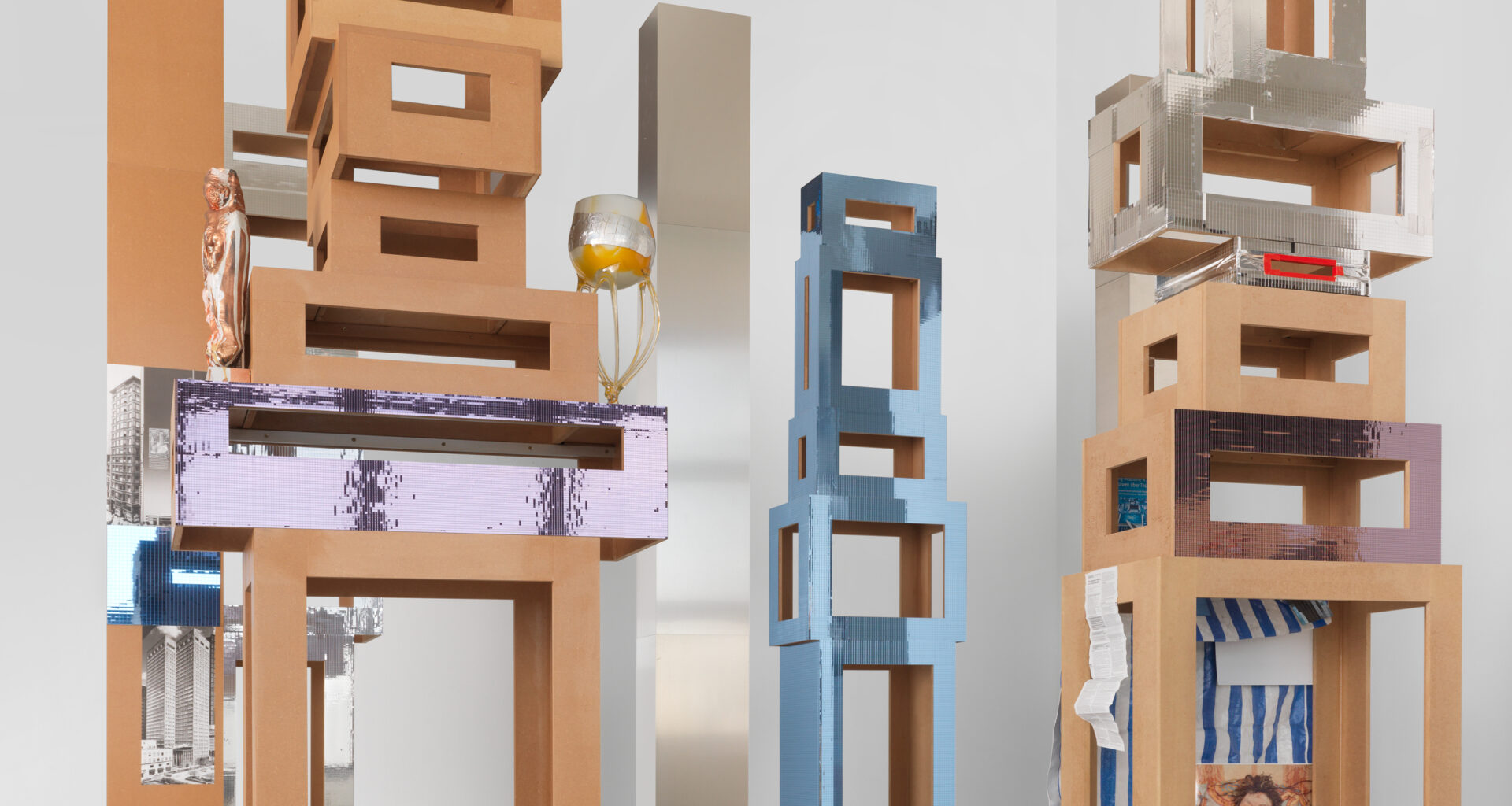
Vollmond stands as an industrial monument to the postwar era of reconstruction that Genzken grew up in. Another cenotaph at Den Frie is an installation of MDF columns—Genzken’s final monumental work—akin to ruinous skyscrapers (Untitled [4 Türme, 3 Stelen], 2015). The towers are adorned with ephemera—a safety leaflet by the pharmaceutical brand Ratiopharm, a Der Spiegel cover picturing Vladimir Putin flying a jet, a plastic replica of a German Renaissance mother and child, and a photograph of Genzken with her ex-husband Gerhard Richter. Though Genzken and Richter broke up in the nineties, he remains a much-cited touchstone of her biography, and one that Genzken too seems to still be reckoning with.