
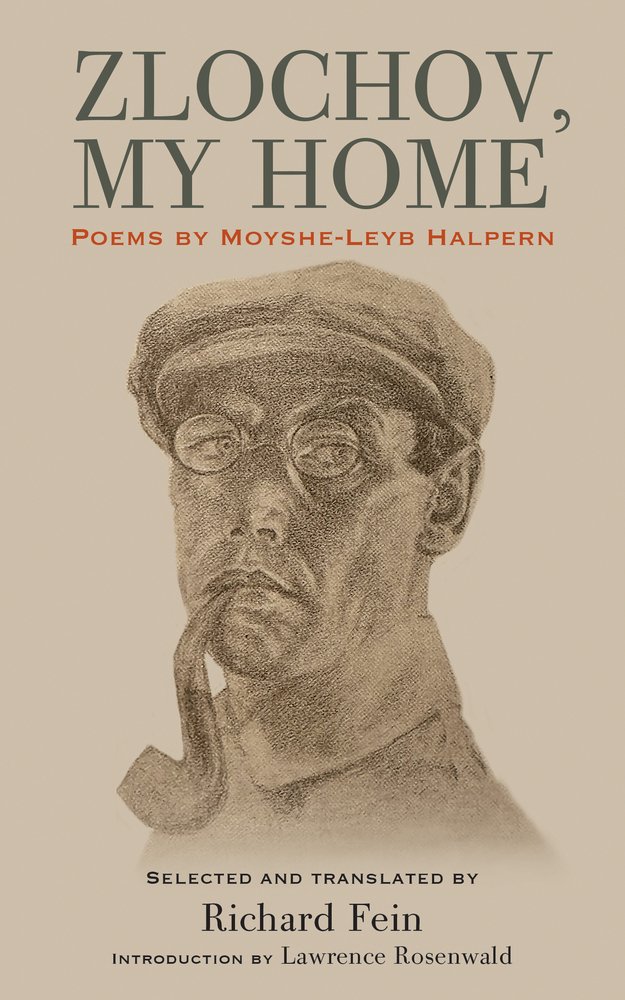
Zlochov, My Home: Poems by Moyshe-Leyb Halpern
Translated from the Yiddish by Richard Fein
Excelsior Editions, 2026
More than forty years ago, the Jewish Publication Society of America released In New York: A Selection, a collection of Moyshe-Leyb Halpern poems translated from Yiddish into English by Kathryn Hellerstein. This collection, which showcased versions of approximately one-third of Halpern’s original 1919 text, In New York, proved a landmark in American letters, for it not only introduced English-language readers to a poet that scholar Ruth Wisse has called “perhaps the most powerful voice in the entire history of Yiddish poetry,” but provided modern poetry enthusiasts with a fuller picture of certain innovations in verse beyond traditional Western European and Anglo-American canons. Moreover, Hellerstein’s graceful, crystal-clear renditions afforded readers a unique glimpse into one writer’s experience during the Jewish diaspora of the late-nineteenth/early-twentieth centuries. Even in translation, Halpern’s passionate urgency was evident. “The engine stirs up wake,” he observes in one section of “In a Foreign World,” a long serial poem that tracks with considerable intimacy the poet’s journey from Zlochev, Galicia, (Austria-Hungary) to America: “The ship departs, / And watching people waving from the shore, / I feel a strangeness in my heart of hearts. / Minute by minute, we’re distanced more and more.” Said distance is both literal and metaphorical. The ship that carries Halpern across the Atlantic inches further from sources of love and familiarity towards a place that will leave him, as he admits in later stanzas, “bewildered” and “struggling” with loneliness and isolation.
This poem—and many others from In New York: A Selection—articulate a moving, valuable perspective of the immigrant experience through literature. However, this theme is only one facet of Halpern’s approach. Intense, ironic, often satirical and occasionally mercurial, the poet’s range resists quick summation, in part because his relationship to the home he fled induced both nostalgia and hostility: “Long for home and hate your homeland,” he declares in the opening line of “Homesickness.” There, Halpern’s pronounced alienation occupies a space as complex and authentic as Richard Wright, or other searching modernists. Clearly, he had much to offer the curious reader. One might be excused for assuming, then, that In New York: A Selection marked the start of a period in which Halpern would receive sustained attention through frequent translation and publication. Sadly, this was not to be. Although generous samplings of his work appeared in both The Penguin Book of Modern Yiddish Verse (1987) and American Yiddish Poetry (1986), Halpern has remained virtually unknown to readers beyond select enthusiasts of Jewish and Yiddish literature. This is why poet Richard Fein’s fresh translations of Halpern, now available through Excelsior Editions, are especially welcome.
“In a Foreign World” does not appear in Fein’s Zlochov, My Home: Poems by Moshe-Leybe Halpern, but this omission signals one of the collection’s strengths. As Lawrence Rosenwald notes in his “Introduction,” Fein’s selection differs from the three aforementioned projects because he features many poems formerly not rendered into English. The basis for the selection appears to have been personal—Fein translating those poems which best engaged his interests—and equitable. In addition to In New York, Halpern’s two other collections are The Golden Peacock (1924) and Moyshe-Leyb Halpern, Volumes I and II (1934). If history has privileged portions of In New York above the other titles, Fein’s Zlochov takes a definitive step to balance this. More than anything else, Zlochov, My Home makes a compelling case for full translations of each of Halpern’s books.