
When I got to my corral in Prospect Park in Brooklyn, I felt my nerves start to kindle, anticipating the 13.1 miles I was about to run. I’ve done this before—many times, in fact—but I still get that feeling of excitement mixed with anticipation and a touch of anxiety (what if this time, I don’t finish?).
I was about to run the New York City Half Marathon for the second time, and thinking about the runners ahead of me helped to bring me a sense of calm and confidence.
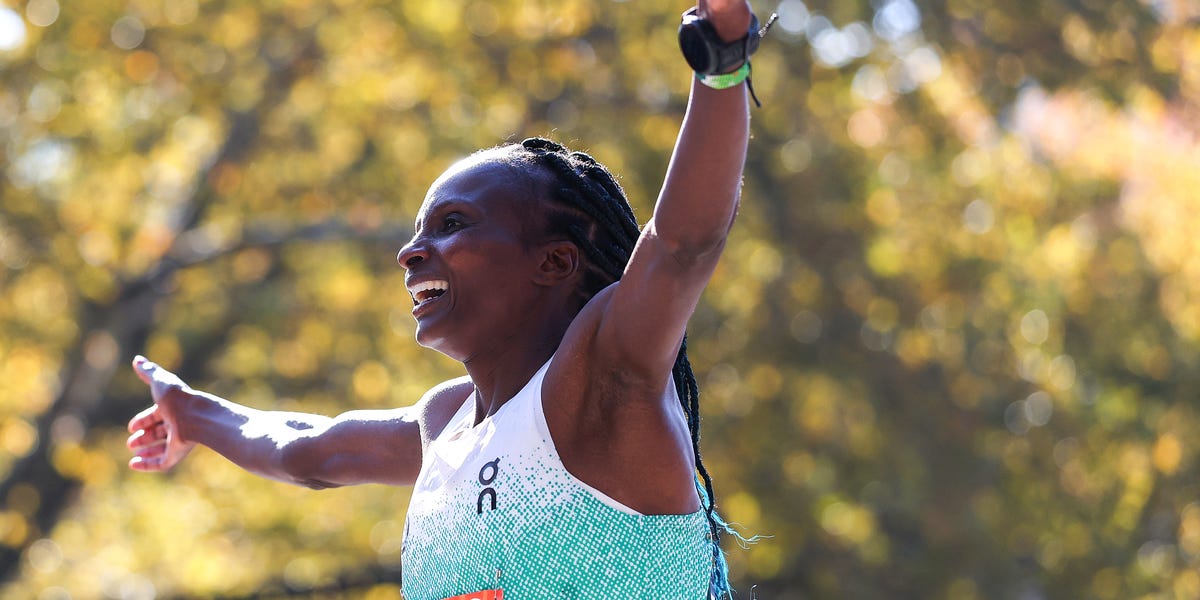
A few weeks ago, I had the honor of getting advice from some of the pros, including women’s race winner and course record-setter Hellen Obiri of Kenya, who finished in 1:06:33.
While you may assume the pros are in a different league (because, well, they are), consider these words of wisdom from Agnes Ngetich of Kenya, who holds the record for the fastest road 10K (28:46): “I believe that all of us, as runners, are in search of the same thing, irrespective of how fast or how far we can run.”
So I took their racing strategies with me to the starting line, remembering their tips as those excited nerves started to take hold. Here’s what you can take with you into your own 13.1.
Related StoryDon’t Overdo It in Training
As a first-time half-marathoner, American Grant Fisher, world record holder in the indoor 3,000 meters (7:22.91) and 5,000 meters (12:44.09), admittedly felt “weird” giving advice on this, but it’s worth taking to heart: “I would say be gentle on your body,” he says.
It’s tempting to add an extra day of running or strength training if you’re feeling good, but Fisher says less may be more. “Everyone likes to see progress, but you’ll have a much better time if you do it gently and gradually, whether that’s increasing the days that you run, increasing your long run, or adding a mile here or there to a workout,” he says. “What I found with myself, being just slightly cautious in that build, I think pays dividends if [it means] you can stay healthy.”
I’ve been working with a personal trainer virtually for the past three months and—before talking to Fisher—asked her about adding an extra running day to my routine because I was feeling pretty strong and healthy. Her response: “I would stick with three times if that’s how you typically train for a [half] marathon,” she wrote. “I would rather you air on the side of caution. If you wanted a fourth cardio day, I would get on a spin bike.”
So, I took both of their advice to heart and stuck to my three runs a week. I arrived to the start (and finish) line injury-free.
Related StoryOptimize Your Strength Work
Like the New York City Marathon, the NYC Half is also undulating (read: hilly as heck). From the incline of Prospect Park to climbing the Brooklyn Bridge to finishing on a slight hill in Central Park, you definitely gain elevation. In fact, I turned on Apple Intelligence on my Apple Watch during the race so I could access the Workout Buddy feature, and I got reminders throughout the race that I just completed more elevation than I have all year!
The pros were well aware of this course challenge and prepared accordingly, starting with strength training. “For my career longevity and health, I continue to fine tune [my] strength program with my team and I believe this will add value to me for the upcoming event and in the future,” Ngetich says. Specifically, she added plyometric exercises, like split squats with a jump and various jumping exercises for her calves, as well as anti-rotational core work.
Annie Frisbie, the second-fastest American (in 2:24:12) at the 2025 TCS New York City Marathon, who finished eighth in the women’s race for the half marathon (in 1:09:25), says her best advice to other runners of any level is to train for the hills and terrain as much as the distance itself. “Adding in hill repeats, strength sessions, and pace changes can be helpful tools to add to your training so you feel strong on the up and downhills,” she says. Specifically, she focused on her glutes, quads, and hamstrings, in addition to her core and lower back, when it came to strength work.
I already strength train two to three days a week, and include moves for all the muscle groups mentioned by Frisbie, as well as specifics like jumping split squats and anti-rotational core work (hello, Palloff presses!) so it was cool to learn I had something in common with Ngetich and Frisbie!
One thing I did more often during this training cycle, though, was hill repeats, as advised by Frisbie. Perhaps one benefit of all the treadmill running I had to do this season is that it’s easy to manipulate the tread up and down for this type of workout—and I definitely think it paid off as I cruised through the inclines of the course.
Related StoryFind Positive Distractions
For Ngetich, a visit from New York Road Runners staff to Kenya in February was a welcome reprieve from the grind of training. The visit reminded her that sometimes, to run well and persevere, we need encouragement that comes from outside the training bubble. “These moments quietly refuel something in us,” she says, adding that balancing the joy of running with running as a profession and the positive distractions that keep both alive is key. “I hope every runner heading to the start line in New York carries something like that with them too,” she says.
I got this insight from Ngetich just before heading down to Tampa, Florida two weeks before race day to spend some time with family (and in much warmer weather!) and it couldn’t have come at a better time. I still got my runs in, but I really focused on being present when I was with my family (including two adorable nieces) and feel like I arrived back in NYC refreshed and more ready than ever for the race.
Recover as Hard as You Train
Many of the pros who gave me advice said some variation “recover as hard as you train.” In fact, it was the tactic Frisbie focused on going into the NYC Half. “I have a really strong base of fitness underneath me, and now the best thing I can do to keep and improve that fitness is making sure I’m recovering efficiently,” she says, adding that she set a goal to get around eight to 10 hours of sleep, as well as regular bodywork and quality nutrition.
While this wasn’t something totally new for Frisbie—she’s made a conscious effort to be more disciplined with these habits over the past couple of years—she’s found small, consistent choices really stack over each build. “When I’m consistent with these things every day, I notice a huge difference in my overall buildup and health,” she says.
Obiri, too, prioritizes recovery, including between her workouts and especially the few days before the competition. Specifically, she tries not to do hard workouts too close to each other.
Sleep in particular was a theme with Julia Paternain of Uruguay, who has a 1:10:16 PB in the half marathon. She works on getting as much shut-eye as she can ahead of races. “Sleep is the best recovery tool out there and I always feel much more ready to go when I am rested,” she says.
I can appreciate sleep is uncomplicated and free—something that I already protect like it’s my job (so much so I wonder if I let it interfere with my social life too much, but that’s another story!) That said, when I get a subpar night of sleep, I try not to check my sleep data before my run so it won’t influence my effort.
If you, like me and Paternain, are getting plenty of shut-eye most of the time, an off night here or there won’t totally derail you.
Related StoryFocus on Effort Early On in the Race
It’s always good advice to avoid going out too fast in the first few miles of a half or full marathon, but it may be particularly worth paying attention to for races with hills, especially at the start.
“There are a few sharp uphill and downhills in the first two miles of the [NYC Half Marathon] and it can be easy to get swept up in a faster pace with adrenaline from the start,” says Frisbie. “My advice is to stay patient and focus on effort rather than pace in those early miles.”
One way to do just that is to use RPE, or rate of perceived exertion. In the first couple miles of the race, I felt like I was at around a 5 or 6 (which is the bridge between moderate and hard effort) and it felt like a good sweet spot that correlated closely with the pace I was going for (about 9:00 per mile).
From there, Frisbie says you can get more dialed into pace: “The course eventually opens up and has some great miles for locking in to a faster pace,” she says. “Staying calm early will help you push in the later miles.”
For me, I ended up keeping a pretty steady effort and pace throughout the race, but there was definitely an opportunity to kick it into high gear toward the end, especially with the energy of NYC’s Times Square.
Related StoryDon’t Skimp on Fuel or Water When It’s Cold
I’m as guilty as the next runner of skimping on hydration when I’m not sweating a ton like I do in warmer months. But Obiri’s advice rang in my ears when I thought about skipping a water station, which popped up about every two miles.
In fact, one of her big focuses in general is on carbs and fluids, along with protein to fuel hard training. “I’m taking a lot of water before and after my training,” she says, adding that she also takes Maurten (one of her sponsors) on longer runs after every 5K and during track sessions. “For my long run, I typically have seven bottles and I practice like it’s race day,” she says.
I also took two mini water bottles with me to sip en route to the start and at least a few swigs of water at every water station. I paired this with a GU around mile 4 and mile 8. I think this strategy not only helped midrace, but contributed to my recovery afterward. I maintained a steady feeling of energy throughout the entire race, and felt less drained later that same day, too. (I was able to carry on throughout the day, including going out to dinner, rather than feeling like I needed a couch day!)
Related StoryCrowd Source Energy (Literally)
Obiri and Paternain suggest using the positive energy from the crowds to propel you to the finish line.
“The NYC Half is really amazing,” Obiri says. “Think about the good support behind cheering crowds, the refreshing and serene Central Park feeling that’s right at the finish line, with instant healing.”
As I raced, I found it was easy to draw energy from the crowd in Prospect Park, Times Square, and ultimately Central Park. I also found myself drawing energy from small acts of kindness that I noticed around me. For example, in Central Park about a quarter mile from the finish, a man got in lockstep with a struggling fellow runner, encouraging and hyping them up.
This helped to remind me of the power of running and why I do this. When you’re in the middle of a race and it starts to feel tough, it can be easy to question why you signed up in the first place. For me, outside of all the physical and mental benefits I get from it, it’s also about the community and camaraderie of the sport.
At the end of the day, I finished in 2:04 (on the nose), which is not my best half-marathon time, but not my slowest either! More important to me than any time is the fact that I felt really good for most of the race and afterward—I’ve recovered quickly! The hardest part was the headwind and chilly temps, but my body felt ready and willing to go the distance, thanks (in part) to these pro tips I took to heart.