
(LA)HORDE & Ballet national de Marseille
Age of Content
BAM and Dance Reflections by Van Cleef & Arpels Festival
February 20–22, 2026
Brooklyn
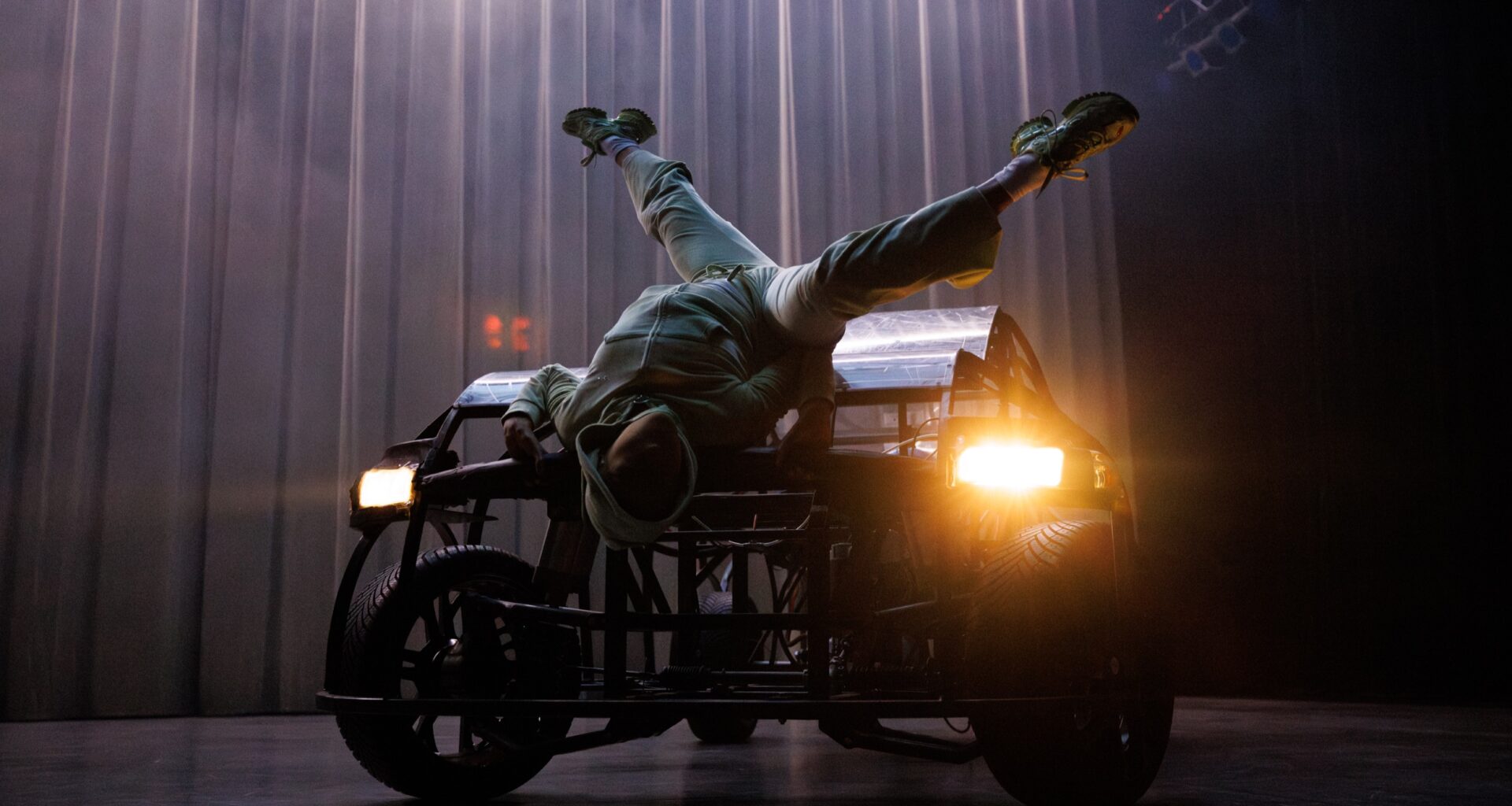
As house lights dim, the skeletal frame of a car appears; gliding, it seems to drive itself from the wings towards center stage. Its welded steel form is partially clad in transparent plastic that cocoons fog rolling across the stage, at once evoking a bootleg greenhouse and the cybernetic endoskeleton of an assassin from The Terminator. The hooded figure of a dancer, adorned in a rhinestoned Juicy Couture tracksuit, mounts the vehicle’s transparent hood. Lying back, the machine appears to control its passenger, who is absorbed into the mechanical body as their legs scissor through the air. As more dancers enter from the wings, donning hair braids, nylon scarves covering their faces, and matching Juicy tracksuits, two sky blue receiver tanks stored in the vehicle’s interior launch the car’s pneumatic system. In a scene inspired by Grand Theft Auto, the company clambors on and around the vehicle, breaking out in fights. To a score of hard, high-BPM techno by Gabber Eleganza, the skeleton thrashes, and the bodies of the dancers alongside with violent exuberance.
As the car’s skeleton hurdled across the stage, I was teleported to time spent living and working as an architectural designer for François Roche, kingpin of the 1990s digital extravagance that the performance exuberantly resuscitated. From his office on the outskirts of Paris, I slept on a camping cot beneath a six-axis KUKA robot which I would remote control as playfully as a toy car. This Sunday, though, I am attending a matinee at the Brooklyn Academy of Music (BAM) which concludes a weekend of performances of Age of Content by LA(HORDE), the artist collective which has directed the National Ballet of Marseilles since 2019. In addition to the car, scenographer Julien Peissel constructed a catwalk, metal staircase, hydraulic garage door, and haphazardly stacked pile of cardboard boxes to frame the stage, evoking the austere placelessness of a logistics center. Within its interior, the eighteen dancers performed a choreography of internet dances, pay-per-view horniness, and video game stunts, emptied of human feeling. The influence of Demna—former creative director of Balenciaga, whose debut collection at Gucci opened a few days after Sunday’s closing matinee—was felt in the ensemble of shaggy-haired twinks moving stiffly like NPC avatars. The audience, seated comfortably within the interior of BAM’s Howard Gilman Opera House as the strongest snowstorm in a decade blankets New York City outside, is presented with an extravagant vision for the end of the world which could have been hallucinated by a feverish AI.
In his seminal essay Das Unheimliche, Freud first described the uncanny as emerging from motion where one expects stasis—or the confusion of life and death—before ultimately defining it as something the conscious mind represses but which returns.1 To the psychoanalyst, dance is uncanny by nature: it stages the body as an instrument of another’s will, thus surfacing the relations of control and submission that we typically turn to arts and public life to forget.2 Age of Content raises these themes of dependency and subjection to the surface as subject matter; its title reflects the age at which a person becomes legally competent to consent to sexual activity, society’s ultimate vehicle for coercion. But as the first dancer—a machine—glides into view, uncaniness emerges also from the animation of its inert form. The vehicle reappropriates the practices of subordination which choreograph the rest of the ensemble through its remote control by one dancer observing from the catwalk, whose role as floor supervisor leaves the audience uncertain whether he is even a member of the company. Uncanniness too is raised by the injection of virtual avatars into the ensemble’s bodily flesh, which comes to resemble the lifeless digital puppets that populate our screens. Stillness where we expect life, plastered with vacant smiles. The rapid disappearance of naturalism, honesty, and truth at the hands of role-playing and spectacular entertainment, facilitated by our increasingly organic screens.