
Falling Water Given
Tanya Bonakdar Gallery
February 19–April 18, 2026
New York
Marcel Duchamp declared The Bride Stripped Bare by Her Bachelors, Even (The Large Glass) (1915–23) finished years after it was inadvertently broken in transit. In its current form, restored by Duchamp in 1936 and permanently installed in the Philadelphia Museum of Art, long swooping cracks peel crosswise, like two insect wings angled diagonally from the horizontal spine where the top and bottom glass panels meet. Yuko Mohri invokes The Large Glass and disperses it throughout the ground floor of Tanya Bonakdar Gallery.
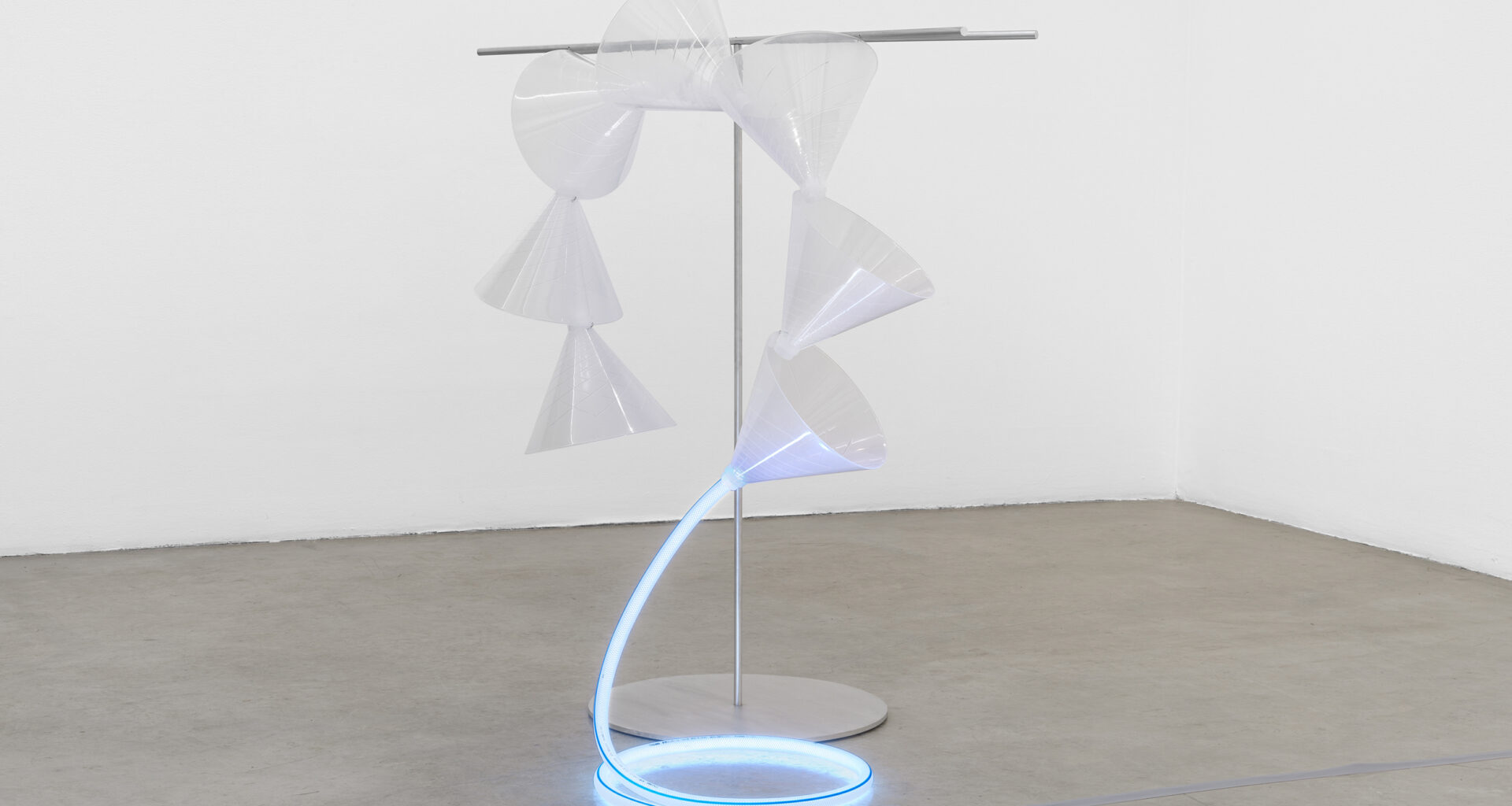
Moré Moré (Leaky): Sieves (2024) cites The Large Glass directly by extracting the funnel and rod shapes from Duchamp’s composition and arranging them as a standing sculpture. Its mute presence in the gallery is swallowed by the gallery’s larger works and their moving parts. However, it’s a neat ode to Duchamp that takes the architecture of the funnel as the connective tissue between his work and her continued interest in improvised solutions to leaks in Tokyo subway stations, as pictured in her “Moré Moré Tokyo (Leaky Tokyo)” series (2009–21), of which two photos are included in this presentation. But as Mohri notes in a recent interview: “My curiosity is from the bottom.” Given this, we might think about the directional output of a funnel in the reverse, where a narrow opening widens, much like a bullhorn or speaker.
Three suspended wooden structures repeat Duchamp’s framework as a continuation of the artist’s “Moré Moré (Leaky): Falling Water Given” (2015– ) series. Always presented as treble installations, the 123-by-69-inch stretcher-bar assemblages are made into discrete, closed circuits, fitted with found objects that facilitate or react to the movement of trickling water. The titling of this series is similarly an act of recomposition, referring to Étant donnés: 1° La chute d’eau [Given: The Waterfall], Duchamp’s swan song. Mohri hangs instruments, plastic apples, funnels, and household items from the support structures with fishing line and extension springs forming cycles of accumulation and drainage—gulp and release. Water is siphoned through silicone tubing from plastic vessels stationed beneath the hovering kinetic sculptures. These artificial vascular systems run as dilapidated machines. But the water doesn’t stream or glide easily; rather, micro diaphragm pumps labor to route fluid upward and throughout. A sibilant accompaniment, like a metronome, emerges from these mechanical expirations that back an indeterminate score.
An unlikely ensemble of drum, cymbal, and triangle fills in the composition with sandy texture and chimes. Walking around these orchestrations, it’s difficult to refrain from searching for the exact moment where sound is made. And yet, identifying the source doesn’t make predicting their output any more possible; indeed, simply spotting a leak often tells you very little about the reserve and how long it’ll last. Mohri’s autonomous band is tasked with an indefinite performance that furnishes the gap between provisional and perpetual.
Upstairs, Mohri shifts to an electronic register. Her “Decomposition” (2021– ) series groups locally sourced fruits on wooden readymade sculptures. The largest takes the form of a desk placed between two hardwood-encased stereo speakers. Set on top in a single ripe row. From left to right: an orange, dragonfruit, red apple, green apple, and a horned melon, are hooked up with electrodes that detect and translate their moisture content into pitched tones. On the wall behind, a mounted LED light panel coordinates this inner activity with transient glows. As the exhibition continues, and the fruit naturally withers, the feedback will unravel into a new pool of frequencies. When the show opened, the conducted sounds were rather sparse and blended uniformly; but during a subsequent visit, a fuller, syncopated pulsing of noise filled the room to the effect of a group of musicians’ scattered tuning of instruments. However, in Decomposition (2026) the downbeat of an overture never arrives. Left to fester, the fruit just go on humming and stopping—their discordant harmonies crawling over one another.