
Three ballot measures approved by New York City voters last year will change the city’s complex land use review process for housing proposals.
Two of the measures create new processes that are expected to cut down the city’s current land use review process by several months, and one measure creates an appeals board that can override city council decisions that block affordable housing.
The measures took effect at the beginning of the year, and one is currently being tested. The Mamdani administration recently announced that a housing development in the Bronx’s Mott Haven neighborhood will utilize a new expedited review process—established by one of the measures—to create approximately 84 new affordable homes.
As affordable housing developers size up the projects they intend to propose this year, some developers and housing advocates are hopeful the new review processes will be faster and less expensive.
But it will take time for developers to become accustomed to the new approval pathways. And some fear that the measures will make it more difficult for tenant advocates, organizers, and council members to negotiate for deeply affordable housing or funding for things like parks and cultural institutions.
“In the short term, there’s going to be a lot of confusion, to be honest,” says Emily Goldstein, director of organizing and advocacy at the Association of Neighborhood Housing Developers, a membership organization for nonprofit housing developers in New York City.
“In the medium term, we’re going to see the benefits of expedited, truly affordable housing being developed. And in the medium-to-long term, I think we will start to understand what this actually means in terms of the political dynamics,” Goldstein says.
While tedious and imperfect, the city’s current land use review process, called the Uniform Land Use Review Procedure (ULURP), was designed to decentralize decision-making power to local communities in the wake of the federal urban renewal program, which funded the demolition of neglected and deteriorating housing and displaced thousands of residents. The city’s shift to community-level decision-making was also a response to the consolidation of urban planning power under Robert Moses, the former parks department commissioner who wielded unprecedented power and is responsible for much of the city’s infrastructure.
All housing proposals that require zoning changes or involve city funding or city land must go through ULURP. The process includes a review of the proposal from the local community board, borough president, City Planning Commission (CPC), the city council, and the mayor. Previously, the final say on a proposal went to the city council. Council members have used their votes to approve projects and leverage their veto power to gain concessions for the district in the form of deeper affordability and amenities.
While ULURP still exists, there are now different avenues—including expedited review processes—housing proposals can go through for approval.
Questions remain about how the new measures will shake up political dynamics in New York City—often a dance between developers and their lobbyists, council members, community groups, and nonprofits over how deeply affordable housing will be, how many stories high a building can rise, and how many parking spots a project will include.
Because “affordable” does not necessarily mean that a project will be affordable to those who earn area median incomes, community groups like Our Bronx worry that they’ve lost the power to shape certain projects, fueling concerns about development aimed at higher-income residents that could displace residents.
Proposal 2 creates two new processes for fast-tracking certain affordable housing projects. The first is for publicly financed affordable housing projects. The process includes a 60-day review by the local community board and a 30-day review by the Board of Standards and Appeals (BSA), an independent board that decides requests related to zoning and land use.
The second process creates a faster review for projects in the 12 community districts with the lowest rates of affordable housing. The process allows projects to be reviewed by the local community board and borough president simultaneously, followed by a 30- to 45-day review by the CPC. The CPC has final approval power instead of the city council. The Department of City Planning (DCP) will calculate and publicly announce which 12 council districts produce the least affordable housing before the end of the year. Those districts will be subject to the new process starting January 2027.
Proposal 3 creates an Expedited Land Use Review Process (ELURP) for “modest” housing projects and climate-resilient infrastructure. “Modest” housing projects are smaller-scale developments that increase density by no more than 30 percent in most neighborhoods, as laid out in a Charter Revision Commission report. Under this process, the local community board and the borough president have 60 days to review applications, followed by a 30-day review and finally a vote by the CPC. (Dispositions of city-owned property to Housing Development Fund Corporation cooperatives instead require a 30-day council review, as in the case of the Mott Haven development proposal currently under expedited review.)
Ballot Proposal 4, the most controversial among city council members and other politicians, creates an Affordable Housing Appeals Board made up of the mayor, the speaker of the city council, and local borough president. That board can reverse the council’s decision on an affordable housing project with a two-to-one vote if the project meets the minimum affordability requirements of the city’s Mandatory Inclusionary Housing (MIH) policy.
That measure is now in effect, and the Affordable Housing Appeals Board can approve projects that are rejected by the city council. None have advanced through this new process, DCP tells Shelterforce and Next City, but the measure has already had an effect on the city council.
Councilmember Vicki Paladino did not want to deal with the new appeal process and voted to approve a housing application she opposed. Paladino told City Limits, “I’m really not happy about any of this, but this is what the props were designed for—to force our hand on unpopular projects.”
The New York Housing Conference (NYHC), a nonprofit that advocates for affordable housing in the city, says it expects DCP, the Department of Housing Preservation and Development (HPD), and the BSA to develop formal rules for these processes in the following months. “These rules will further clarify applicability and process, among other details,” according to a statement.
First Tests of the Expedited Land Use Review
An application for an affordable housing project at 351 Powers Ave. in the Bronx’s Mott Haven neighborhood has begun the expedited review process. It is expected to undergo two months of simultaneous community board and borough president review, followed by one month of city council review and a vote. The typical review process would have taken roughly seven months, according to HPD.
Fifth Avenue Committee, a nonprofit housing developer, tells Shelterforce and Next City that it expects one of its housing projects to go through ELURP this spring.
Michelle de la Uz, Fifth Avenue Committee’s executive director, says the project will include 70 units of affordable housing at the corner of Nevins and Wyckoff streets in Brooklyn. The project will begin the expedited land use review soon, de la Uz says. The review process will last only three months thanks to the expedited process established by ELURP.
She says the process will conclude with a vote from the CPC, a 13-member board appointed by the mayor, borough presidents, and public advocate.
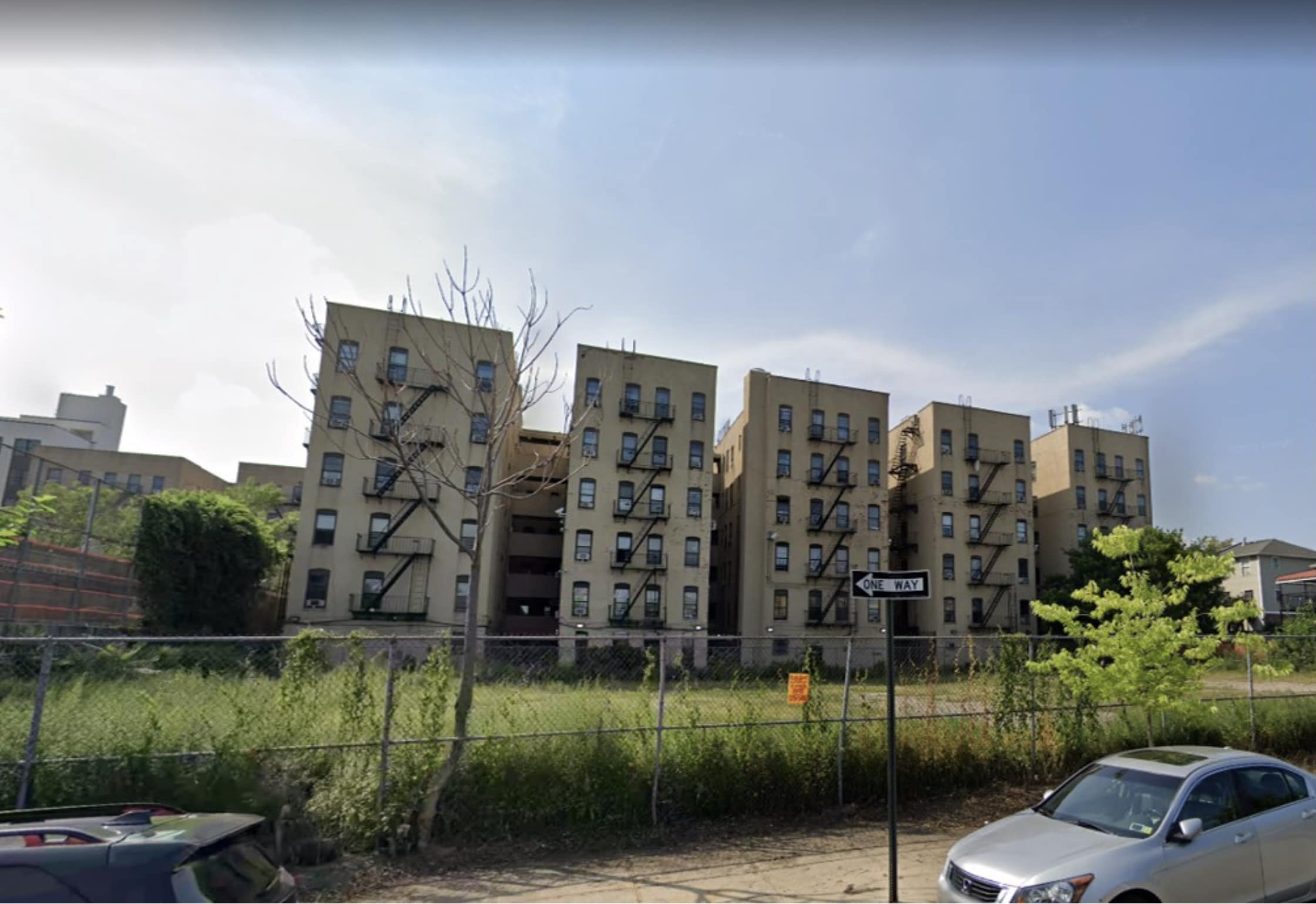
An application for an affordable housing project in the Bronx’s Mott Haven neighborhood is going through the new Expedited Land Use Review Process (ELURP). Photo courtesy of the New York City Department of Housing Preservation and Development
De la Uz and Fifth Avenue Committee support all three housing ballot measures and believe the level of community input will stay the same even with a shorter land use review period. Plus, de la Uz says, private developers will still negotiate with council members who are bargaining in good faith rather than end negotiations if they don’t get their way.
De la Uz says that in her experience, the vast majority of projects that go through ULURP change very little. “Why wouldn’t we think of shortening it and making it less costly? If the process wasn’t adding value, why wouldn’t we think of revising the process?”
The ballot measures are “not a silver bullet,” she says, but are just one lever that the city can influence.
Proponents of the measures also believe they will lead to more and deeper affordability by speeding up land use review processes.
“The places where the impact seems clearest [are] expediting . . . lowering costs to move proposals for 100 percent affordable housing through zoning change,” Goldstein says. “That’s something we and our members are really excited about.”
Goldstein says the traditional seven-month land use review process (ULURP) is expensive and that the fast-track process will enable developers to build affordable housing faster and more efficiently.
“There may be mixed perspectives on general increases in housing supply, but there is broad consensus that we are in desperate need of truly affordable housing, and this will make it faster and easier to build [it],” Goldstein says. Since the Association of Neighborhood Housing Developers’ membership primarily develops 100 percent affordable housing, the land use review for most of their projects will now be expedited, she adds.
According to Rachel Fee, executive director of NYHC, 19,000 affordable housing units have gone through the city’s land use review process over the past decade. “The impact could be substantial in terms of the number of projects that have a reduced period for public review,” Fee tells Shelterforce andNext City.
De la Uz says that while the new process could theoretically cut developer costs and lead to more affordable housing, she mainly expects it to speed up approvals. Fifth Avenue Committee is not yet budgeting projects based on expected cost savings, she says, and cost was not the main reason the nonprofit supported the measures.
Financing Delays and Vacancies Persist
Oksana Mironova, a housing policy analyst at the Community Service Society, a nonprofit that focuses on inequality, says the new measures will play a minor role in new housing development given that development typically fluctuates based on financing rather than on permitting.
While the ballot measures will have some impact, Mironova says that it will be “small and in [the] context [of] all the other stuff that’s happening within the housing market,” including the availability of government subsidies.
“Things like interest rates and other stuff that really has nothing to do with zoning or anything that the city has control over really shaped the market so much more,” Mironova says.
Sandra Lobo, executive director of Our Bronx, questions the extent to which land use reviews have caused construction delays with affordable housing. Our Bronx (formerly the Northwest Bronx Community and Clergy Coalition) opposed all three housing-related ballot measures, and Lobo argues they take power away from working-class residents.
She says the main cause of construction delays is HPD’s lengthy approval process for subsidies, which she attributes to the agency’s staff shortages.
She is not alone. In November 2025, NYHC released a policy brief that included a survey of 21 affordable housing developments in New York City. Sixty-two percent of respondents cited HPD’s staffing as the main reason for project delays. Additionally, the policy brief noted, HPD’s average loan processing time is nearly 4 years, and average additional costs due to lengthy processing is $1.2 million per project.
“When we think of vacancies and delays on the city side . . . that from our experience is the more challenging part,” Lobo says.
De la Uz agrees that HPD’s timeline for evaluating properties for subsidies is far too long, noting that it’s typical to wait four to five years for HPD’s approval.
How the Ballot Measures Shift Power
Some nonprofit housing developers and tenant advocates are taking a wait-and-see approach to the ballot measures’ effects on political power in the city. The measures signal the diminished power of “member deference,” in which the city council generally voted according to the whims of individual councilmembers.
Of particular concern to the city council and advocates for a local control is Proposal 4, which essentially eliminates council members’ ability to negotiate any additional affordability or concessions for additional amenities as long as a project meets the city’s minimum affordability requirements.
Council members will no longer have the final veto in most scenarios, as long as the project complies with the city’s MIH requirements. (A majority of NYC’s community boards voted against MIH in 2015. The council approved it the following year.)
“The council member could be largely cut out. . . . It really takes away a lot of their power,” Goldstein says. Developers may be less interested in negotiating with council members if they can go to the appeals board in the event of a “no” vote. Or the process could create different alliances, as council members negotiate with borough presidents or the speaker of the city council instead of directly with developers.
“The power jockeying is still going to be there, but it’s just going to be rerouted and look differently,” Mironova says.
While politically and rhetorically distinct from its predecessor, Mayor Zohran Mamdani’s administration has largely embraced much of Mayor Eric Adams’s approach to housing development. Mamdani voted in favor of all three housing-related ballot measures adopted by Adams’s 2025 New York City Charter Revision Commission and appointed Leila Bozorg—who served as Adams’s executive director of housing and played a central role in the development of the “City of Yes for Housing Opportunity” plan—as deputy mayor for housing and planning.
Mironova says she voted against Proposal 4 because it concentrates power among only a few people. “There’s really not that many guardrails,” Mironova says.
But she also notes that the current neighborhood-by-neighborhood strategy for approving new housing development is not ideal.
“One-off negotiations abstractly and objectively aren’t great. . . . It’s better to have overall comprehensive planning from an equity perspective, as opposed to having every group in every neighborhood fight each battle individually,” Mironova says.
Lobo, with Our Bronx, says the ballot measures empower officials who might lack a neighborhood-level understanding of the developments they approve. She says that community opposition to developers’ projects is a result of developers’ insufficient outreach or a lack of understanding of the neighborhood in which the project is being developed.
“The community is only being presented [with] a plan once it has been established,” Lobo says.
She points to the Mott Haven development as Exhibit A.
“In the Bronx, we are building the most affordable housing. . . . We’re the most affordable borough, but it’s not affordable [for] who lives here,” Lobo says. “We will be a very different place in 5, 10 years with these ballot measures.”
This story was published through a collaboration between Shelterforce and Next City. Next City is a nonprofit news outlet that publishes solutions to the problems that oppress people in cities, inspiring social, economic, and environmental change through journalism and events around the world.
About the Author