
An alliance of business groups, government watchdogs and transit advocates is calling on state lawmakers to reject the Transport Workers Union’s renewed push to enshrine two-person subway crews in state law.
In a letter sent Wednesday to state Assembly Speaker Carl Heastie, state Senate Majority Leader Andrea Stewart-Cousins and the relevant committee leadership in both houses, representatives of nonprofit groups Reinvent Albany, the Partnership for New York, the Regional Plan Association, the Citizens Budget Commission, the Effective Transit Alliance and NYU’s Marron Institute voiced their opposition to a pair of bills working their way through Albany.
“This legislation would prevent the MTA from adopting the industry standard and realizing operational efficiencies as it deploys new trains designed to work with the billions of dollars of advanced signal technology being installed throughout the subway system,” the letter reads.
At issue are Senate Bill S9586 and Assembly Bill A10706, both backed by the TWU, which — if made law — would require the MTA to keep a two-person crew on all subway trains currently staffed that way.
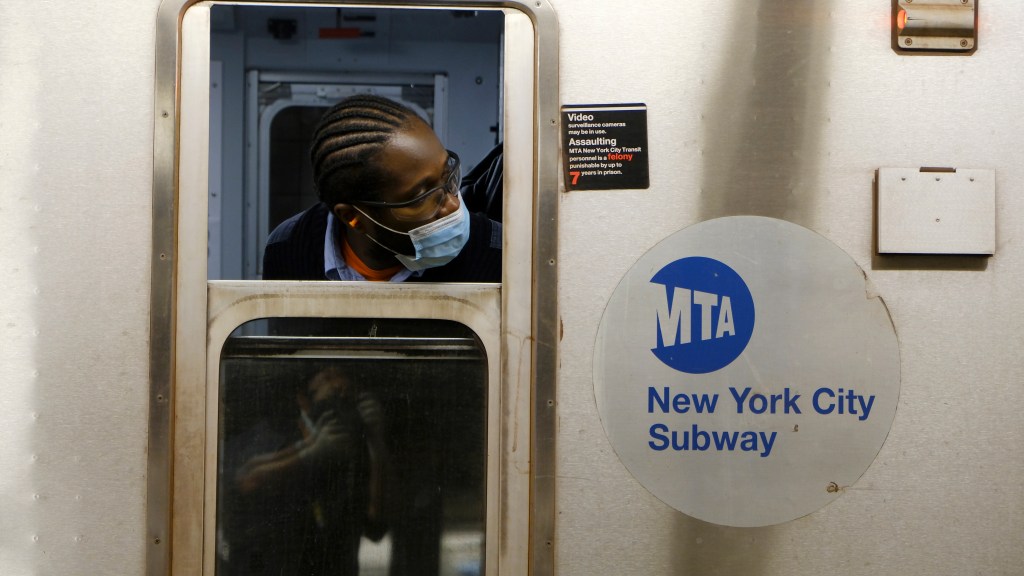
The vast majority of subways in the system are staffed by a crew of two: a conductor stationed mid-train, and a train operator in the forwardmost operating cab.
But some trains — like the gray-bulleted shuttle trains, or weekend service on the G train — run with only a train operator in an arrangement known as “one-person train operation,” or OPTO.
The TWU has historically been opposed to scaling back train crews. OPTO was briefly in place on the L train in 2005 — after the Canarsie line was equipped with modern signals that allowed for significant automation of train operations — but was ultimately abandoned amid contract negotiations with the union.
The MTA has since installed modern signaling for the No. 7 train, portions of the E, M, F and R trains along the Queens Blvd. line, and portions of the F and G along the Culver line in Brooklyn. Modern signals are due to begin operation soon on the Crosstown line — the remainder of the G — as well as on the Eighth Ave. line of the A, C and E.
With the union’s urging, state legislators passed a law last year that would have required all trains — including those already running under OPTO rules — to run with two crew members.
Gov. Hochul vetoed that effort, which would have cost the MTA an estimated $10 million in order to add conductors to the system’s handful of OPTO lines.
Earlier this year, union leaders — who say they expect the MTA to try to expand OPTO during upcoming contract negotiations — pushed for the modified legislation that’s currently in committee, which would allow all trains currently operating under OPTO rules to remain so.
The union has argued that, despite the automation made possible by modern signaling, two-person train crews serve important roles in an emergency and can aid disabled passengers.
The consortium of organizations behind Wednesday’s letter wrote that “[fewer] than 6% of 400 rail lines around the world use two or more train operators,” citing a report written by one of the signatories, NYU’s Marron Institute.
“These systems have operated safely without conductors, or any staff in some cases, on board,” the letter reads.
It costs the MTA roughly $400 million per year to cover payroll and benefits for the New York City subway system’s roughly 3,600 conductors.