
L.A. Dance Project
Romeo & Juliet Suite
Park Avenue Armory
March 2–21, 2026
New York
How do you revamp Romeo and Juliet? Sergei Prokofiev’s notoriously dense and difficult score, first composed in the 1930s, has vexed many choreographers looking to tell the love story anew, but Benjamin Millepied thinks he might have the answer. The founder of the L.A. Dance Project has been refining his company’s Romeo & Juliet Suite since 2022, and in March, the production had its New York City premiere at the Park Avenue Armory. Millepied is a former dance director of the Paris Opera Ballet and lately a mainstay of the American contemporary dance scene, and his solution to the Romeo problem is an audacious one: why not gut-renovate it? After all, Prokofiev was forced to modify his original composition to satisfy the Stalin regime, transforming a spare, modernist score into the unwieldy, traditionalized version we know today. A Romeo more faithful to Prokofiev’s intentions would be lean and propulsive, but formally inventive, too. To distill the ballet in this way would try any choreographer (and only a few—Mark Morris and Matthew Bourne among them—have undertaken similar projects). But it poses an unusual challenge for Millepied, whose complex, interdisciplinary work can hardly be described as minimal. Is he up for the task he’s set himself?
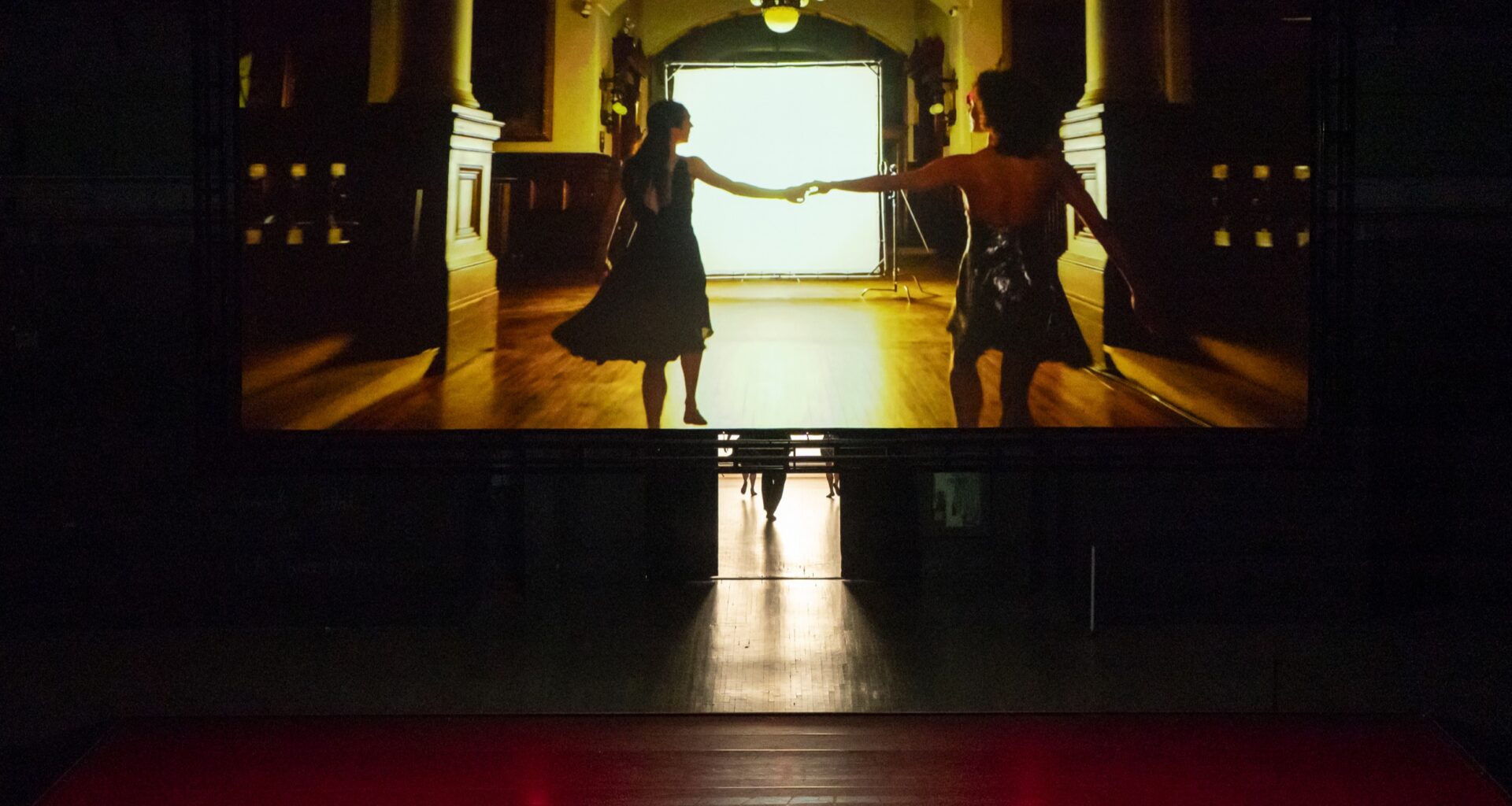
Romeo & Juliet Suite unfolds in a tight eighty-minute stretch, sans intermission. It’s Prokofiev chopped and blended: scenes are roughly rearranged, whole passages scrapped. Gone, too, is the regalia of old Verona. The dancers look like they’ve raided a thrift shop, dressed in anything from cocktail attire to formless sweats; they seem to exist outside of any particular time or place. What they belong to, instead, is the digital realm. Suspended above the stage in the Armory’s drill hall is a large video screen, and just seconds into the performance, a roving cameraman (Sebastien Marcovici) appears to track the dancers’ movements throughout the stately Armory. We see his footage projected: a dancer ambles onto the stage, then dashes off a ramp and into the lobby, where the rest of the cast is gathered. Two principals emerge from the throng, and the camera captures them in close-up, as in an opening credits montage. This is our Romeo and Juliet, who may or may not resemble Shakespeare’s star-crossed lovers: two same-sex couples, along with one heterosexual couple, rotated in the roles during the Armory run.
Millepied’s career began at the New York City Ballet (NYCB), but he found popular success as a Hollywood choreographer—his CV includes Black Swan and Dune—and he has long been interested in the relationship between cinema and dance. Film, for Millepied, is not merely a means of preserving this most transient of art forms, but an essential part of his choreographic process: “another element of making the movement more impactful,” as he put it at a pre-show talk in early March. By setting a cameraman loose amid the action, Millepied draws our gaze to the constituent parts of his choreography: the tensile muscles in Romeo’s arm as it bends and extends; the coy, hopeful glances the couple exchange during their balcony pas de deux. These are the sorts of impressionistic details that are often hard to make out from the audience, and Marcovici—a former NYCB principal himself—has a knack for identifying them, while moving alongside his subjects so fluidly he is nearly imperceptible.
Clearly, this is a Romeo and Juliet for the screen age, and some of its visuals were lovely—like when Marcovici trains the camera on a sleeping Romeo, and Juliet materializes on the stage below him, as if summoned by his dream. But at times, the juxtaposition of onstage dance and on-screen video made me feel as if I were committing the cardinal sin of scrolling on my phone during a live performance. This is because Millepied’s choreography is so Byzantine, and Marcovici’s camerawork is so attuned to it; he swoops and spins just as the dancers do. The doubled effect could be dizzying, and I felt my attention being divided in real time. It comes as something of a relief when the dancers disperse from the stage altogether, and we see only Marcovici’s footage of them elsewhere in the Armory (the famous “Dance of the Knights,” for example, is shunted to an alcove in the back of the hall, outfitted like a miniature speakeasy)—though we then miss out on the unique satisfactions of experiencing dance in the flesh. It’s a strange paradox, and one that Millepied hasn’t quite figured out how to address.