
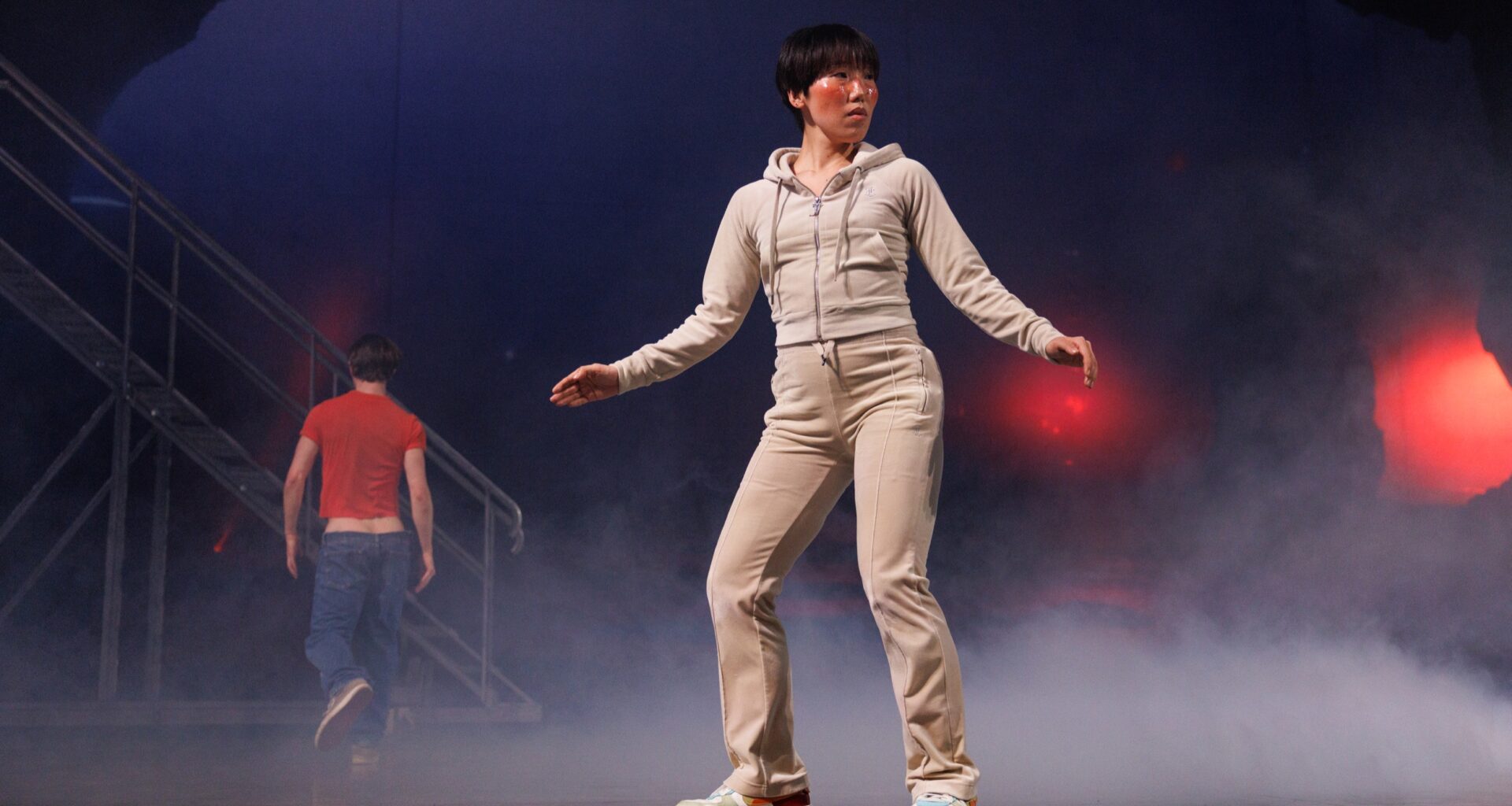
Then they’re all moving backward, disappearing along with the car behind the tan back curtain. The music follows, growing muffled and distant.
Bang. A tile in the ceiling drops open and something falls out—a cloth mannequin?—causing audible gasps in the audience. A dancer in a white sparkly jumpsuit crawls from behind the boxes—now causing laughter—moving like a robot on the moon. We have clearly swiped to another world: a world that looks a lot like a video game, where characters move with exaggerated precision in a perfect imitation of Sims. The curtain opens to reveal a hot-red backdrop (designed by Frederik Heyman) and another man in a red shirt steps out. The others return in eccentric street clothes (by Salomé Poloudenny) and the combat continues, but different this time. It’s less clean. There are more finger guns, simulated shootings, and laughter (hands held up to faces, heads thrown back, bouncing). Dancers grab each other by the mouths, fingers hooked inside cheeks, and puppet each other around. It’s—purposefully, I believe—hard to watch. Age of Content comments on online culture, after all, and that includes our growing desensitization to violent images.
The next time the piece swipes, it’s to a scene more explicitly sexual. Still cartoonish, still flamboyant, but not veiled. Couples climb atop each other and writhe. They bounce each other like basketballs and hump the floor. It all has a masturbatory tone—consensual but not mutual—everyone using each other for their own purposes. (And isn’t that internet culture in a nutshell?)
The final swipe is to a bright, warmly lit land (Eric Wurtz’s lighting design is superb) where joy, or its artifice, abounds and only smiles are allowed. Some of the previous over-the-top choreography continues, but in this new light, and set to Philip Glass’s hypnotic music, it now looks innocent. Yes, they are still pounding crybabys on the floor and pretending to shoot each other, but they are also executing jazzy spins and slides. They shimmy, they bang-bang-bang, they hump, they pas de bourrée. It goes on and on and on, the plastered grins never fading because it’s all great! It’s all okay! Finally, in a Broadway-ish moment, the dancers all form a line at the back of the stage, run at the audience, jump and scream, and then collapse. And… scene.
After, as the audience around me leapt to a standing ovation, I felt exhausted. Confused. Delighted. Still processing. I felt a lot like how I feel after a solid session of doomscrolling. But to have this sensation simulated in a live 3-D performance by a group of incredibly talented and diverse dancers, in a roomful of art-loving people, was the opposite of soul-sucking. It was hopeful.