
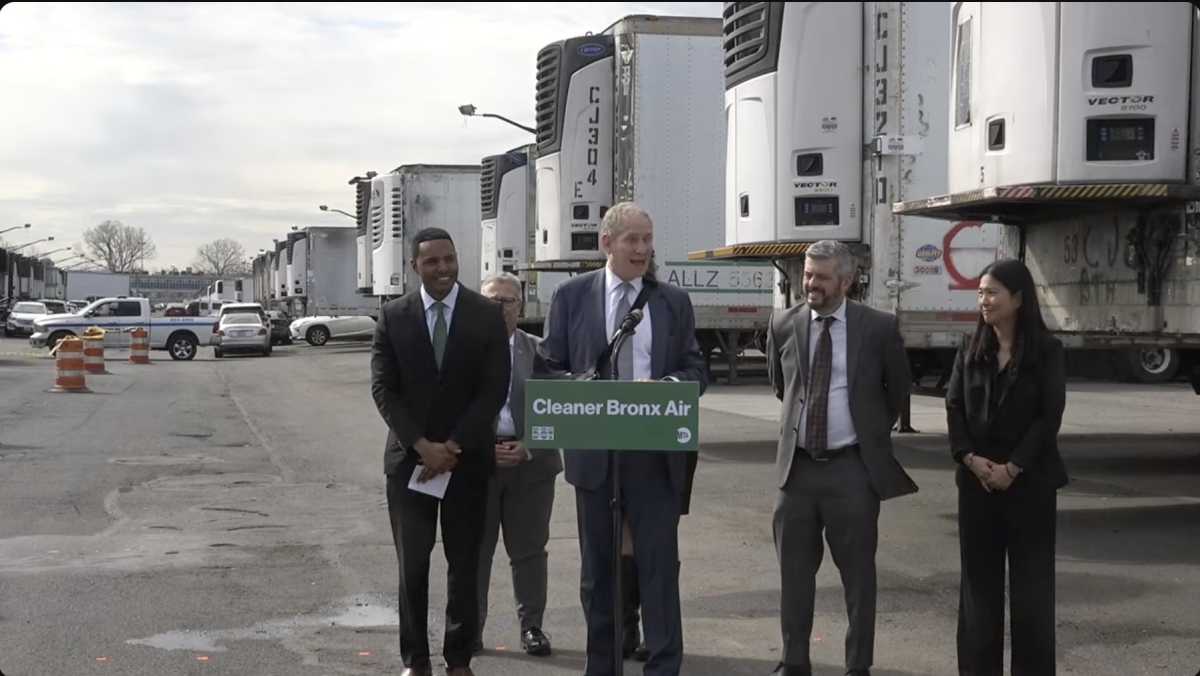
MTA Chair and CEO Janno Lieber announced that the city would begin using congestion pricing funds to replace dirty diesel powered refrigeration trucks with hybrid and low emissions models as part of its mission to reduce air pollution around the city.
Courtesy of the Metropolitan Transit Authority
MTA officials and elected representatives announced Wednesday that they will purchase a new set of 75 hybrid and clean-diesel refrigerated trucks for the Hunts Point Produce Market using revenue collected from the city’s congestion pricing program, promising to drastically reduce carbon emissions in the area.
The investment represented some of the lesser-known priorities of the tolling program, which launched on Jan 5, 2025, and aimed to reduce traffic and pollution on the city’s busiest streets while also raising money for public transit improvements.
U.S. Rep. Ritchie Torres, who serves the South Bronx, praised the commitment, calling it a “monumental breakthrough for public health and environmental justice” and gave credit to MTA Chair and CEO Janno Lieber for making good on investments in the Bronx with congestion pricing revenue.
“He has kept his word,” Torres said. “He’s honored his commitment to the public health of the Bronx.”
Ahead of congestion pricing’s kickoff, residents, leaders and environmental advocates in the Bronx feared the already famously polluted area would suffer increased traffic and pollution because of drivers diverting their routes through the borough to avoid the congestion pricing zone in Manhattan below 60th Street.
Fears of Bronx congestion pricing problems shattered
The MTA’s own environmental assessment of the program estimated that congestion pricing could bring 4,000 additional vehicles into the borough per day from drivers seeking to evade the extra cost.
But officials said the tolling program also included mitigation efforts such as the purchase of cleaner freight vehicles, investments in public health for overburdened communities like neighborhoods in the Bronx, and the creation of more public greenspace to combat CO2 emissions.
Now, more than a year into the tolling program, transit leaders said that fears of excessive overflow traffic into nearby neighborhoods are still unrealized.
The MTA, NYC DOT and Hunter College all studied the change in traffic flow in the Bronx in March of 2025 and found no significant increase in cars or trucks diverting through the borough.
Still, the congestion pricing plan promised to distribute and invest funds with equity in mind, meaning investing in historically overburdened and polluted neighborhoods, especially in the South Bronx.
Transit officials and elected leaders set their eyes on the Hunts Point Produce Market. The sprawling market in the Bronx serves as a transit hub for delivering fresh food to New York City, accounting for about 60% of the fresh produce in the city.
Much of that food is trucked through the use of Transport Refrigeration Units (TRUs) that run on diesel and emit around 15% CO2 than standard vehicles, according to a 2020 study published in the journal, Science of The Total Environment.
City Council Member Justin Sanchez, who represents Hunts Point, said that all of the freight deliveries out of the market came with a cost to the residents.
“The unfortunate reality is that those same trucks that nourish our city are the ones that have burdened our community for generations,” Sanchez said.
Torres said the South Bronx was particularly susceptible to air pollution, contributing to the state’s highest asthma hospitalization rates, according to the NYS Department of Health.
“If you live in ‘Asthma Alley’ surrounded by a thousand TRUs, you are breathing some of the most polluted air in New York City,” Torres said.
Transit officials said that’s why replacing the TRUs at the market with cleaner energy models has the potential to drastically reduce emissions in the South Bronx.
While additional community investments have yet to be finalized, Lieber promised that more concrete solutions to cleaner air would be forthcoming and involve collaboration from all levels of government.
“Its no secret that congestion pricing was very controversial,” Lieber said. “But in using it to solve problems, we have great partners and we still do in the city of New York, in Congress and in the council.”
Watch the announcement here:
Reach Sadie Brown at sbrown@schnepsmedia.com. For more coverage, subscribe to our newsletter and follow us on X, Facebook and Instagram!