
Made in America: The Industrial Photography of Christopher Payne
Cooper Hewitt, Smithsonian Design Museum
December 12, 2025–September 27, 2026
New York
Made in America: The Industrial Photography of Christopher Payne, a solo exhibition now on view at the Cooper Hewitt, is, in the photographer’s own words, “a celebration of the making of things.” Indeed, in his visits to American factories, Payne has documented machinery, workers, techniques, and the materials of manufacture—but as the era of workers making things in America draws to a close, we might ask what these photographs really represent. Those of us who lived through some portion of the industrial age’s apotheosis, and enjoyed the surfeit of manufactured products it provided, were taught by photography to admire the power and promise of technology and industry. In newspapers, magazines, textbooks, and corporate annual reports, photography shaped our image of factories and, with it, our admiration for them.
Industrial photography has long celebrated repetition, scale, and precision. Early factory photographs, however static and posed, established a vocabulary of order and colossal scale. Photographs made in 1913 at the Ford plant where moving assembly lines for automobile manufacturing were first implemented illustrated the potential of mass production: rows of men stand at their work stations; ranks of identical car chassis and bodies recede diagonally into depth, a compositional formula that would be repeated for decades. For the rest of the twentieth century, photography hewed to variations of this theme. Precision machinery, dedicated workers, and reverence for mass production were the order of the day. Year after year, industry was presented as orderly, powerful, and abundant. Rows of identical fuselages, artillery shells, tanks, and bombs receding in clear perspective signified national strength. During World War II, such imagery functioned as both documentation and propaganda, suggesting that America’s manufacturing capacity would secure victory and, afterward, prosperity. That celebration of industrial promise remains visible in Payne’s work.
What distinguishes Payne’s photographs is not their departure from this tradition but their refinement of it. Equipped with contemporary cameras capable of extraordinary fidelity, he renders machinery and materials with remarkable clarity. The large-scale prints at Cooper Hewitt are impeccably sharp, their lighting meticulous. They present vignettes of the American factory worker making products that, in an era when “Made in USA” carried particular weight, ranked among the best in the world. Payne’s photographs attain that kind of excellence, exalting the act of manufacture itself.
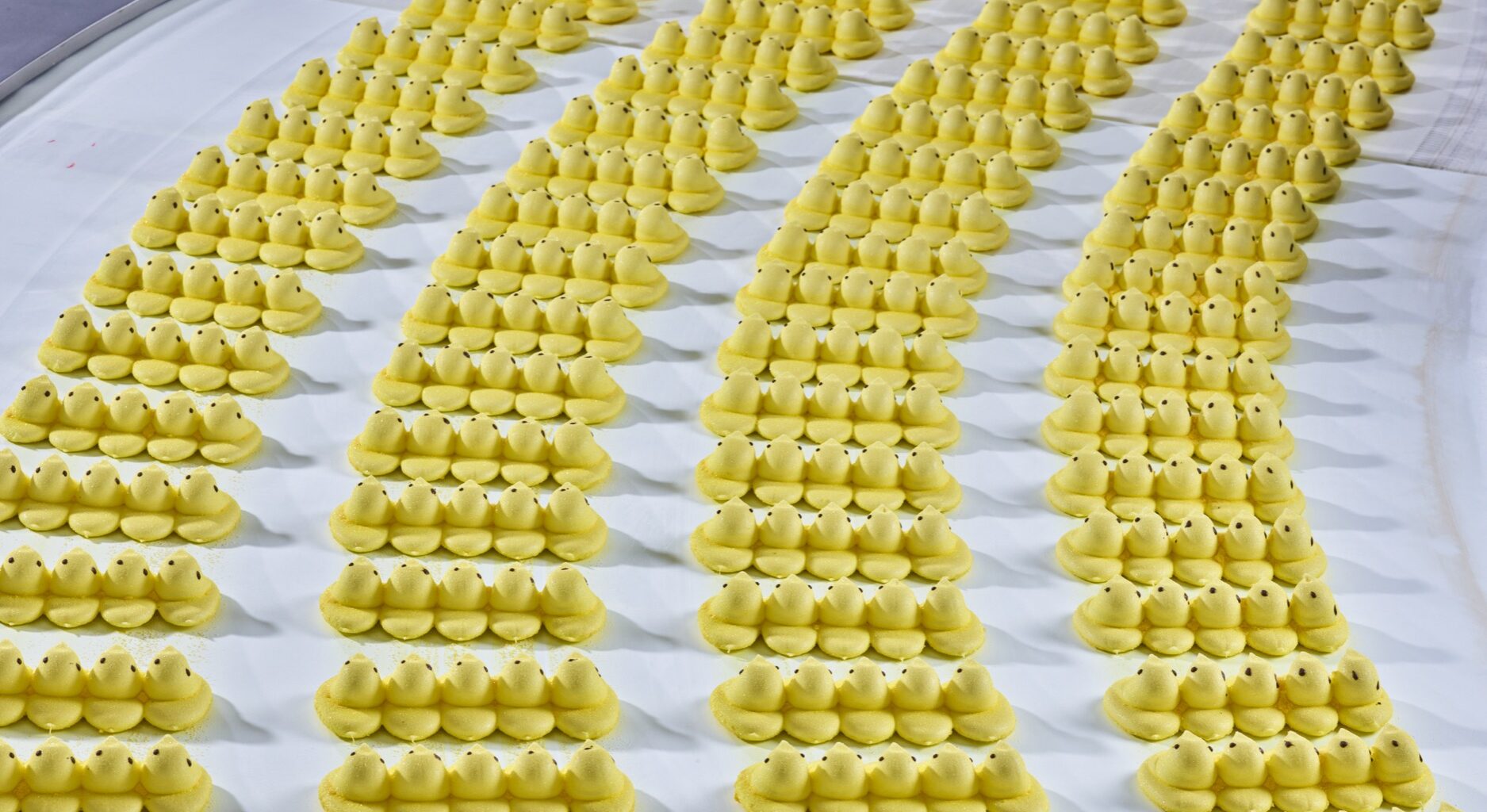
Repetition and pronounced perspective recur throughout the exhibition. Peeps Marshmallow Chicks winding along a conveyor belt in a gentle S-curve have immediate appeal—nostalgic to some, ironic to others. Payne’s low, raking light defines their brilliant yellow forms and casts complementary shadows that give each confection sculptural presence. The range of manufacturing on view spans eras, from antique pencil- and hat-making machinery to advanced aerospace and technological production.