
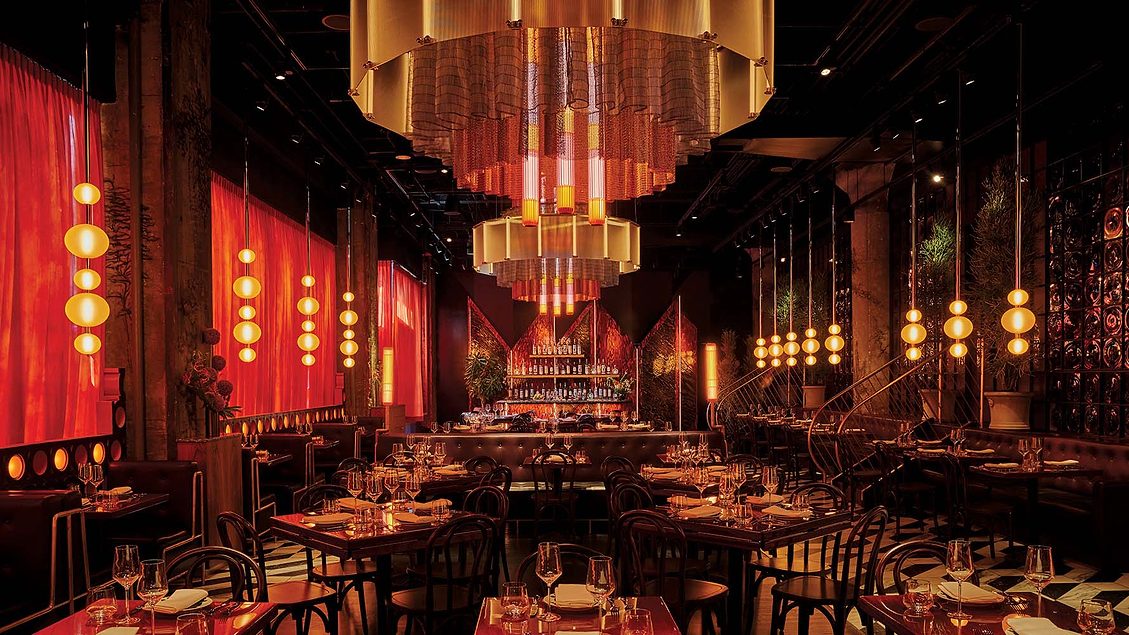
The intersection of 34th Street and Ninth Avenue in Manhattan is far from tranquil. Midtown traffic barrels and bellows, office workers stream between Penn Station and Hudson Yards, and, somewhere, construction equipment inevitably roars. But at Limusina, a Mexican restaurant designed by Brooklyn-based GRT Architects inside a formerly derelict loading dock and garage, a riot of sumptuous detailing and a well-choreographed layout renders that hubbub worlds away, as suggested by its name, which means limousine in Spanish.
Hospitality group Quality Branded approached GRT in 2024—the two had collaborated on the design of several eateries, including Bad Roman, an equally brazen Italian restaurant in New York City that opened its doors in 2023.
“The work that we have completed with Quality Branded is maximal and kind of intense,” says Rustam Mehta, GRT founding partner. “They push us to experiment, and this project afforded that opportunity in spades.”
Limusina’s 8,200-square-foot space is located within a brick-clad warehouse built in 1962. A redevelopment in 2019 adapted the eight-story structure as the podium of an office tower. Despite the site’s transformation, this cavernous ground-level expanse—heavily stained in oil and soot—remained largely untouched and vacant for years.
1
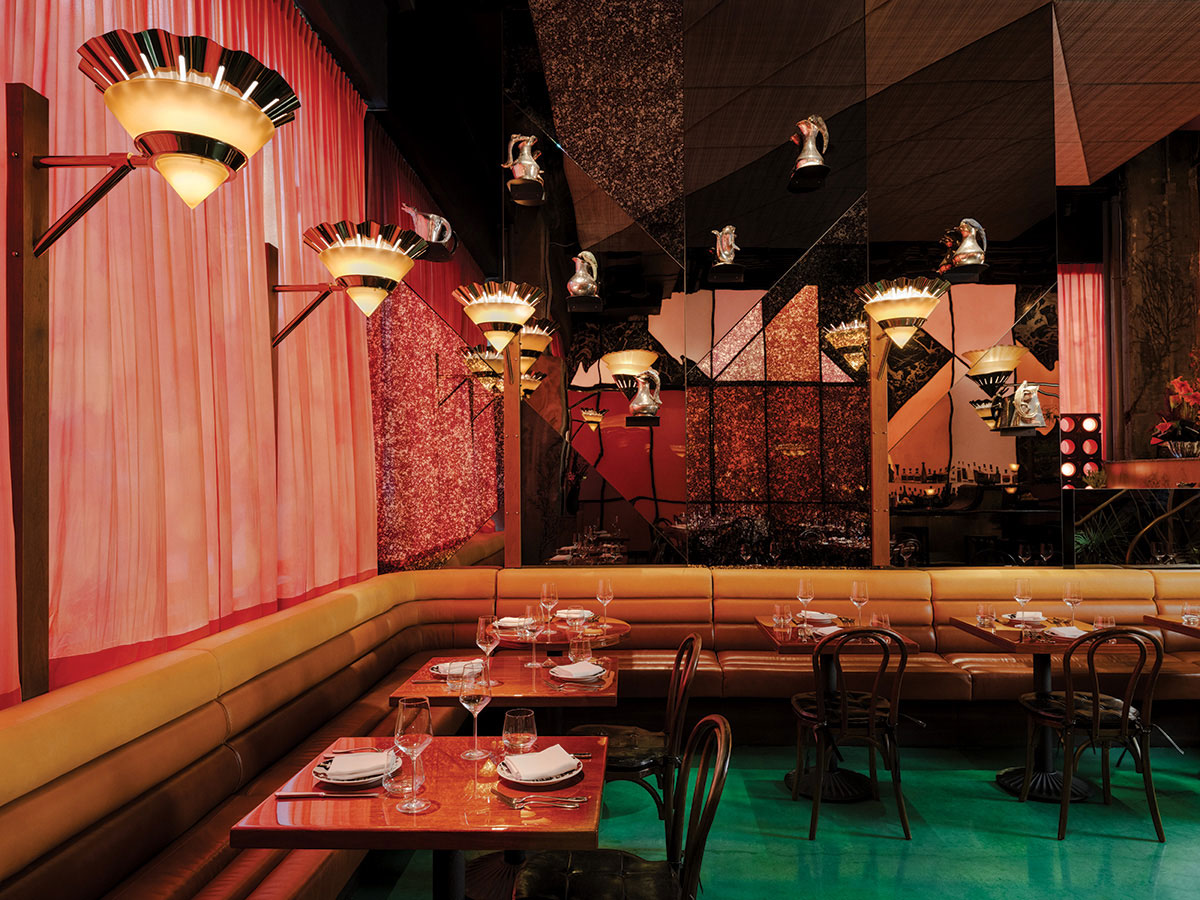
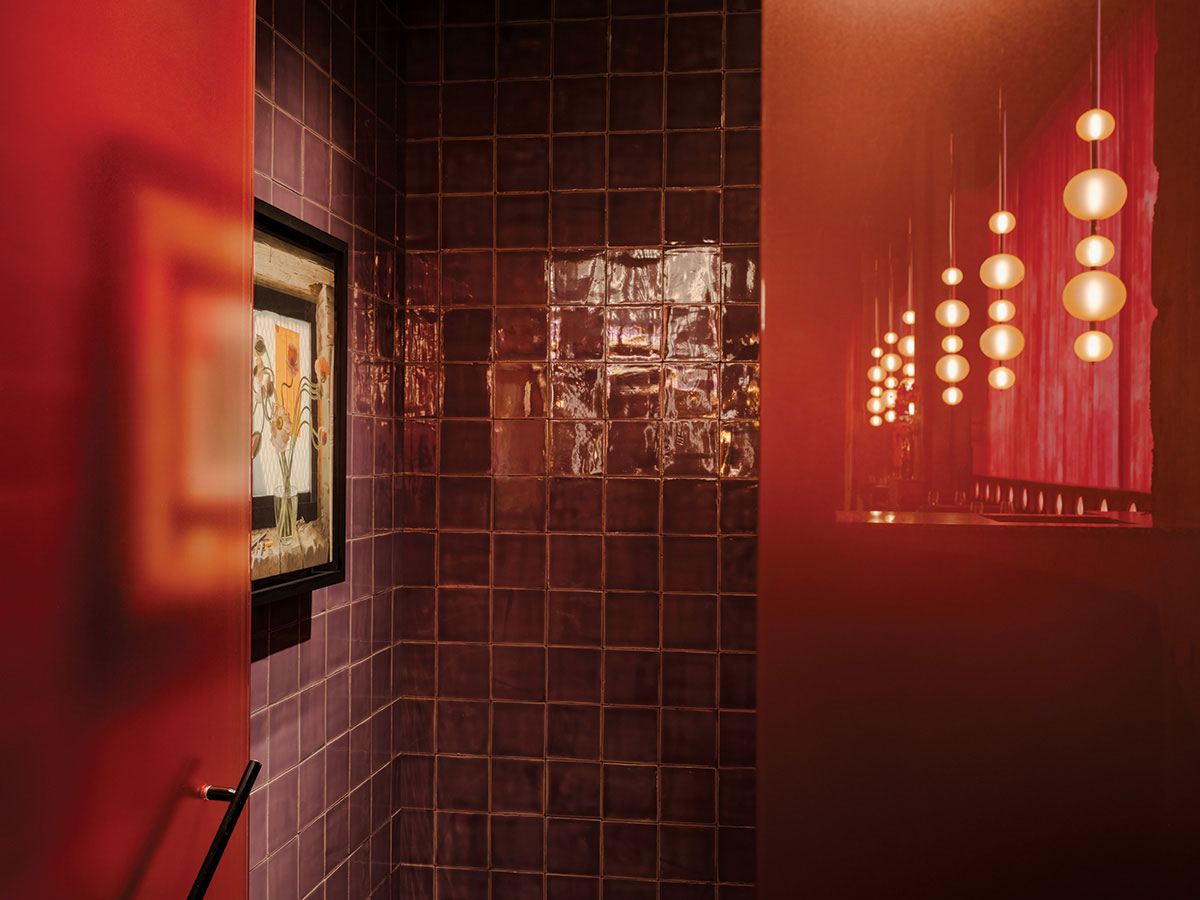
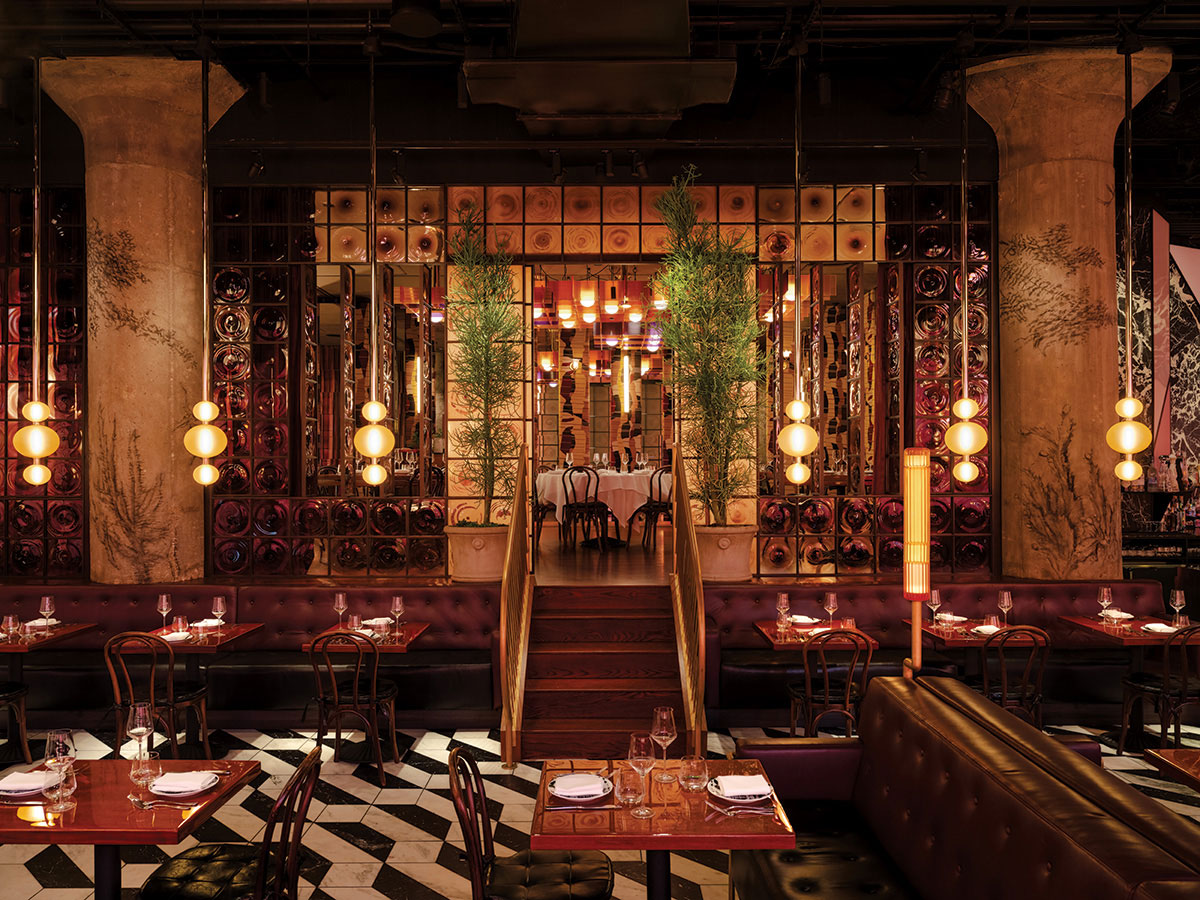
Red and purple saturate the interior (1 & 2). Photos © Brian W. Ferry
2
A major obstacle to the space’s present-day repositioning was its significantly sloped floor: the central area had a nearly 2-foot difference in elevation from end to end, and two ancillary spaces, one to the north and another to the east, were approximately 3 feet higher and 2 feet lower, respectively. For the design team, that sectional complexity provided an opportunity to create varied zones throughout the restaurant. The sloped floor was leveled with concrete to serve as the main dining area, while the ancillary spaces can be used for both private events and regular turnover. “This project was very much a three-dimensional puzzle to work out,” notes Mehta.
The entrance is positioned on the site’s southeast corner and leads to a foyer surfaced with glazed aubergine-colored tiles. To this antechamber’s immediate left is the primary dining area, which is accessed through a set of translucent, bright-red glass partitions. A similar treatment is applied to the storefront windows, in the form of diaphanous curtains that filter daylight and obscure outdoor commotion.
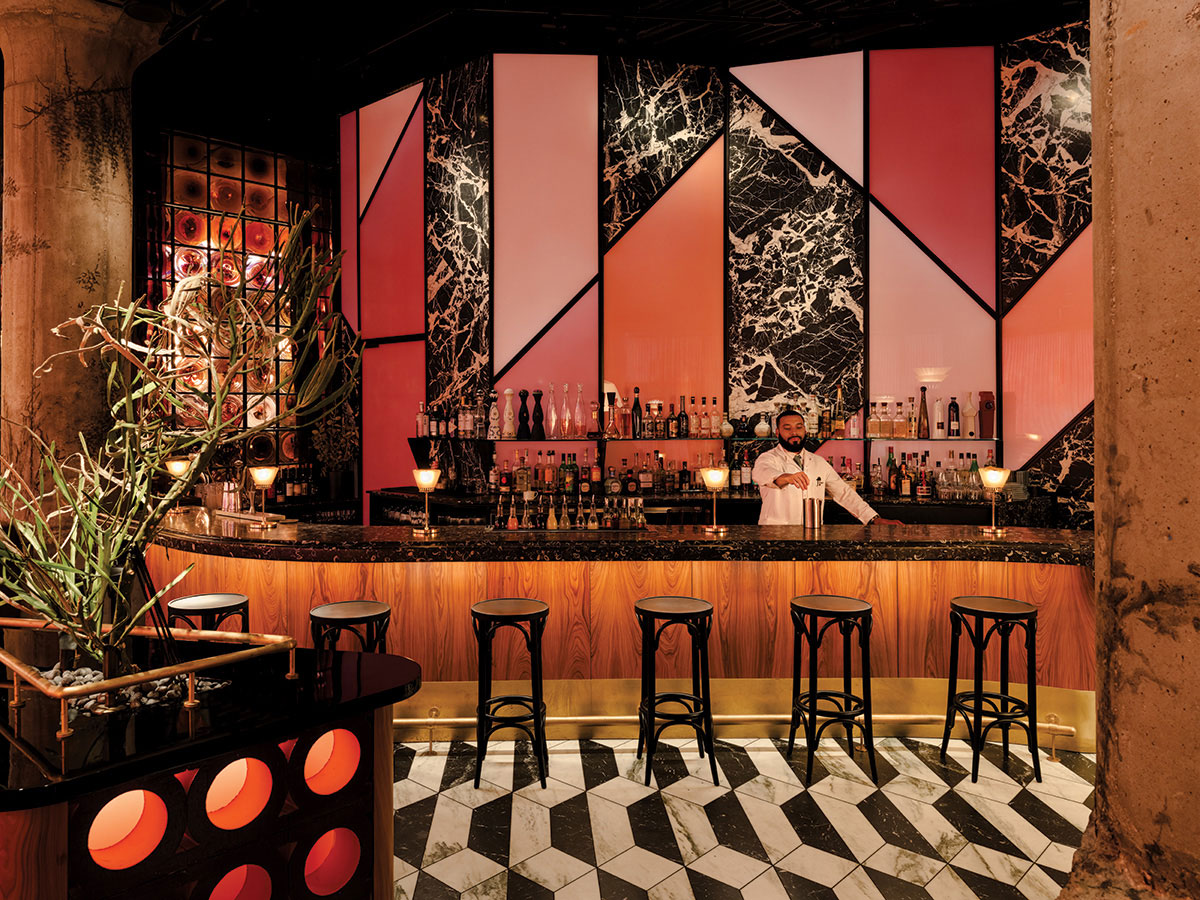
The first few steps into the restaurant’s main hall are a revelry of conspicuous materials, often used inventively. The room is anchored by an expansive bar, topped with black shell stone slabs that curve and step to meet Limusina’s changes in grade. It is backed by a faceted wall of light boxes and dark marble. Throughout, concrete breeze blocks integrated with lighting form banquettes and partitions. Black-and-white marble slabs arranged in a trapezoid-and-square pattern line the floor. A service bar, placed at the western edge of the restaurant, consists of glossy plywood panels painted by hand to exaggerate the wood’s grain. The existing concrete columns were kept exposed but now feature hand-painted floral motifs. All these details are sensually illuminated by spherical pendant lamps and two 8-foot-wide chandeliers of concentrically arranged rings of fluted-glass panels, fabric and copper-chain metal mesh, and tubular bulbs.
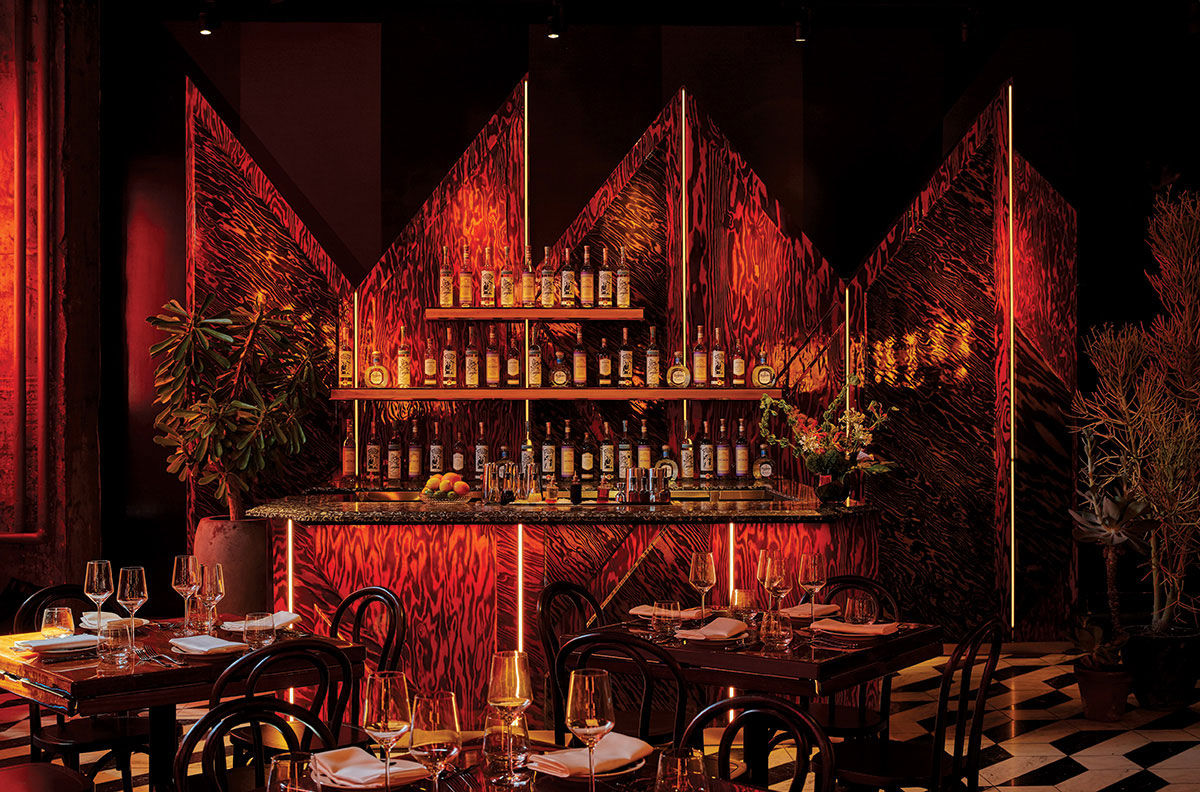
The service bar is built of plywood panels. Photo © Christian Harder
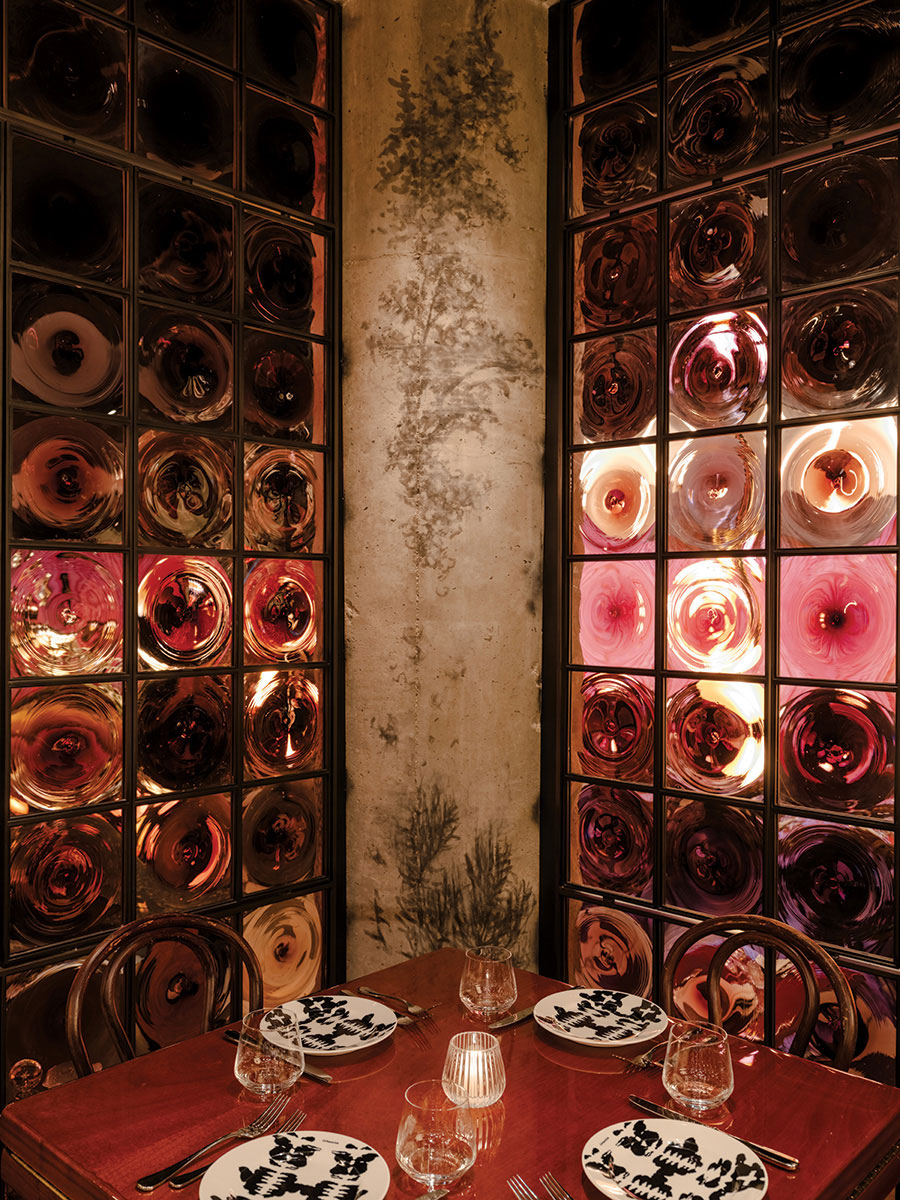
One of the ancillary dining spaces, a former loading dock perched a few feet higher than the main dining area, doubles as a private event space. It is ensconced in an operable screen of light-purple blown glass that, when open, offers a prime vantage point for people-watching. Here the walls are covered in patterned dyed leather; overhead, lamps placed within a colored acrylic grid bathe the room in a warm glow.
3
Blown-glass partitions enclose the uppermost dining space (3 & 4). Photos © Brian W. Ferry
4
Another auxiliary area, positioned at the restaurant’s lowest point, is dubbed “the pool.” Fittingly, its floor is a deep turquoise, an effect created by acid washing the concrete floor. “It’s a chemical reaction where you have no idea what will happen once the concrete absorbs the substance, and then another reaction occurs once you seal it,” explains Mehta. A section of the “pool” area can be made private by using a set of sliding glass doors; its walls are surfaced with red travertine blocks treated with a purple fill.
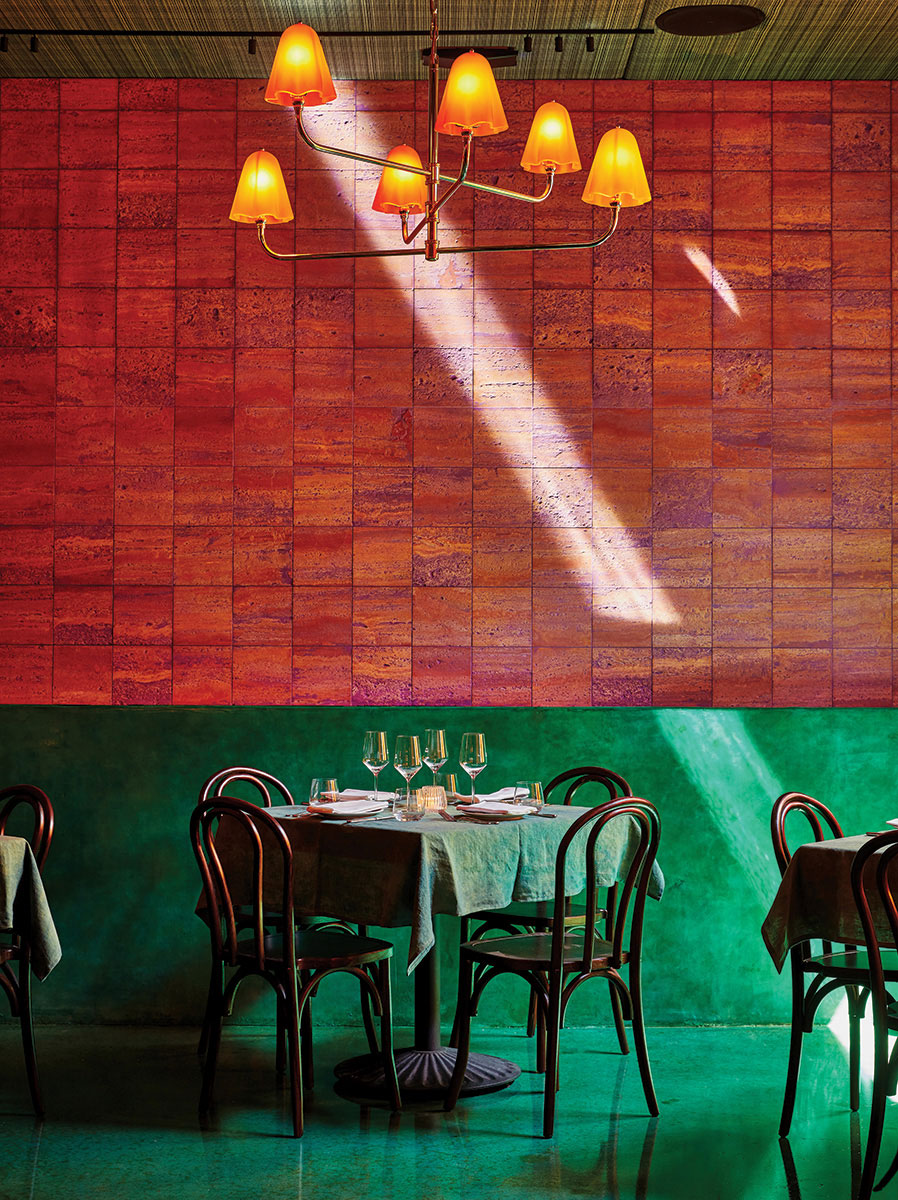
Red travertine blocks with a purple fill surface one room’s walls. Photo © Christian Harder
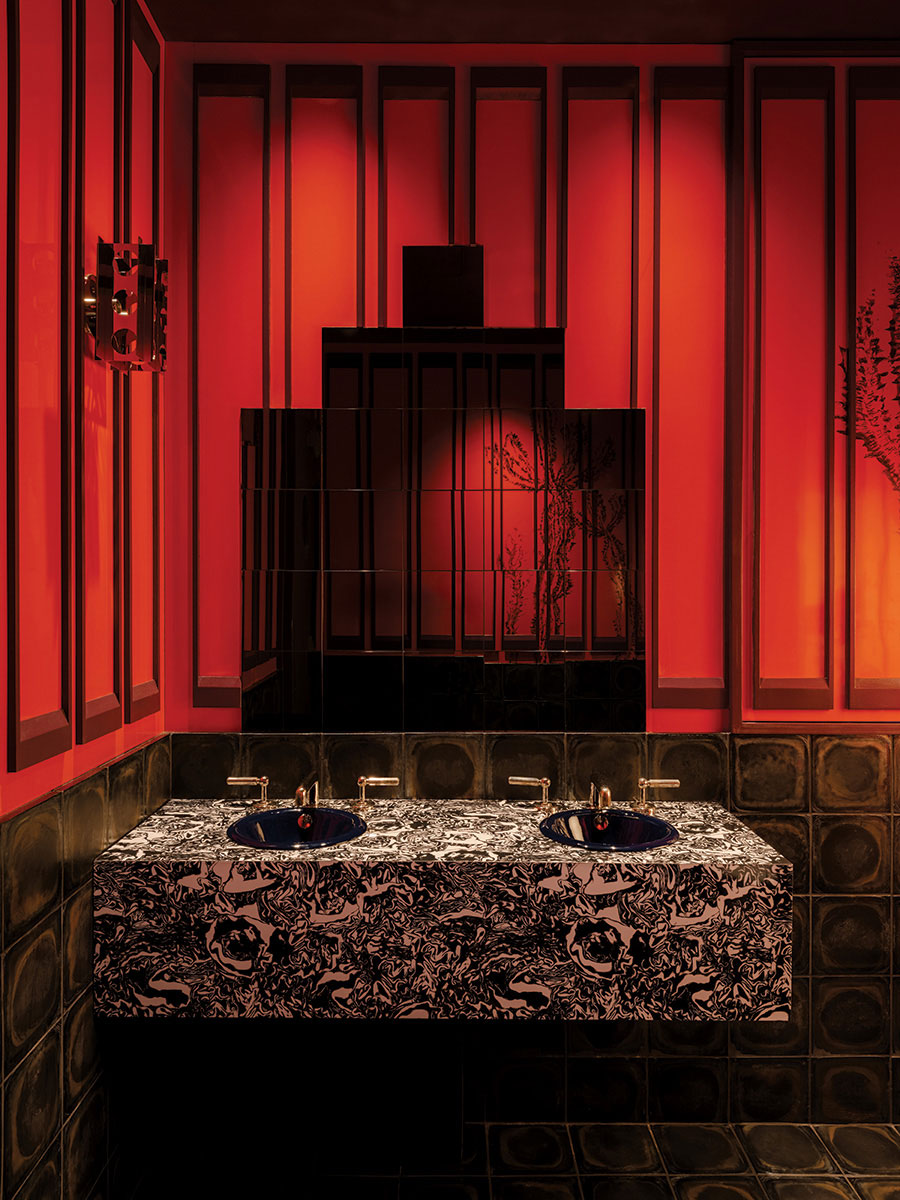
Phenolic laminate is used for bathroom vanities. Photo © Brian W. Ferry
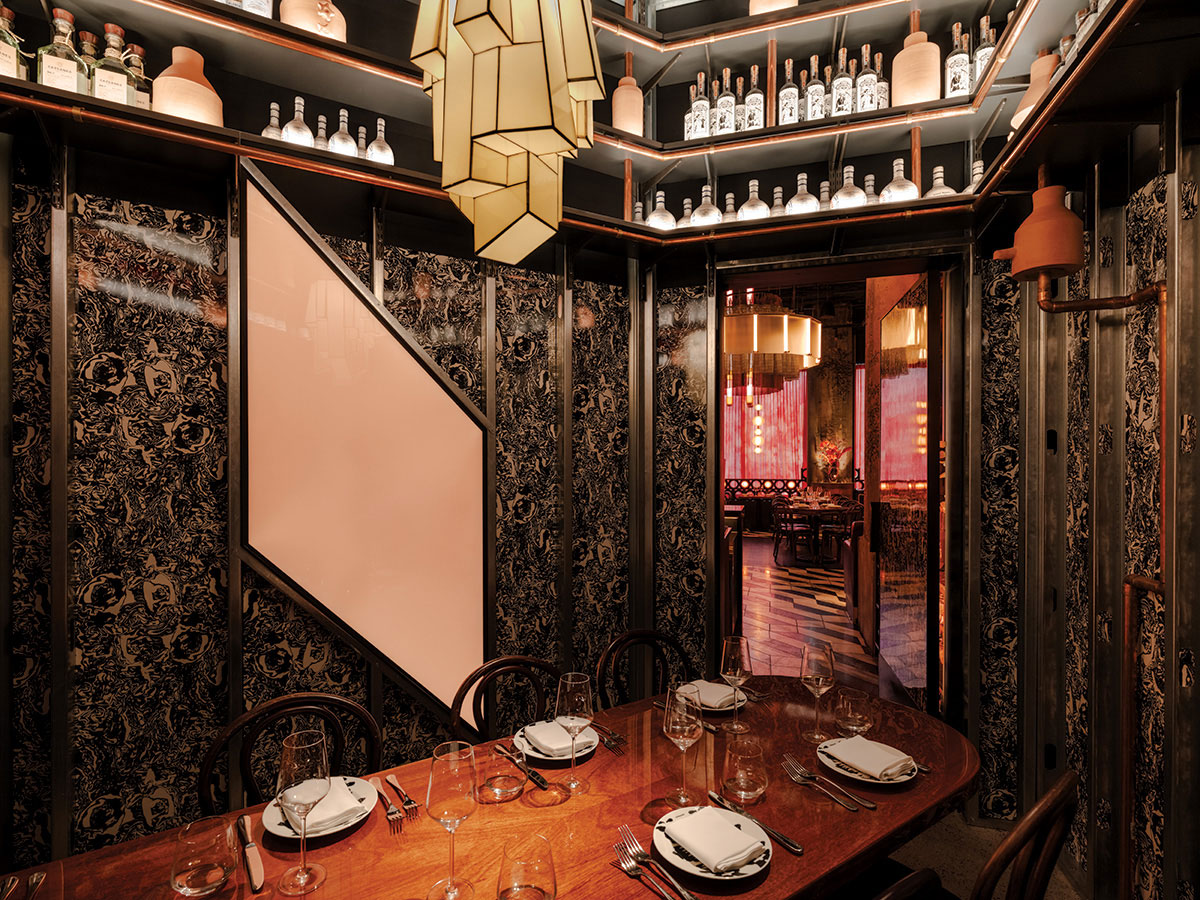
The same level of detail found in the dining spaces is applied elsewhere in the restaurant. In the restrooms, cast basalt tiles are used for flooring and wainscoting, and a striking phenolic laminate, which resembles something of a metamorphic rock with cabbage-like veining, covers the floating vanities. A one-table private dining space with a speakeasy ambience, accessed through the main bar’s backdrop, is lined in the same material.
5
The primary bar’s faceted backdrop (5) shrouds a private dining room (6). Photos © Brian W. Ferry
6
Limusina is not for those seeking an understated dining experience. GRT Architects’ many gestures are delightfully extravagant and demonstrate a deep understanding of how to blend opulent materials to create a space worth lingering in. “Maximalism, when done wrong, is going to look like a strip club,” states Mehta. “It must have subtlety and an antigravity feeling. That leads to a retro-futuristic whole.”
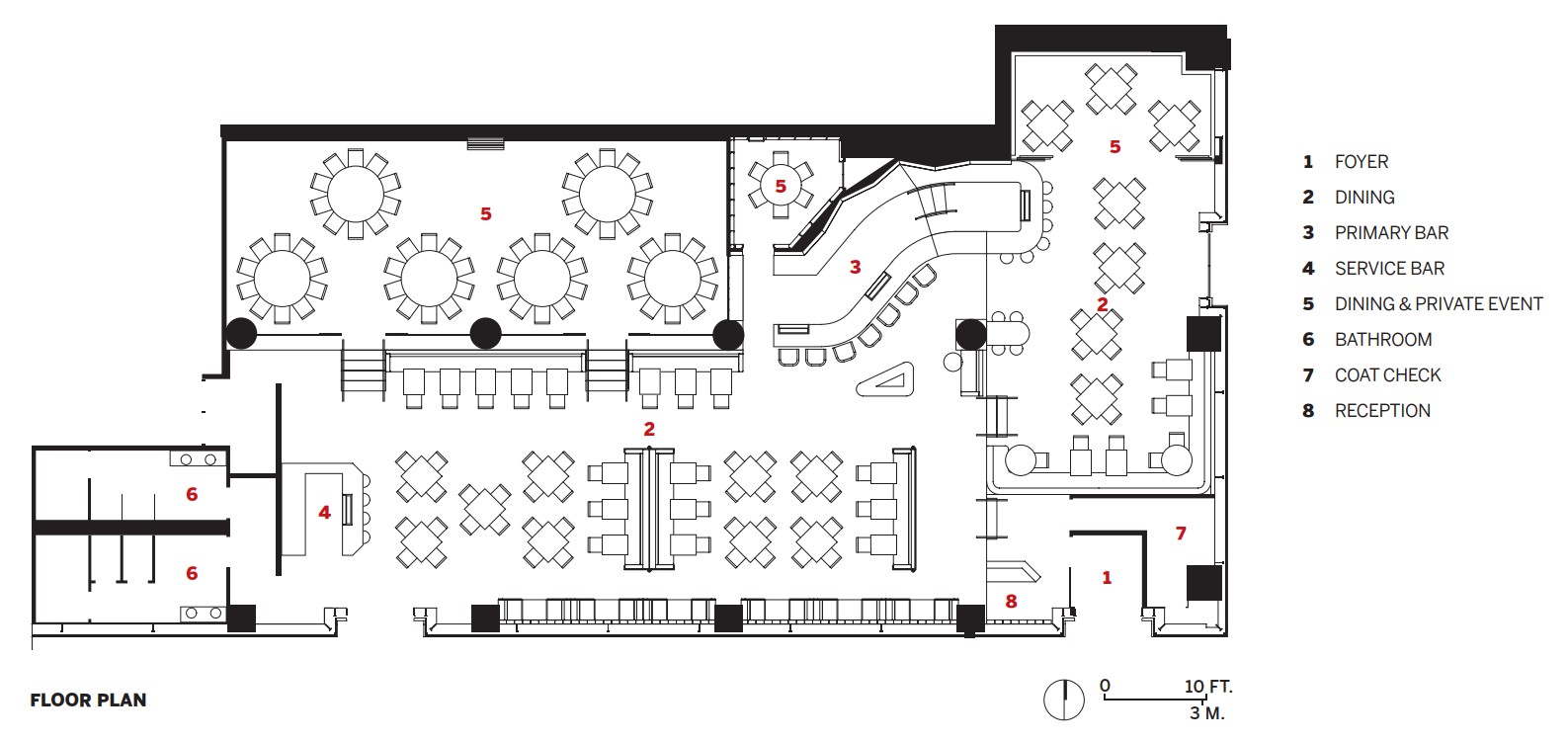
Image courtesy GRT Architects
Credits
Interior Designer:
GRT Architects — Rustam Mehta, Tal Schori, founding partners
Executive Architect:
NuZine
Architect of Record:
ASDA Design & Architecture
Engineers:
B2 Engineering (MEP); A Degree of Freedom (structural)
Consultant:
Focus Lighting
General Contractor:
Nicon Build
Client:
Quality Branded
Size:
8,200 square feet
Cost:
Withheld
Completion:
September 2025
Sources
Custom Upholstery:
Walls Studio
Demountable Partitions:
Modernfold
Cabinetwork and Custom Woodwork:
Quality Wood Design
Paneling:
Hollander Glass (mirrors); Forms + Surfaces (stainless steel)
Plastic Laminate:
Abet Laminati
Floor and Wall Tile:
ABC Stone (marble); CBP Engineering (basalt)
Hand-Blown Glass:
Monarch Glass Studio
Lighting:
Acclaim Lighting, Tivoli (linear); Solais, MP Lighting (accents); Folio (light boxes)