
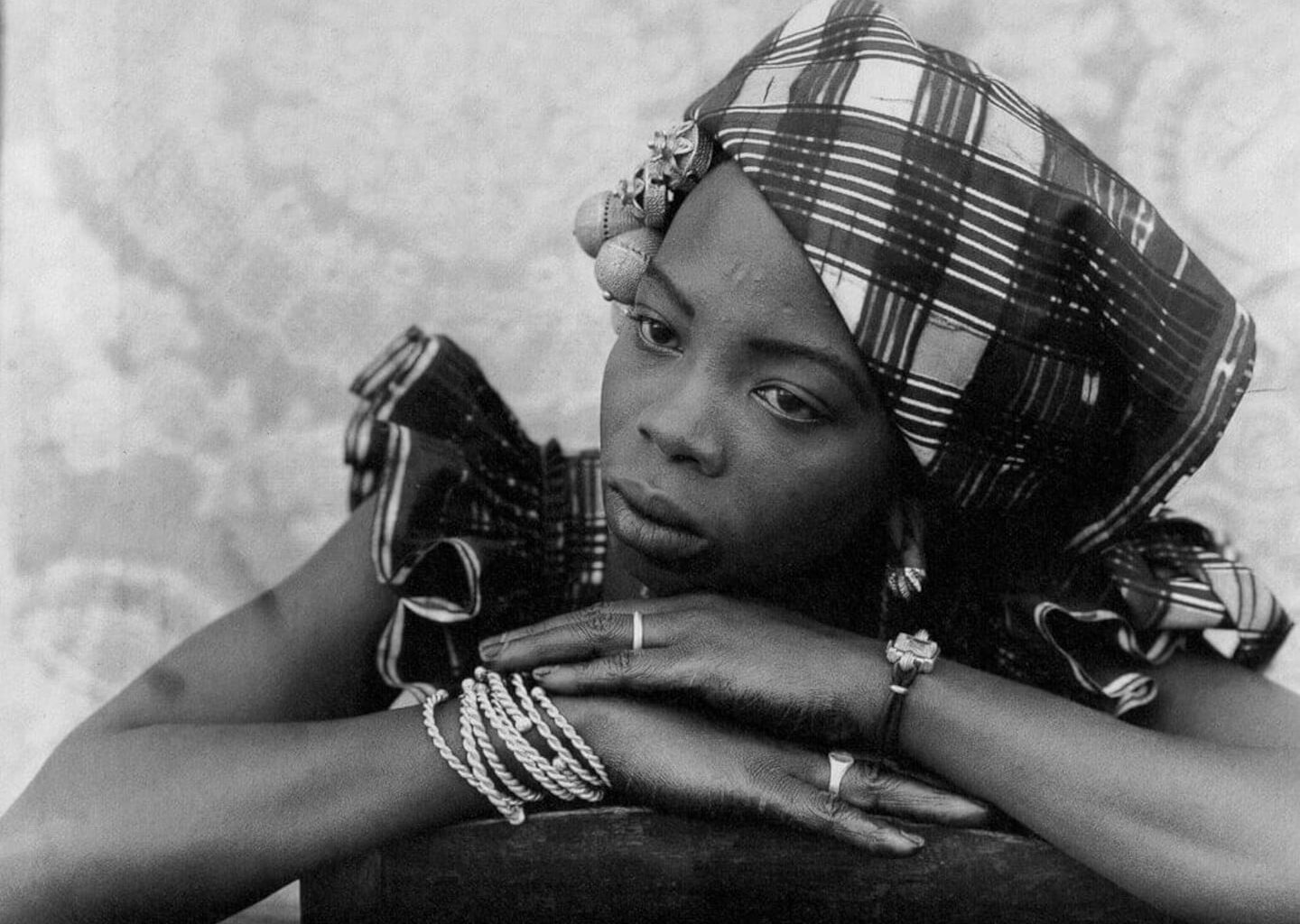
Within the larger miracle that is the medium, smaller, specific miracles occur: Robert Frank reducing 27,000+ exposures to 83 photographs, for “The Americans”; Henri Cartier-Bresson finding himself in so many right places at so many right times, resulting in so many decisive moments; or Seydou Keïta (1921-2001) in a single right place (Bamako, the capital of Mali) for an extended right time (from the late 1940s and into the early ’60s) specializing in something so basic as the studio portrait and transforming it into a theme and variations of near-constant vibrancy and vividness.
As much celebration as retrospective, “Seydou Keïta: A Tactile Lens” runs at the Brooklyn Museum through May 17. It includes nearly 300 items — not just photographs, but fabrics, dresses and other garments, jewelry, and, closer to home, five of Keïta’s cameras, several pairs of his eyeglasses, his national identity card. Even if the several self-portraits on display didn’t give a sense of his personality, and they do, these possessions would.
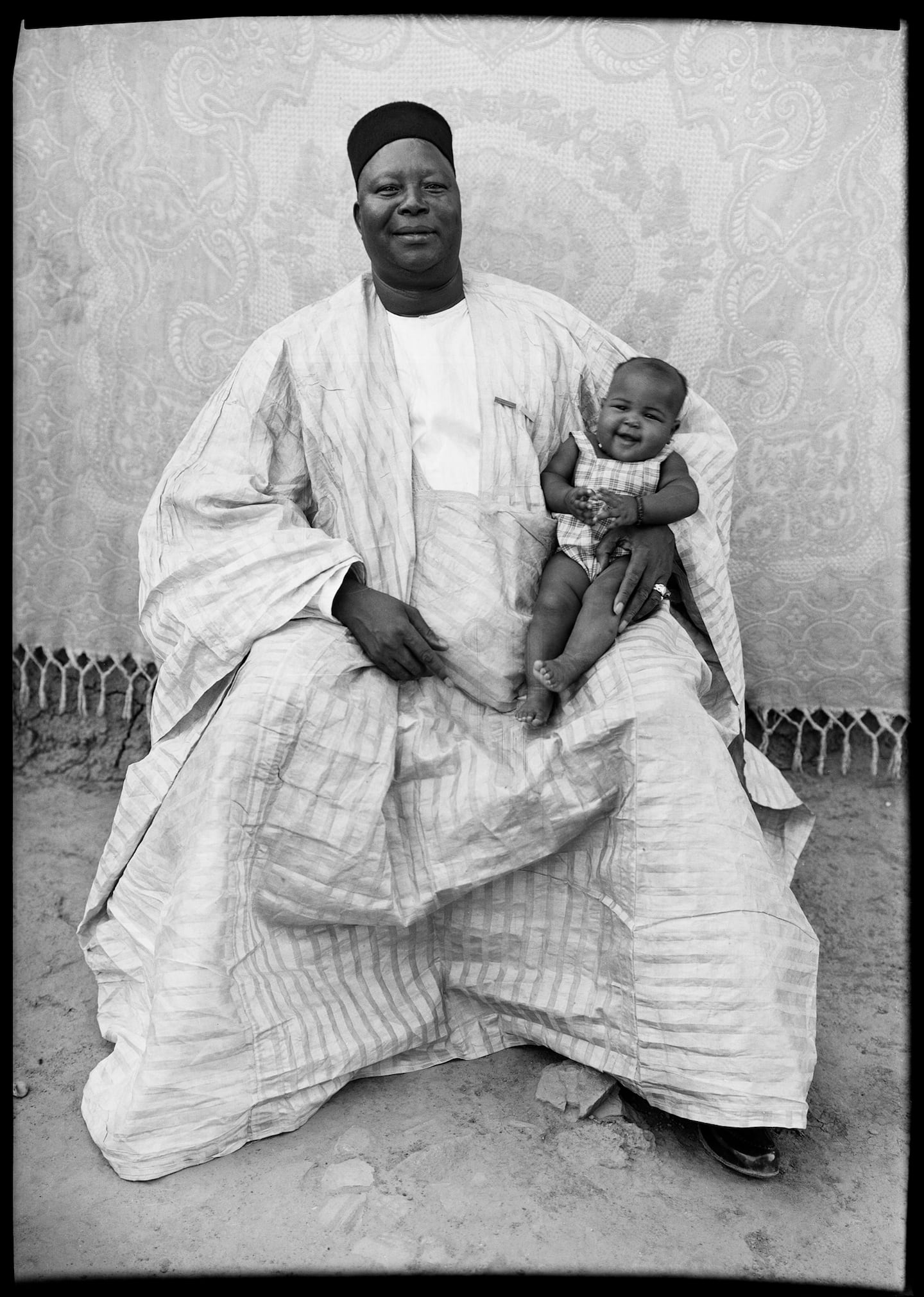 Seydou Keïta, “Untitled,” 1949-51.Courtesy of the Jean Pigozzi African Art Collection © SKPEAC/Seydou Keïta, courtesy the Jean Pigozzi African Art Collection and Danziger Gallery, N.Y.
That word “tactile” in the subtitle takes on two meanings. One is how fully Keïta’s portraits give a sense of his sitters: It verges on, yes, tactility. The other meaning relates to one of the chief means he used to make his portraits so memorable: the gorgeous designs of the fabrics worn by many of those sitters and of the textiles Keïta sometimes used as background. They offer a riot of patterning. Delightful to look at in their own right, those fabrics and the clothing being in the show adds to an appreciation of the photographs.
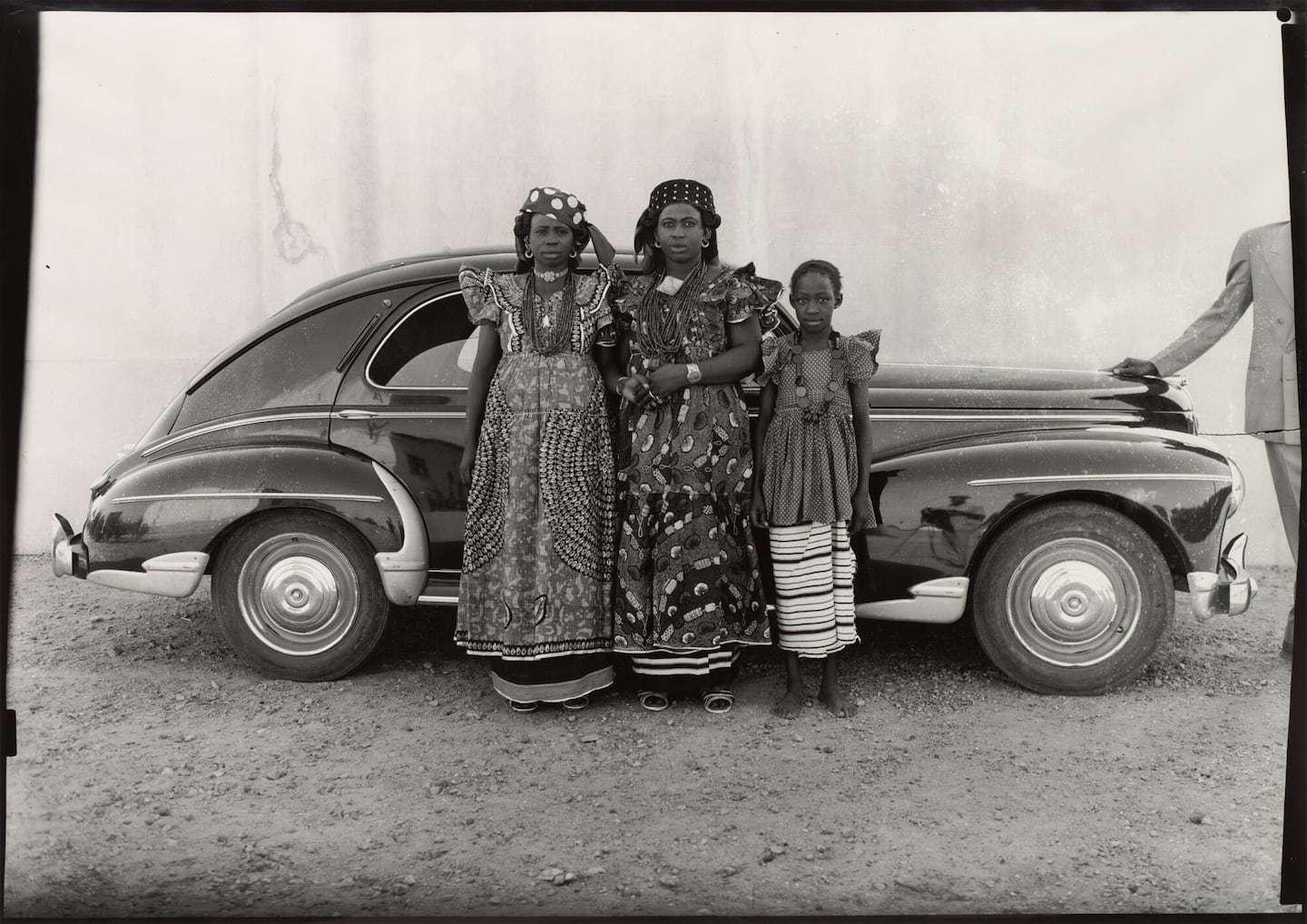 Seydou Keïta, “Untitled,” 1954.Museum of Modern Art/The Museum of Modern Art, New Yo
Go back for a moment to Frank and Cartier-Bresson. Those miracles were the product of extensive travel. So much of Keïta’s miraculousness has to do with his doing his work in not just a single place but a single space, his studio. There are more than 30,000 negatives in his archive, and we can be certain he took many more that didn’t survive. One would think that with such a very large body of work in a single genre, there would be an inevitable repetitiveness. Instead, the sheer variety of the portraits is (almost) as impressive as their quality.
How did Keïta do it? He was as much stage manager, set designer, and even costumer as photographer. Looking at the portraits can become a kind of game, noting the ways Keïta avoids sameness. It starts, of course, with how Keïta posed his subjects and the backgrounds he posed them against. But it extends to hats and headgear (kepis, berets, toques, pith helmets, a burnoose), both European and traditional attire, scarves, jewelry, handbags, uniforms (military and athletic), an accordion, a Singer sewing machine, a rifle.
And that’s just what his clients brought to the sitting. “I also had accessories available,” Keïta recalled: “watches, fountain pens, watch chains, plastic flowers, a radio, a telephone, a scooter, a bicycle, and an alarm clock. A lot of people liked to be photographed with that kind of thing.”
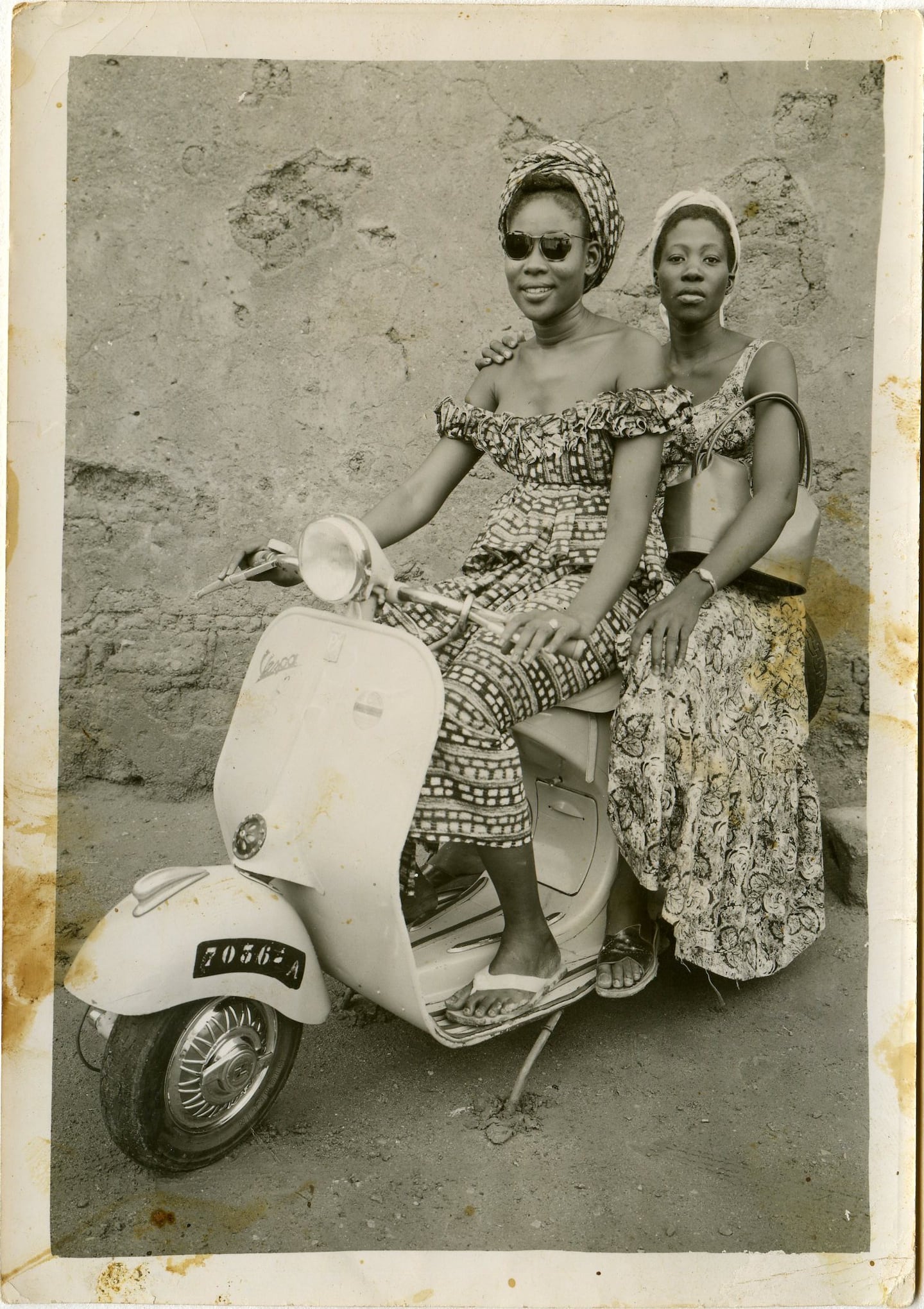 Seydou Keïta, “Untitled,” 1957.Courtesy of the Jean Pigozzi African Art Collection. ©SKPEAC/Seydou Keïta, the Jean Pigozzi African Art Collection and Danziger Gallery,
Keïta charged 300 francs for portraits outside his studio and 400 for inside. His best-known photograph was taken outside. It shows two young women seated on Keïta’s Vespa. (He also owned a much-loved Peugeot; he used that as a prop, too.) The woman in front wears sunglasses. The other stares at the camera. The intricate designs of their dresses jump out from the blank background and the whiteness of the scooter. There such a sense of impending … fun. The kickstand is down, but once it’s up — whoosh — off they’d go.
“How did I know my work was special?” Keïta asked in a 1997 interview. “Everyone wanted me to do their portrait, and everyone would come back afterward and say, ‘Hey, Seydou, my personality really comes through in that picture you took.’”
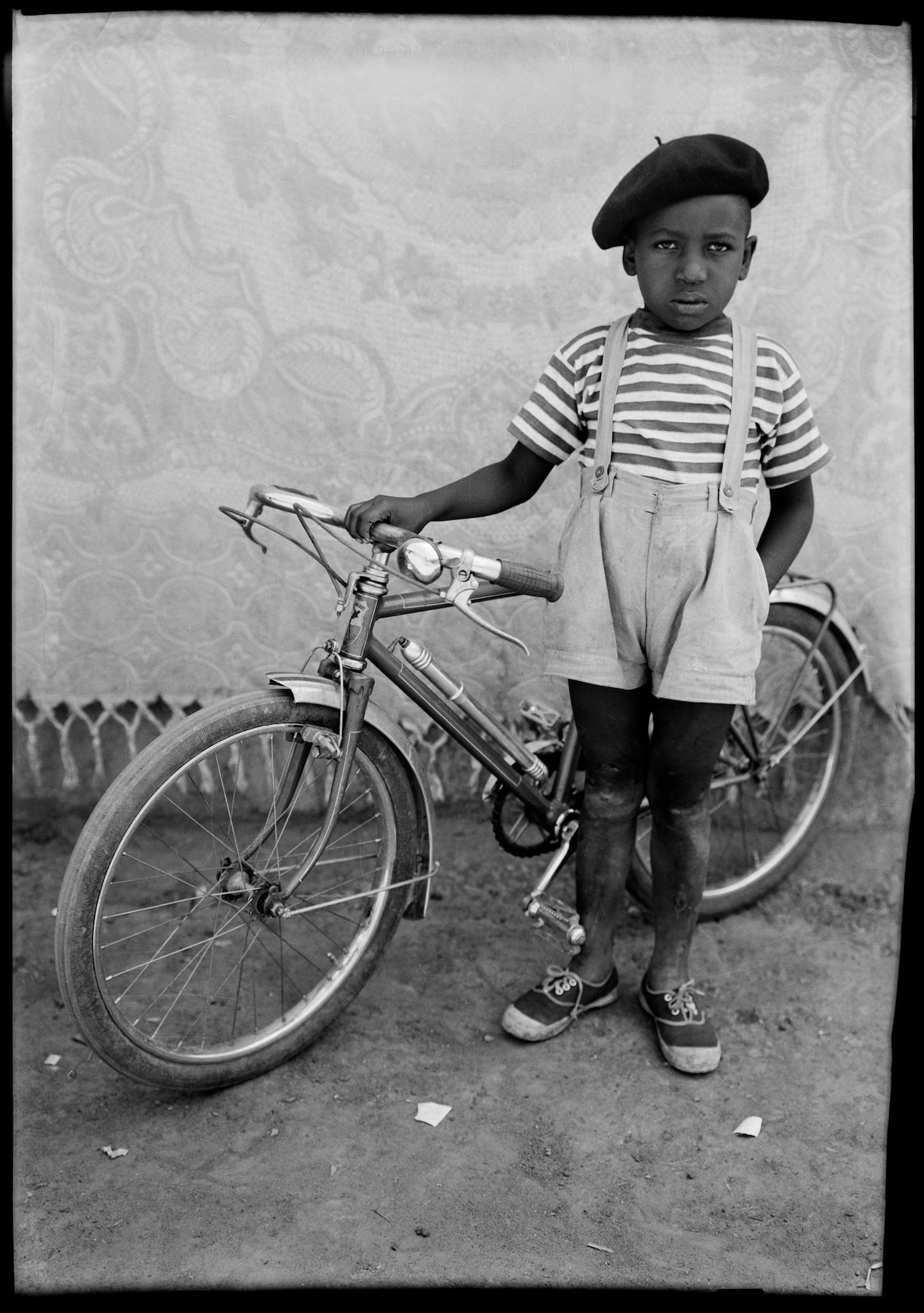 Seydou Keïta, “Untitled,” 1949-51.Courtesy of the Jean Pigozzi African Art Collection. © SKPEAC/Seydou Keïta, courtesy the Jean Pigozzi Collection of African Art and Danziger Gallery, N.Y.
Viewers have no way of knowing if that really is the personality of the sitter. What we do know — we can’t help but notice — is that again and again there’s a sense of a particular person being presented to us. That the sitters are anonymous makes all the more impressive the impression of individual character Keïta managed to impart.
How marvelous these pictures would look in color — or would the effect be too busy? That, too, we can’t know. The marvelousness of what we do have, in black-and-white, is more than sufficient.
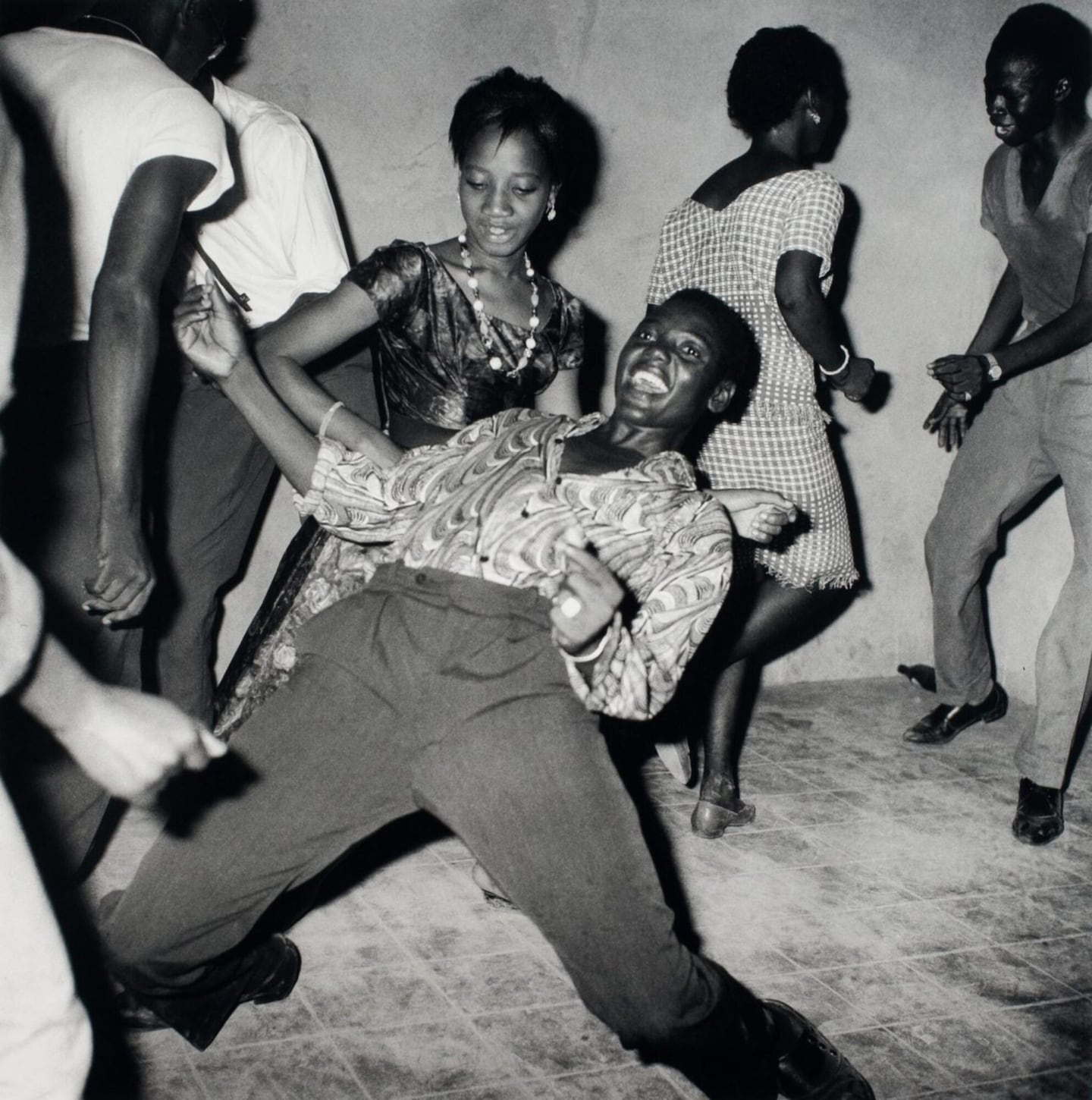 Malick Sidibé, “Regardez-moi! (Look at Me!),” 1962.© 2025 Malick Sidibé. Courtesy of the artist and Jack Shainman Gallery, New York
There are several Keïta photographs in “Ideas of Africa: Portraiture and Political Imagination.” It runs through July 25 at the Museum of Modern Art. He’s among a dozen photographers with work in the show.
They include his fellow Bamako resident Malick Sidibé, who was 15 years younger. Sidibé’s “Regardez-Moi!,” from 1962, takes the anticipatory whoosh of that Keïta Vespa image and lets it loose on a Malian dance floor. Here in abundance is to be found liberation and exuberance and exhilaration (an exhilaration shared by the viewer). There’s also something more. In English, the title means “Look at Me!” Two years earlier, Mali had gained its independence from France. “Ideas of Africa” is about a continent emerging politically and the concomitant emergence of a powerful cultural consciousness.
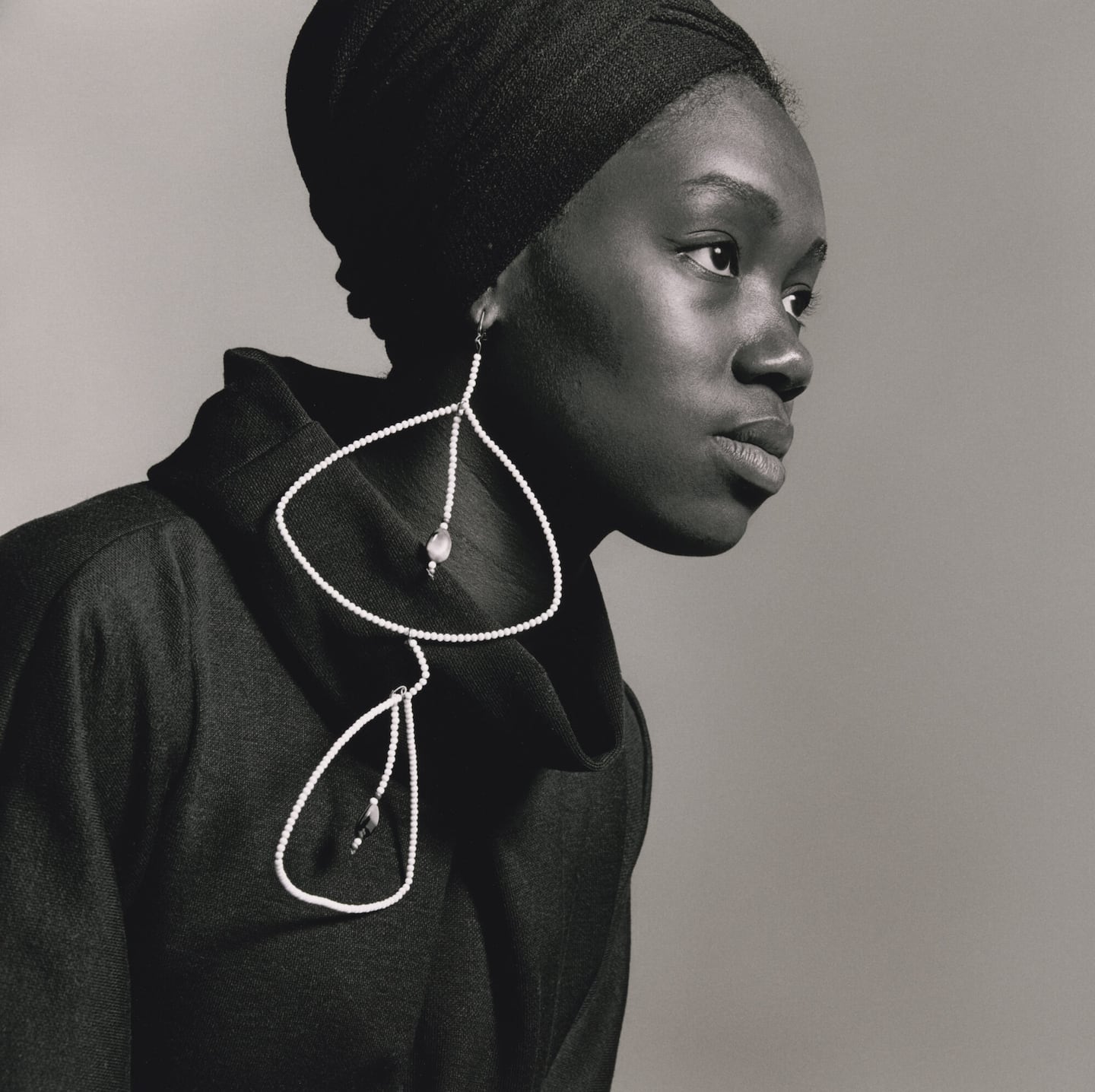 Kwame Brathwaite, “Untitled (Nomsa with Earrings),” 1964-68. © 2025 Kwame Brathwaite© 2025 Kwame Brathwaite
Most of the photographers are African — Malian, Nigerian, Ghanaian, Congolese, Togolese, Central African, Senegalese, Nigerian, Burkinabé — but there’s also an American, Kwame Brathwaite, as well as Janet Jackson’s “Got ‘Til It’s Gone” video (1997), which was inspired by Sidibé and includes allusions to the work of Keïta and other African photographers.
The video nods to Pan-Africanism, with that movement’s emphasis on Africa as a cultural and ideal transcending borders. Another unexpected element in “Ideas of Africa” underscores that: 20 items from Air Afrique, the main provider of air service in francophone Africa. There are in-flight magazines, a matchbox, a key ring, records, books, an Air Afrique suitcase (the logo is very cool). They give a sense of excitement and promise, of — put it this way, Vespas and Peugeots are all well and good. They’re great. Dance floors, too. But they can’t compare to an Air Afrique Caravelle. There’s whoosh, and then there’s whoosh.
SEYDOU KEÏTA: A Tactile Lens
At Brooklyn Museum, 200 Eastern Parkway, New York, through May 17. 718-638-5000, www.brooklynmuseum.org
IDEAS OF AFRICA: Portraiture and Political Imagination
At Museum of Modern Art, 11 W. 53d St., New York, through July 25. 212-708-9400, www.moma.org
Mark Feeney can be reached at mark.feeney@globe.com.