
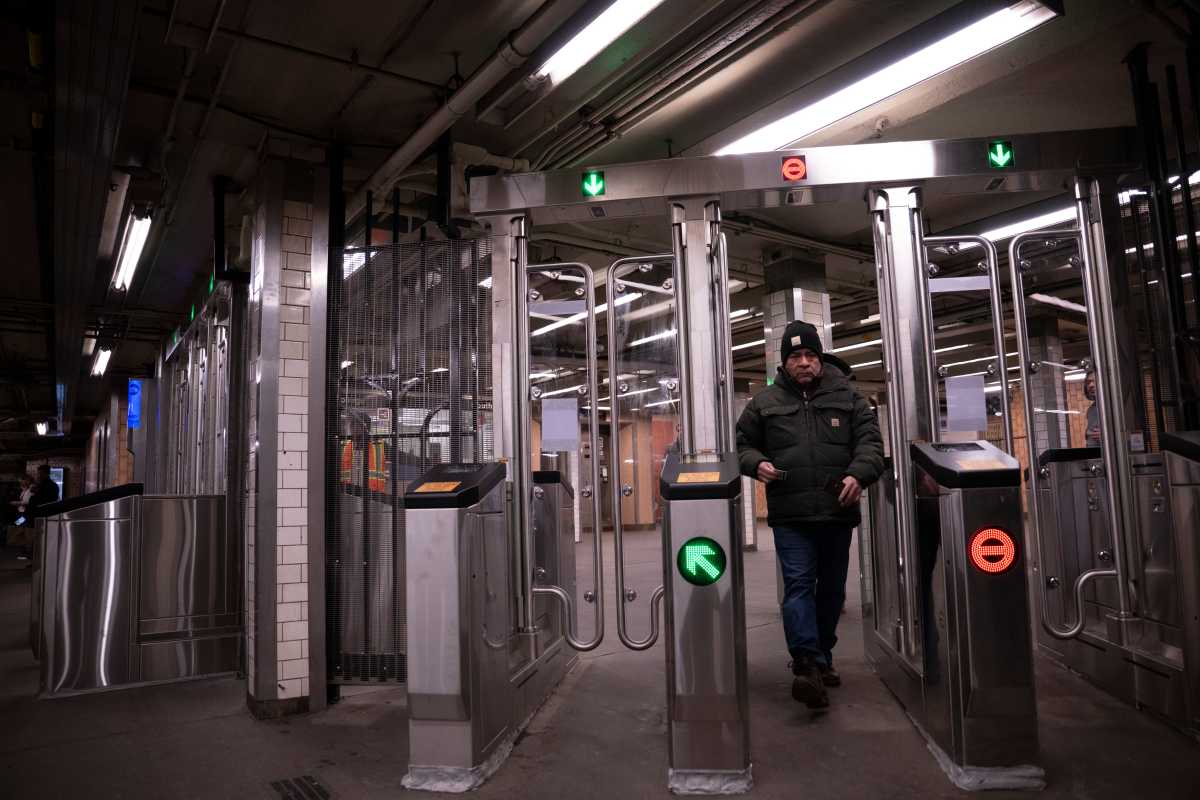
A commuter paying the fare while passing through a new subway gate at the 23rd Street-Baruch College station on Jan. 23, 2026.
Photo by Lloyd Mitchell
One of Mayor Zohran Mamdani’s biggest campaign promises last year was creating a fast, fare-free bus system available to all New Yorkers — an ambitious goal fraught with numerous questions about funding and bureaucratic hurdles.
The buses are run by the MTA, a state agency controlled by Gov. Kathy Hochul. The MTA is hesitant to embrace a fare-free bus system because, as MTA Chair Janno Lieber implied, it would make the rides free for even those who can afford to pay the $3 fare, which isn’t very “fair.”
Mamdani wants a tax increase on the wealthy to pay for a fare-free bus system, among other items on his wish list (expanded free childcare, cheap grocery stores, a massive budget deficit, etc.). Alas, Hochul has made it clear she will oppose any new tax increases, especially as she seeks re-election this November.
In short, everybody is telling the mayor “no” to his desire for tax increases. But they’re not necessarily saying “no” to his vision of affordability, especially when it comes to public transportation. For evidence of that, Mamdani doesn’t need to look any further than the City Council chamber to find it.
On Wednesday, in outlining the City Council’s budget proposal, Speaker Julie Menin announced a dramatic expansion of the “Fair Fares” program, which currently offers half-priced subway and bus rides to qualified low-income New Yorkers. Menin’s plan would offer free transit rides to anyone making up to 150% of the city’s poverty line, which would include individuals earning $23,475 annually and a four-person household earning $48,225 each year.
More than 1.7 million New Yorkers would be eligible for the free Fair Fares program. Cost projections are affordable even in a tough city budget — between $130 million and $170 million in a budget plan that will likely top about $120 billion when finalized.
Best of all, the proposed Fair Fares expansion offers no major bureaucratic hurdles. City Hall doesn’t need to ask Albany or the MTA for permission to do it. There’s no need to wait for feasibility studies or to purchase upgraded buses. And it would be almost immediately available to New Yorkers who qualify.
Mamdani’s preliminary budget in February excluded an expansion of “Fair Fares”; he suggested the budget picture was too bleak to include it. Yet Speaker Menin and her budget staff say they have found a way forward not only on Fair Fares, but also to close the $6 billion budget gap without raising taxes on anyone through a combination of cost savings and other revenue streams.
The mayor wants it all, of course, but he doesn’t need it all. New Yorkers want a more affordable city, and a more affordable public transit system. If that can be achieved without raising taxes, blowing budget holes, or jumping through bureaucratic hoops, then that’s a win for everyone — and that’s all that matters.