
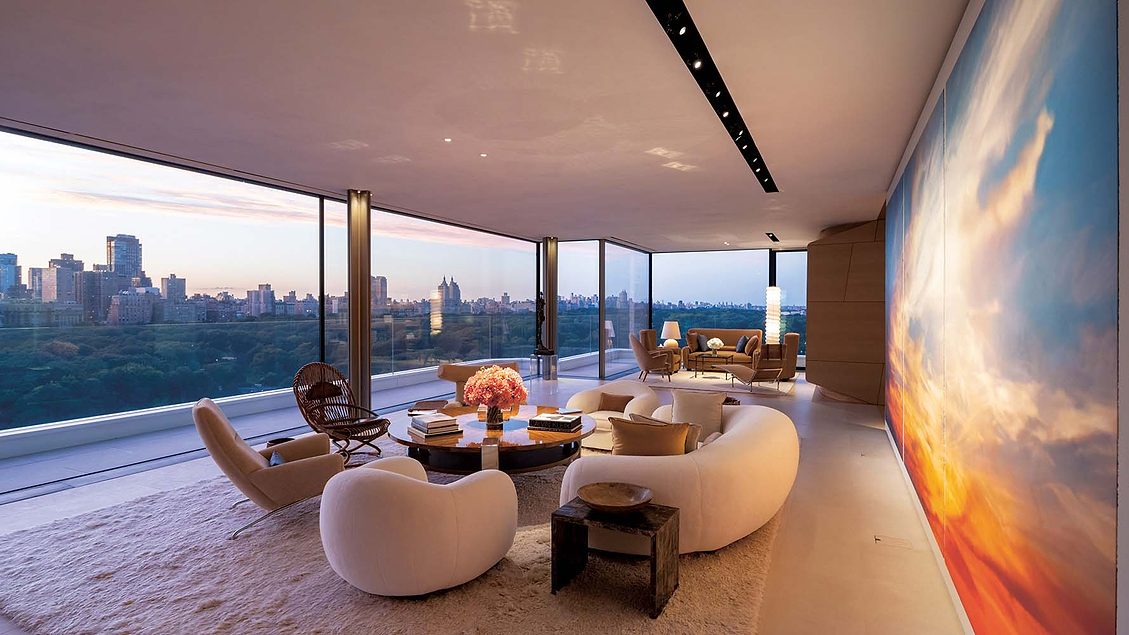
On rare occasion, architects get to explore particular design ideas to the fullest—all it takes is a sympathetic client with the right means and discernment. Fortunately, Diller Scofidio + Renfro (DS+R) had this opportunity in revamping a penthouse apartment in New York City. Although the project is not at the scale of a cultural or civic monument, the commission allowed the architects and a cohort of consultants, artisans, and engineers to create a singular example of this truism. As DS+R principal Elizabeth Diller remarks, “We do few domestic projects, but we took this one on because the client was knowledgeable about architecture and open to a fully bespoke design approach, down to the smallest details.”
Renovating an apartment within a conventionally modern residential mid-rise may not seem all that challenging. However, two factors had to be considered: the 5,500-square-foot space, in an 18-story limestone-clad structure from the 1960s, had sweeping views of Manhattan’s Central Park, plus, the client owned a significant collection of postwar and contemporary art that needed to be displayed properly within the apartment’s confines. The owner, who prefers to remain unnamed, found DS+R through the recommendations of friends aware of the firm’s successful track record with art installations and museum design.
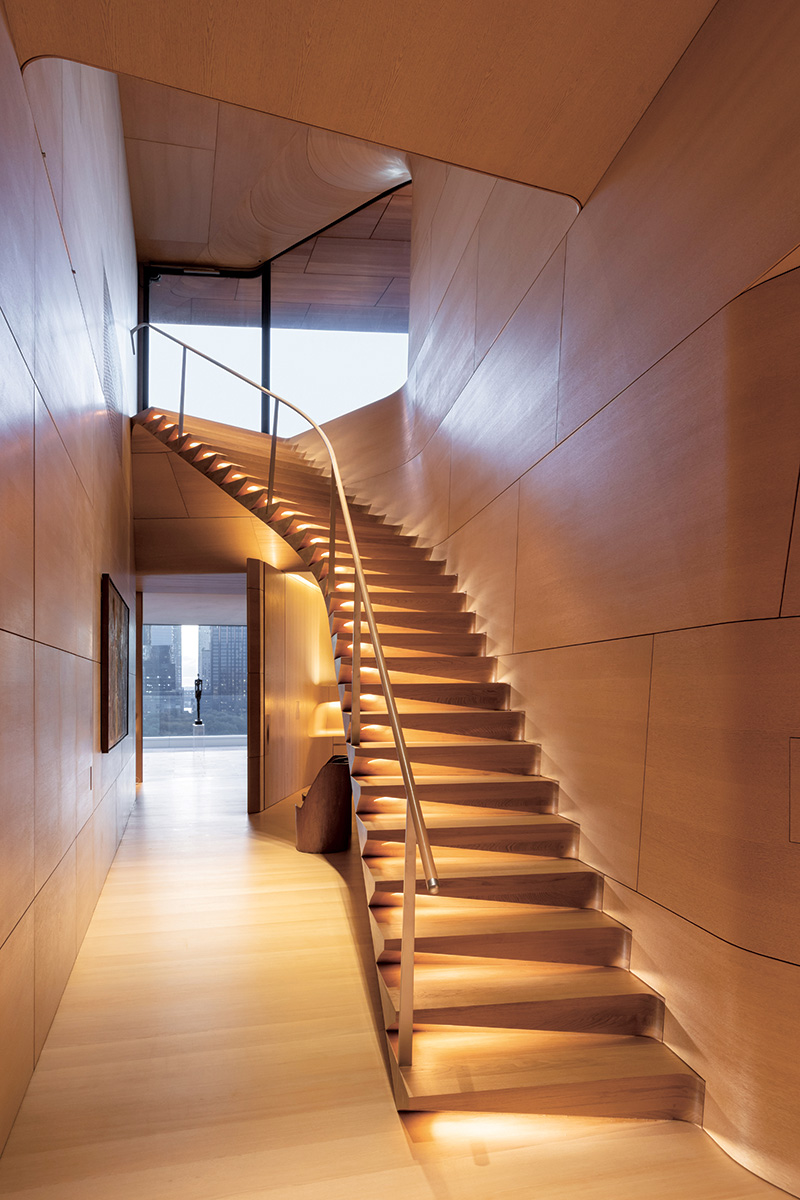
The entry vestibule opens to the central hall (above), which leads to a living area with expansive views of Central Park (top of page). Photo © Iwan Baan, click to enlarge.
With regard to the view, DS+R found that the clunky concrete frame of the tower blocked too much of the breathtaking panorama of the park and city’s skyline beyond. The client also owned the apartment below, prompting DS+R to propose rebuilding the penthouse level using skinny steel columns with a Miesian profile, which would not only support a roof terrace above but ensure that the incomparable view would not be disturbed. The architects inserted steel beams in the floor slab underfoot, then placed the cruciform columns at a remove from the new window wall in the living and dining area. As a fireproofing safeguard, the team coated the columns in an intumescent paint and wrapped them with stainless-steel panels treated with a velvety bead-blasted finish.
The glazed corners at either end of this expanse are kept recessed according to the original floor plan, allowing the dining and sitting areas to be differentiated from the living room. A narrow terrace runs along the outer edge of the entire stretch and continues past the sleeping quarters on the north side. Balustrades of ultra-clear glass virtually disappear. The combined effect of these many subtle moves is potent. When entering the living area from the small and dark entry vestibule, which is clad in a warm German oak, visitors experience, first, a sense of compression, then, rather dramatically, a feeling of release as the view lures their gaze to the park toward the park.
One legal hurdle had to be confronted before this ambitious exercise was carried out: Would the drastic changes to the penthouse’s enclosing walls be visible from the street? Although the building is not landmarked, it falls within a historic district. Happily, the New York City Landmarks Preservation Commission decided the changes could not be easily seen from the sidewalks below and would fit in with the surrounding context.
Within this greenhouse-like setting, paintings are protected from the sun by a UV coating on the outside of the large glass panes. Solar shades and a museum-quality HVAC system keep the glare, temperature, and humidity balanced. An antireflective coating on the inside of the glass assures that occupants have a clear view to the outside; privacy blinds keep voyeurs with telescopes in other buildings from looking in. In addition, DS+R worked with L’Observatoire International to install temperature-calibrated LEDs (with some halogen lighting fixtures) that were not too noticeable. “The client dislikes seeing any devices, including sensors, light switches, and electric outlets,” notes DS+R project leader Jeremy Boon-Bordenave, explaining the many details that conceal unsightly protrusions.
Interior designer Rose Tarlow, who was responsible for the furnishings throughout the apartment, “has a good understanding of the client,” Diller points out. (The client is in the entertainment industry and spends a certain amount of time in Los Angeles, where Tarlow has long had her firm.) “Rose’s eclectic sensibility yielded an interesting mix of materials as well as soft and hard elements,” says Diller. “The effect is neither showy nor overcrowded.” Tarlow helped DS+R select the right beige, off-white, and tan finishes that would appeal to the client. “Also,” Diller notes, “she was very supportive of our work.”
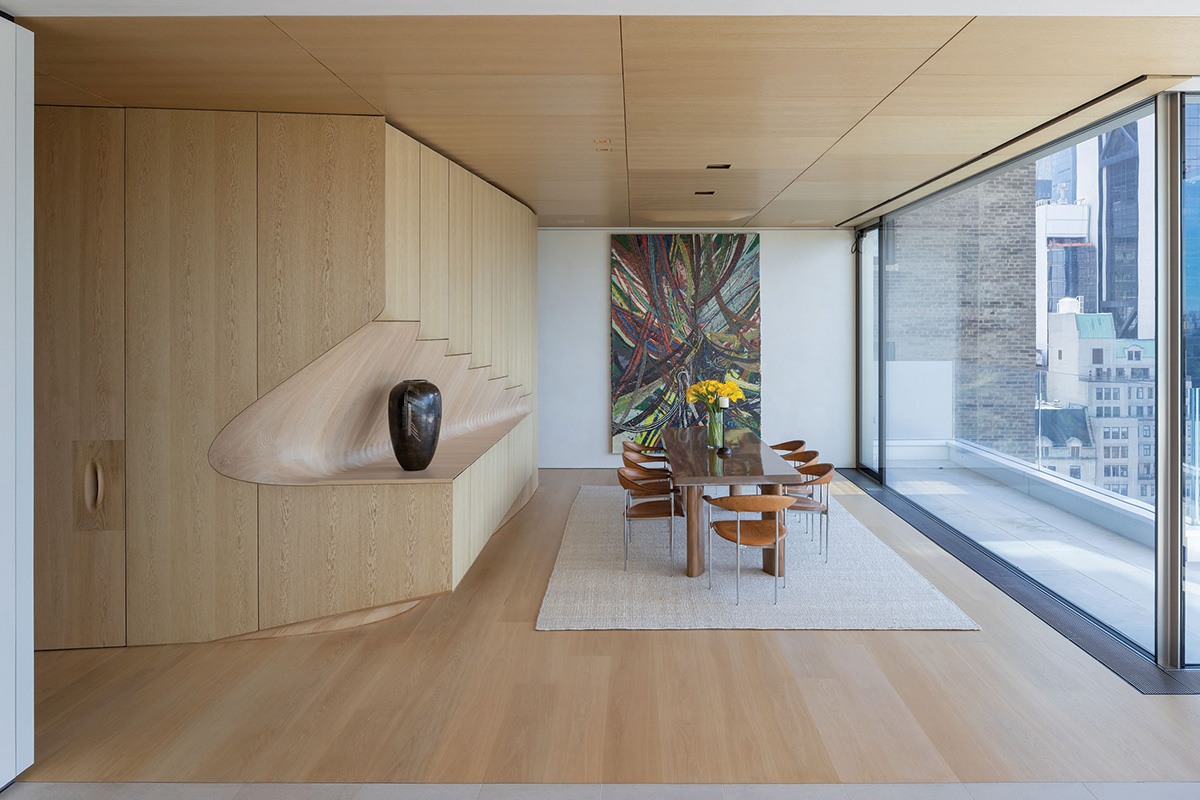
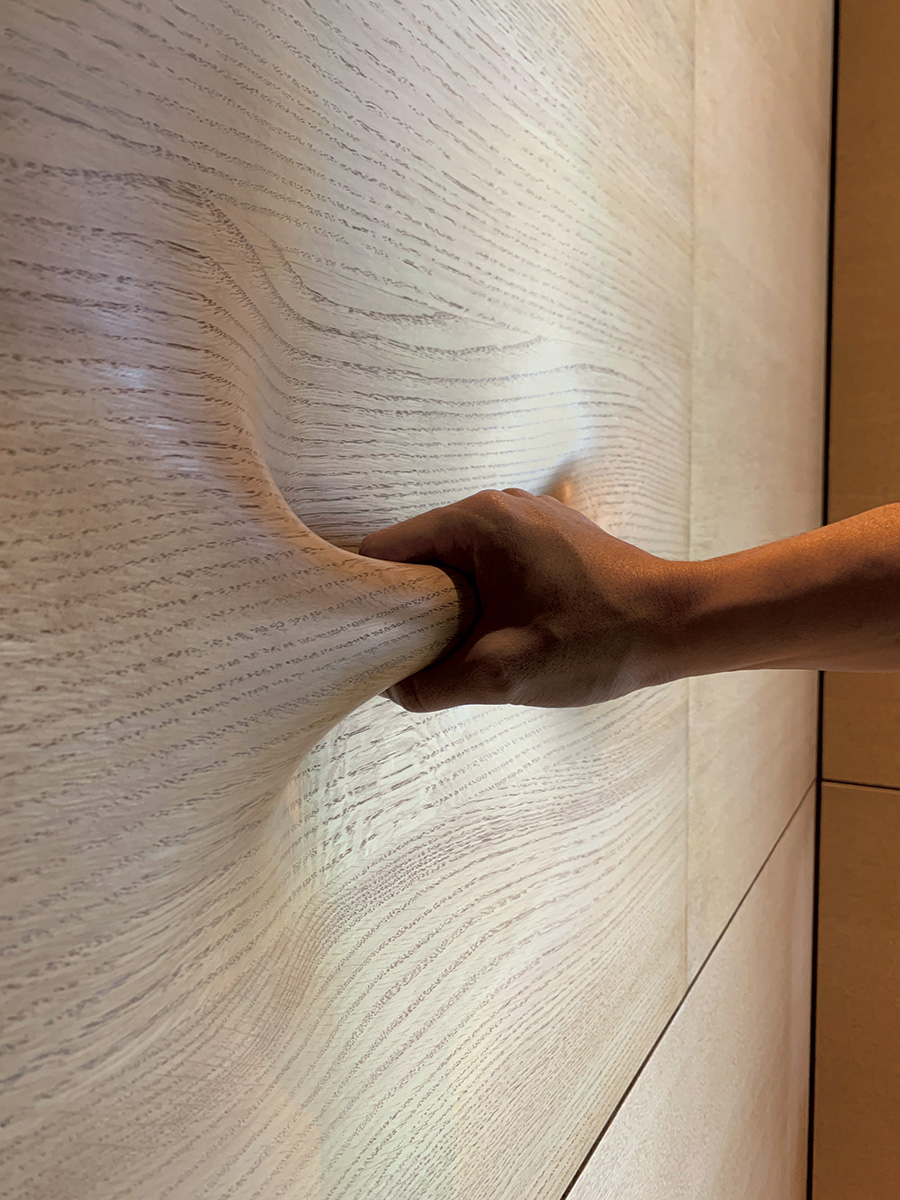
And DS+R’s work is indeed different. Among the firm’s remarkable contributions to the interior are the sculptural built-ins executed in Bavarian Spessart oak, such as the geometrically configured credenza in the dining area, the stairwell in the central hall, and the cantilevering desks in the bedrooms. Also arresting are such idiosyncratic elements as the organically shaped door pulls fashioned with contrasting horizontal and vertical grains. Veneer and CNC-milled solid wood, the architects maintain, are juxtaposed to emphasize both the flatness and depth of the oak.
1
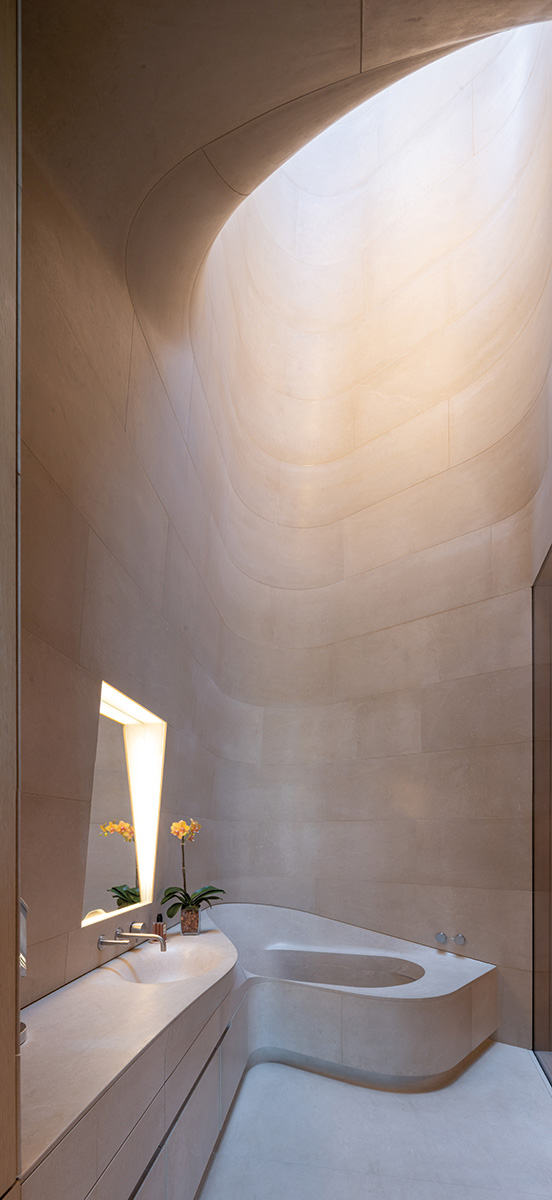
Sinuous details include the milled credenza (1) and door pulls (2), as well as a stone-lined light well in the main bath (3). Photos © Iwan Baan (1 & 3), Diller Scofidio + Renfro (2)
2
3
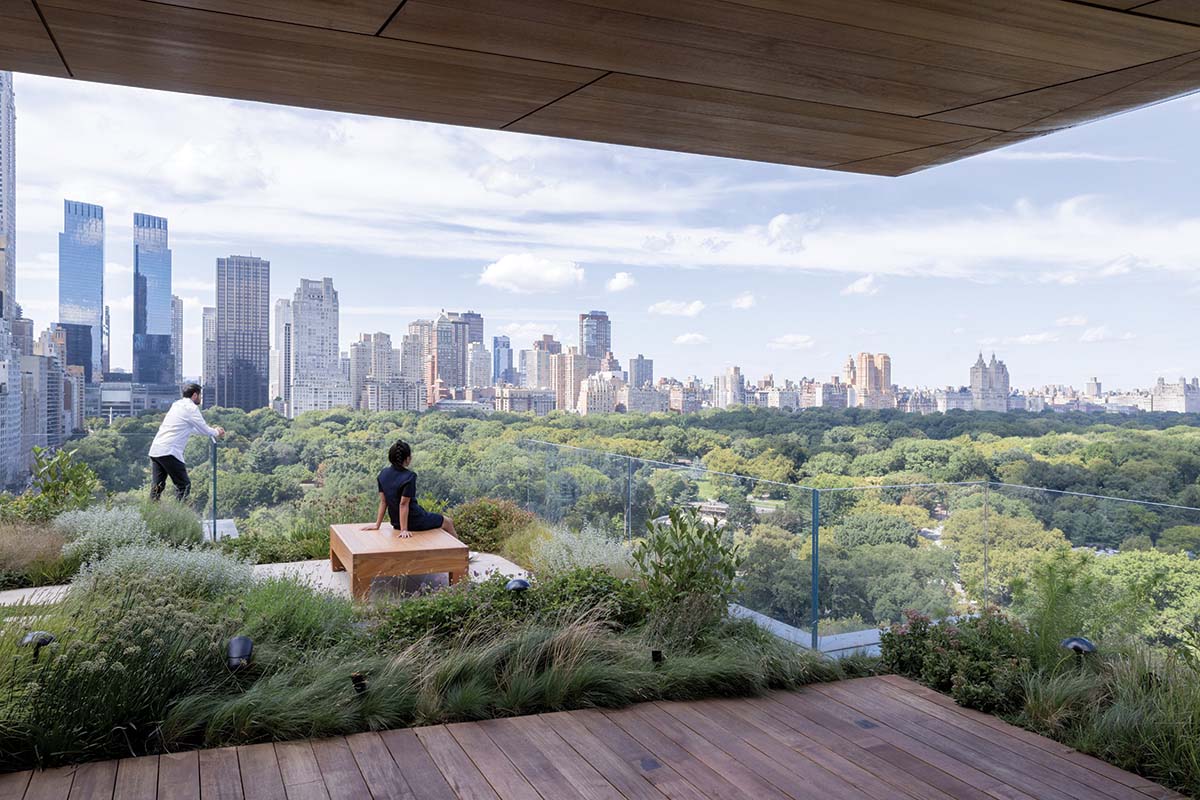
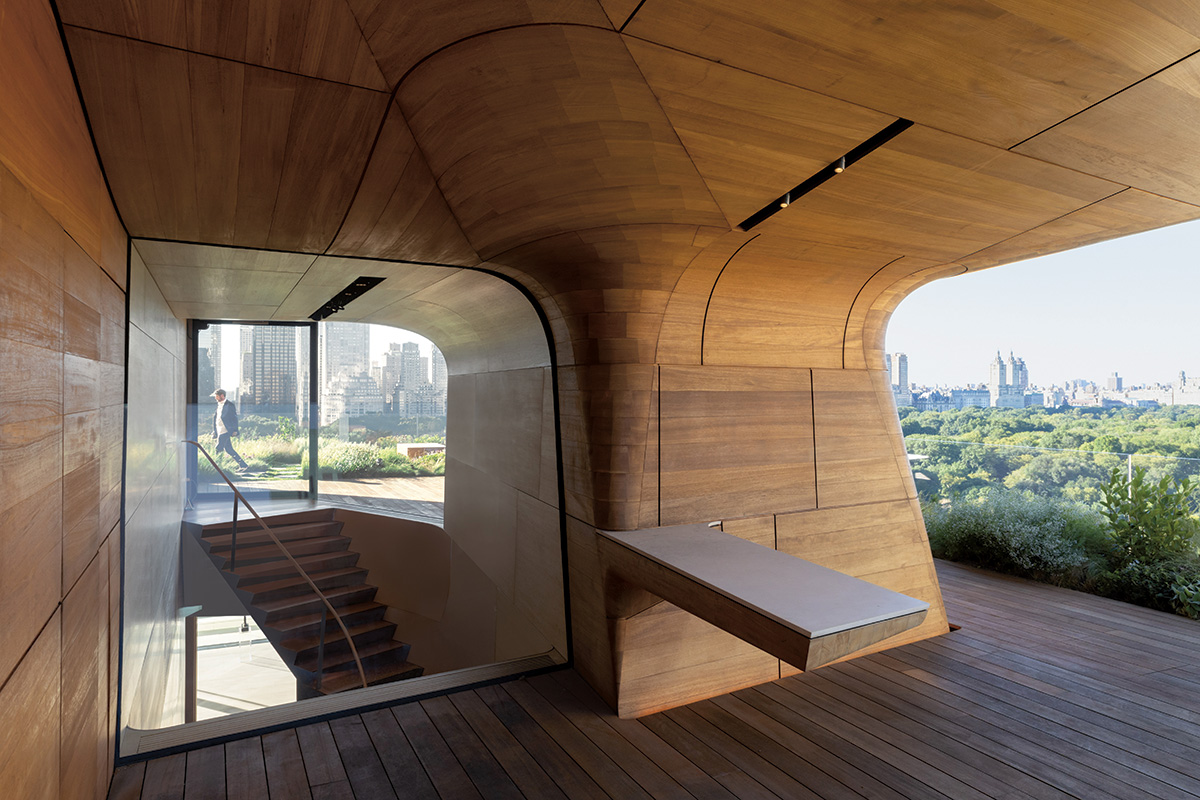
In the central hall, the oak stairway—like the credenza—is a tour de force; it swerves dramatically up to the roof. The architects carved away the solid wood risers to obliquely illuminate the underside of each tread, producing an ambient glow. Aided by the leather-covered handrail, visitors ascend the stairs toward a large glass door that swings open to a terrace, where teak decking, walls, and soffits frame another commanding vista of the park. “We see it like a trunk of a tree that extends upward and outward, forming a canopy to protect an outdoor dining area,” adds Diller. In warm weather, the roof terrace’s lush planting, designed by Piet Oudolf (who worked with DS+R on New York City’s fabled High Line) blends in with the swath of greenery extending west and north.
4
The terrace (4) features teak-wrapped forms (5). Photos © Iwan Baan
5
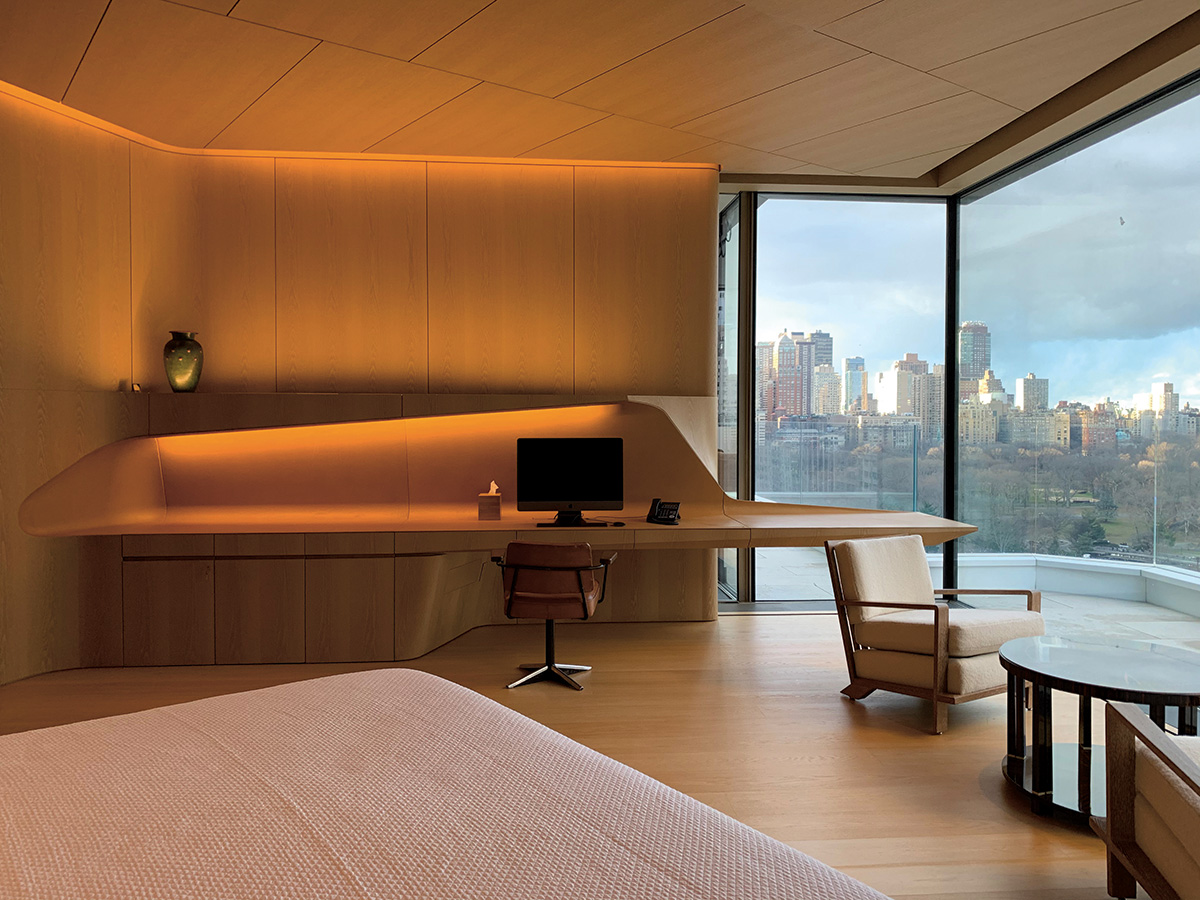
While the roof is given over to outdoor living, a screening room and library on the level below offer an introverted oak-lined setting for enjoying various forms of entertainment. Near the screening room are a bedroom suite and a guest room, each adhering to a tailored aesthetic softened by tan leather on the floors, headboards, and surfaces of oak writing desks. Oak is everywhere—even the retractable aluminum louvers of the window treatment in the primary bedroom are clad in it.
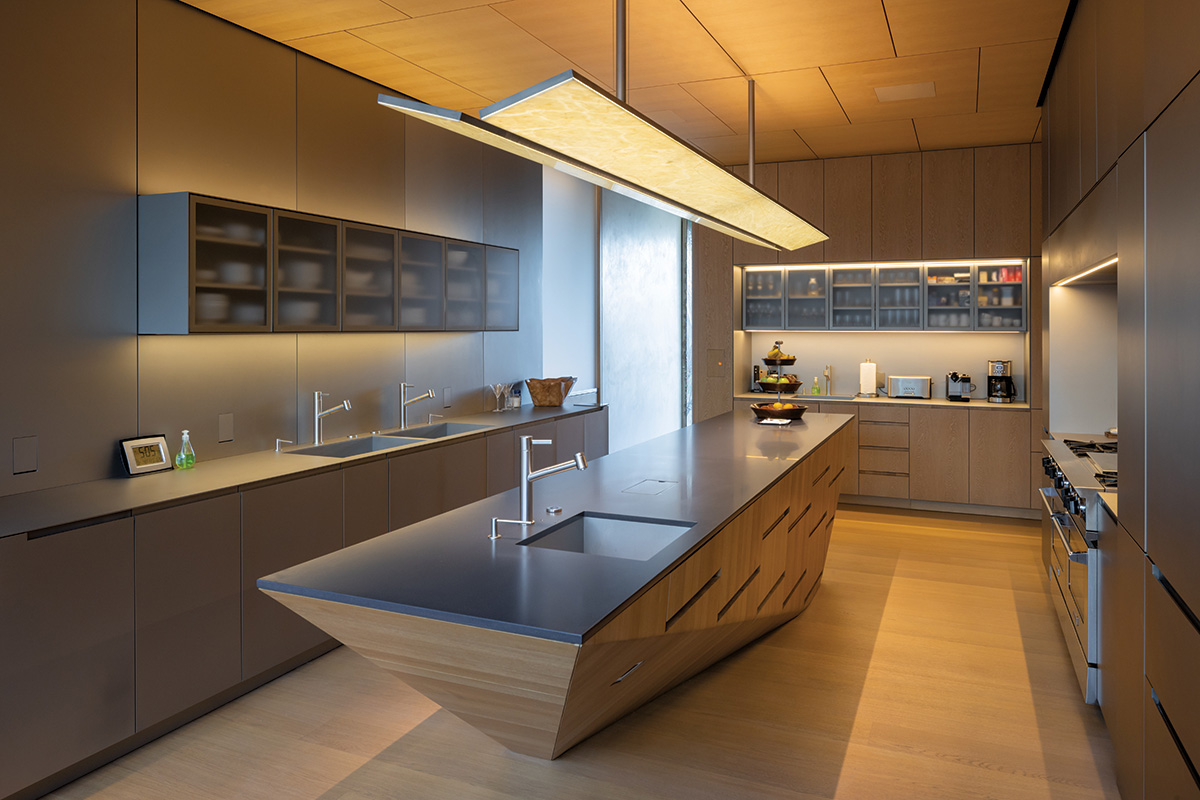
DS+R’s fascination with materials does not stop with the bedroom, as the main bath demonstrates. Here a double-height limestone-clad light well swoops up above a sinuous tub carved out of a single block of limestone. The gentle curvilinear motif of the bathroom is echoed elsewhere—except in the kitchen, where straight lines rule. An island surfaced with a sintered-stone counter anchors the room; suspended overhead is a DS+R-designed V-shaped stainless-steel light fixture. Its elongated backlit Estremoz-marble panels fold into place, like a moth’s wings, when not in use.
6
7
Curved geometries abound, as in the main bedroom (6), except in the angular kitchen (7). Photos © Iwan Baan
In looking back at the residential project, Diller admits to being nostalgic about the time spent—five or so years—on the scheme. “This is unusual, in that we got to go so deep into the details,” she says. “It was more deep than broad, and more personal.” While this kind of inventive architectural endeavor remains a one-off statement, it still affirms the power of the creative act. Specifically, the interior affirms the result of a relentlessly investigative talent meeting up with just the right client.
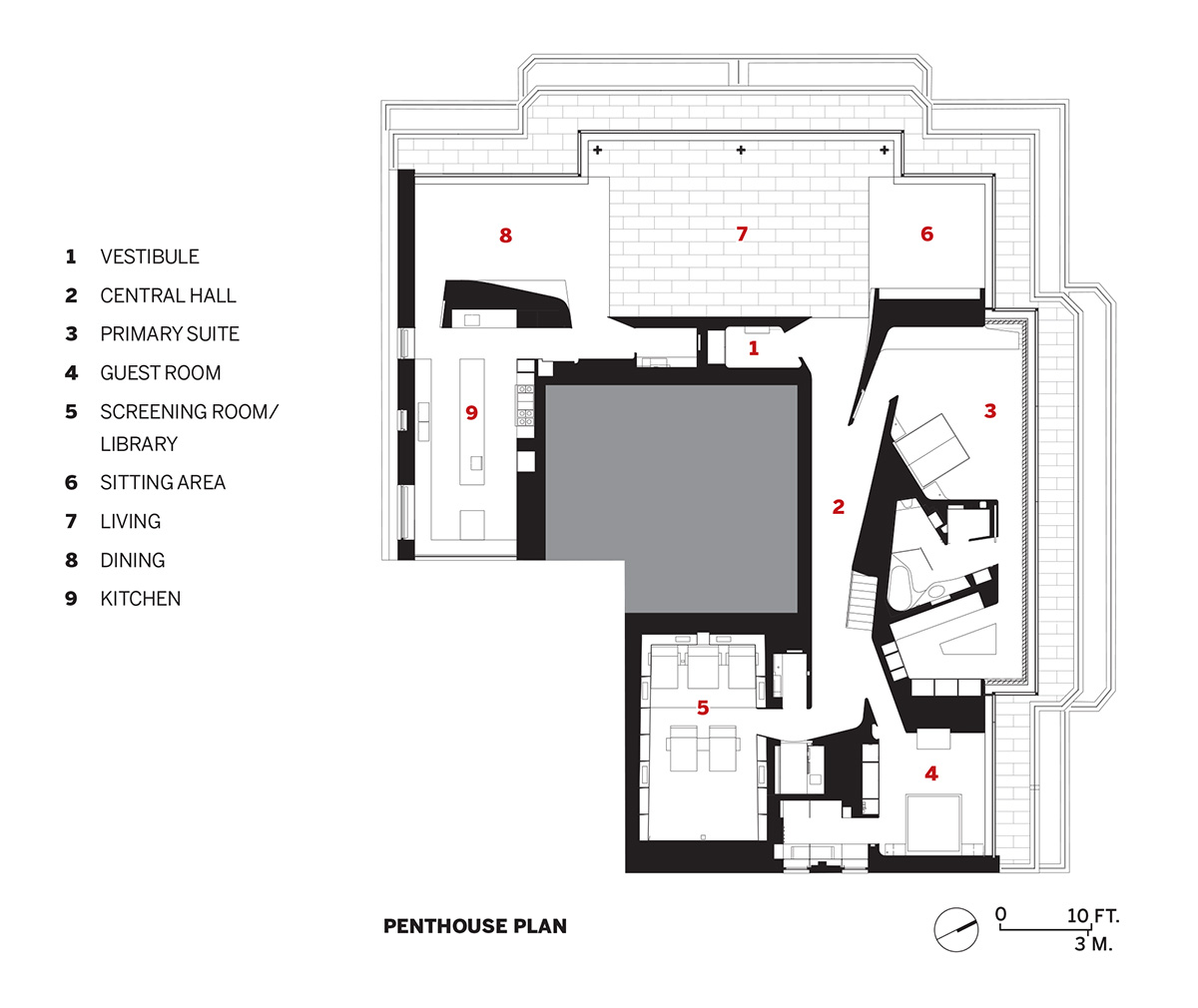
Image courtesy Diller Scofidio + Renfro
Credits
Architect:
Diller Scofidio + Renfro
Interior Designer:
Rose Tarlow
Engineers:
TYLin (structural); Polise Engineering (MEP)
Consultants:
Piet Oudolf, Richard Herbert (landscape); L’Observatoire International (lighting); WSDG (acoustics); Atelier Ten (sustainability); M. Ludvik Engineering, James R. Gainfort (facade)
General Contractor:
REIS
Client:
Withheld
Size:
9,050 square feet
Sources
Millwork:
Merritt
Interior Finishes:
Avorio Limestone (floor and wall tile); Michelle Costello (leather); Rensen (shades); Trufig (outlets)
Hardware:
Rixon (closers); Deventer, Planet FT (seals); Theophile (catches)
Cladding:
Glen-Gery (brick); Guardian, Glass TroschCurtain, Sedak, Freiner + Reifer (glazing); Fetzer (teak panels)
Lighting:
Perfection Electricks, Flos, Viabizzuno, Hunza, Specialty Lighting Industries, No. Eight Lighting, designplan, ETC
Plumbing:
Duravit, TOTO, Dornbrecht, Fantini