

Representative Alexandria Ocasio-Cortez (D-NY) speaks during a stop on the ‘Fighting Oligarchy’ tour with U.S. Senator Bernie Sanders (I-VT) (not pictured) at the Dignity Health Arena, Theater in Bakersfield, CA, April 15, 2025.
REUTERS/Aude Guerrucci
U.S. Rep. Alexandria Ocasio-Cortez this week lent her sizable megaphone to the fight against a New York State Department of Transportation plan that would widen the Cross Bronx Expressway.
AOC — a Democrat who represents swaths of the east Bronx and western Queens — sent a letter to Gov. Kathy Hochul on Thursday, urging the state’s top executive not to pursue any plan that involves expanding the highway.
“On behalf of my constituents and nearly 64,000 local residents impacted by this project, I am requesting that your administration reject any plans to expand the Cross Bronx Expressway beyond its current footprint,” she wrote in the letter.
The democratic socialist lawmaker fired off her missive ahead of an April 7 deadline by which the NYSDOT must submit its final design plans for the $900 million undertaking — known as the Five Bridges Project — to the Federal Highway Administration. The feds extended the deadline from early last month, when the state was originally supposed to submit its chosen plan.
The 6 ½ mile-long highway is infamous because Robert Moses — the official who designed the Cross Bronx — built it by raising entire neighborhoods and cleaving the borough in two. For over half a century, the road has subjected thousands of Bronx residents who live along it to disproportionate amounts of air and noise pollution emanating from its six congested traffic lanes.
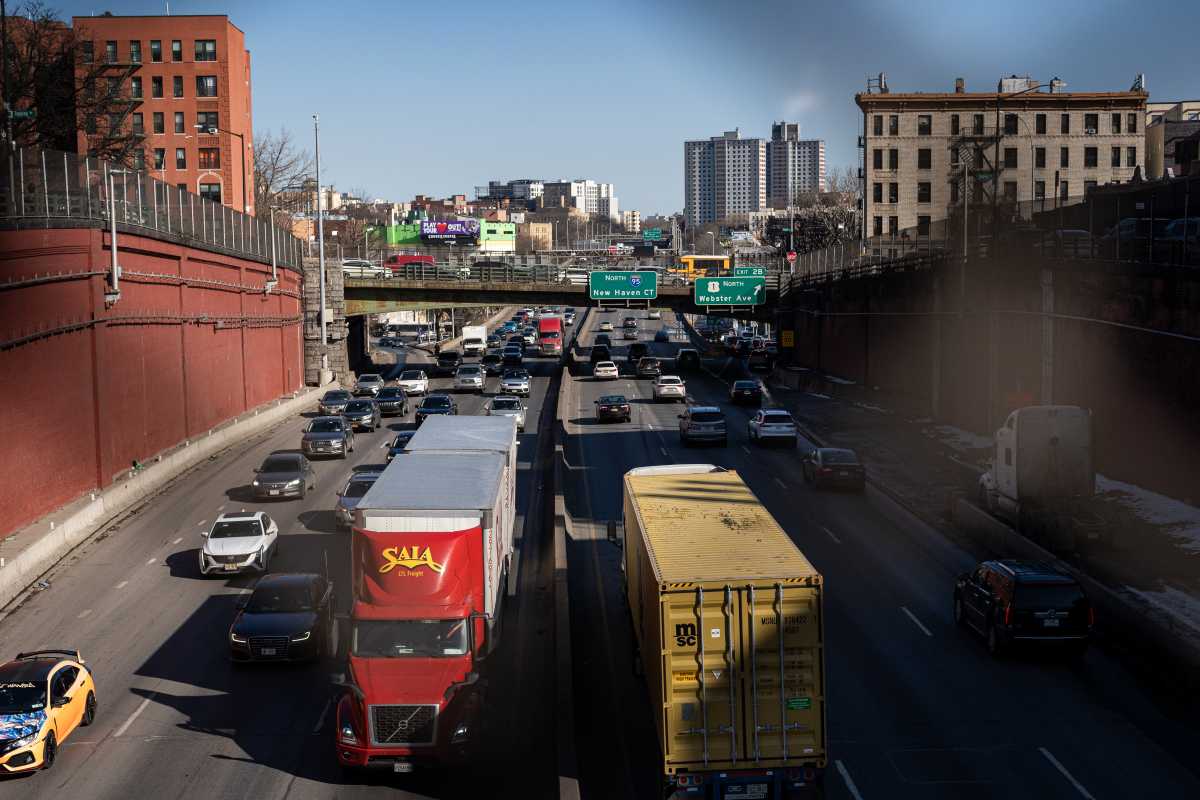 A view of traffic on the Cross Bronx Expressway.Photo by Jonathan Portee
The state’s plan aims to rehabilitate five elevated portions of the Cross Bronx, which are in need of major repairs, between Rosedale Avenue and Boston Road.
But all three design options under consideration include widening the road’s shoulders by 25 feet on both sides to comply with federal regulations, while two of them call for adding a pathway along the highway’s southern end to support construction. The path would then be converted into a bike and pedestrian passage.
In her letter, Ocasio-Cortez echoed the central argument advocates fighting the project have been making for months: that any widening of the highway’s footprint would only compound the rampant air and noise pollution it has inflicted upon Bronxites for decades. She also reiterated their arguments that the state’s environmental review and public engagement process did not give the 64,000 residents living around the project site adequate time to weigh in on it.
“A $900-million repair project in one of the state’s most congested and environmentally overburdened corridors demands rigorous planning that puts residents first. Given the environmental and health hazards associated with NYSDOT’s proposed expansion options,” her letter reads. “I am concerned that any of the proposed expansion alternatives, including the addition of a shared-use path, would only deepen the burdens our communities have long endured.”
In response, State DOT spokesperson Glenn Blain insisted in a statement that the agency has “engaged with the community at every step of the way, making substantial changes to the proposed alternatives in direct response to public feedback.” He also pushed back on the notion that the project is expanding the roadway, saying rather, “it is a needed safety project.”
“NYSDOT is committed to maintaining a safe transportation system for all users, and this project on the Cross Bronx is needed to keep travelers, as well as the community, safe — as the infrastructure is in need of critical repair,” he said.
Ocasio-Cortez pointed specifically to the potential that widening the highway’s shoulders could bring exhaust-spewing vehicles even closer to the Bronx River Houses, New York City Housing Authority development, which sits adjacent to the highway.
“Current renderings propose extending the Cross Bronx Expressway up to 45 feet closer to Bronx River Houses, home to 3,000 public housing residents living directly across the planned construction site,” she wrote. “Families in this neighborhood are already battling some of the highest asthma rates statewide as a result of Cross Bronx pollution.”
The NYSDOT backed off an earlier version of its plan, which involved building a new temporary mile-long section of road designed to divert traffic from the Cross Bronx amid construction. The agency’s move came after intense pressure from the Stop the Cross Bronx Expansion Coalition, an alliance of community advocates.
However, the coalition is continuing to push against the state’s revised plan, insisting that anything more than just repairing the road’s bridges could bring more harm to the communities surrounding it.
Siddhartha Sánchez, executive director of the Bronx River Alliance, which is part of the coalition, said in a statement that “decades of progress are on the line” with the NYSDOT’s current plans still on the table.
“With families here still choking on highway pollution, our work is far from over,” Sánchez said. “We refuse to stand by and watch state officials take the Bronx back half a century with even more traffic and pollution.”