
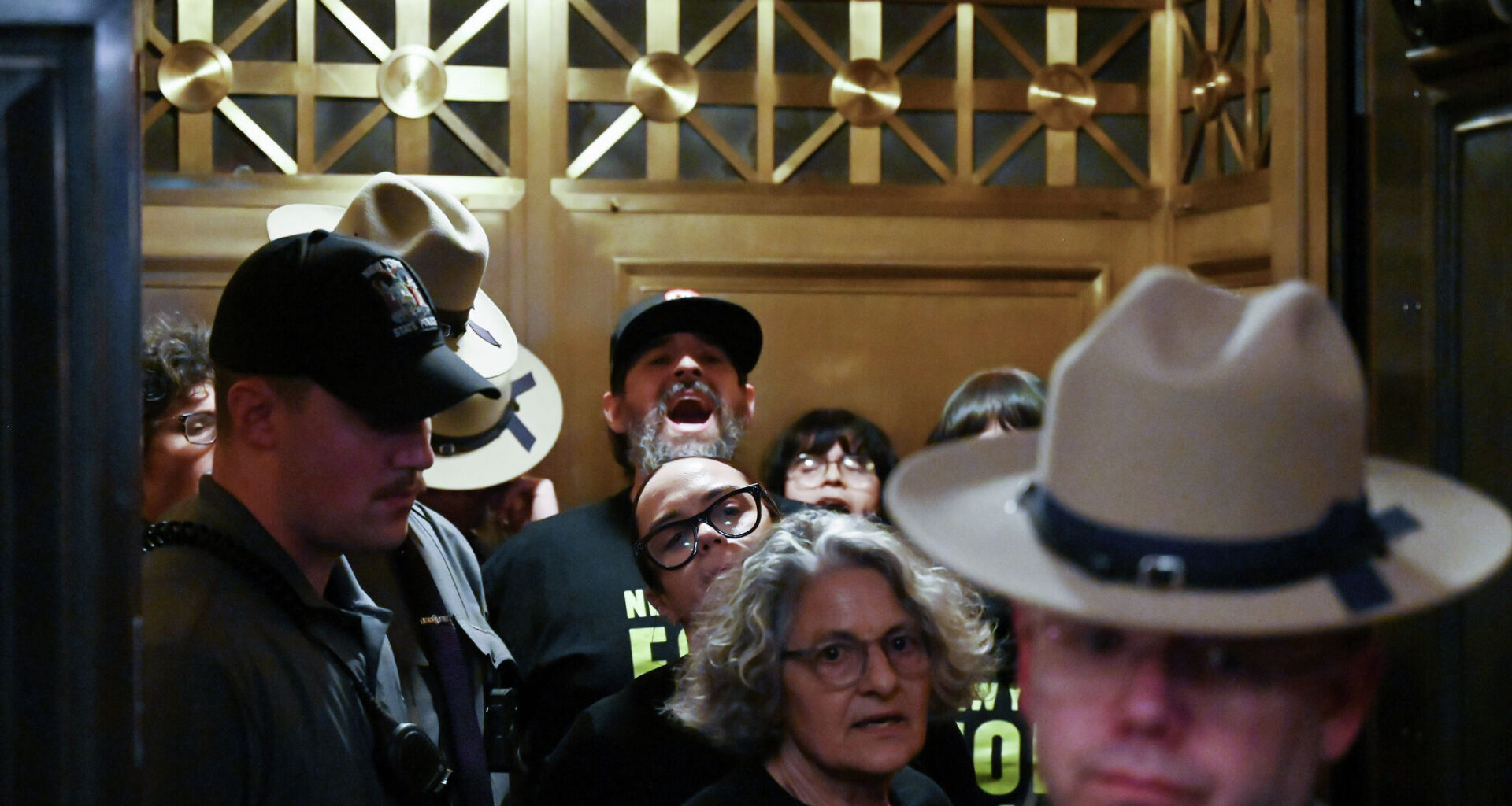
Thirty-five immigration and climate activists were arrested during separate demonstrations at the Capitol in recent weeks after authorities said they blocked multiple entrances. Lawmakers say these demonstrations don’t influence policy positions.
Will Waldron/Times Union
ALBANY — Carlene Pinto sat cross-legged on the floor outside the Senate chamber at the Capitol with six other demonstrators last week, waiting to be arrested.

Nearby, Bryan MacCormack, the co-director of the Columbia County Sanctuary Movement, passed through the almost 150 other demonstrators, each demanding that the Assembly and Senate vote on an immigration bill, known as New York for All, that would prohibit state and local government agencies from assisting with federal immigration enforcement. MacCormack had coordinated the event with state troopers at the protest where detention was part of the plan.
Article continues below this ad
“When the Legislature is choosing not to listen to the people, we have to show them who has the power,” said Pinto, 37, a New York City strategist and organizer. “It’s a courageous act for our immigrant neighbors.”
State troopers arrested Pinto and 13 other demonstrators, charging them with disorderly conduct, a violation, after they failed to heed three dispersal warnings for blocking the entrances to the Assembly and Senate. A week earlier, 21 climate activists were arrested for doing the same in front of Gov. Kathy Hochul’s office. They demanded the governor not try to amend the state’s 2019 Climate Act.
After the protests, an implicit message emerged from state Democratic leaders: protests are noted, but they are not influencing decision-making.
Make the Times Union a Preferred Source on Google to see more of our journalism when you search.
Add Preferred Source
State Sen. Liz Krueger, an influential Democrat and chair of the Senate’s Finance Committee, said that she hopes the protests make a difference, but acknowledged it’s hard for any single demonstration to break through at a Capitol crowded with constant demonstrations.
Article continues below this ad
Assemblywoman Diana Moreno joins demonstrators who are in favor of legislation called “New York for All” that would limit cooperation between local police and immigration authorities.
Will Waldron/Times Union
“I feel like I am spending my day working on really hard, important issues, but it doesn’t mean I’m actually aware of who’s here at any specific day for what specific issues,” said Krueger, who supports both measures and rallied with advocates ahead of the sit-ins. “And I suspect that that is probably very true of the three people in the room as well.”
Krueger was referring to a long-standing New York phrase that describes the closed-door budget negotiations between representatives of the governor, state Senate majority leader and the Assembly speaker.
When asked if the protests influence Hochul’s position, officials with the governor’s office pivoted to policy, emphasizing her proposal in the budget, which she said would hold federal immigration agents accountable and protect the constitutional rights of New Yorkers.
Article continues below this ad
“The governor remains focused on working with the Legislature to keep federal overreach out of New York, and will review all legislation that passes both houses,” said Jess D’Amelia, a spokeswoman for the governor.
When asked about the protests, and whether it changes things during the budget negotiations, Assembly Speaker Carl E. Heastie said: “I don’t want to put a personal judgment on people’s protesting and civil disobedience. That’s their personal choice.”
“We always try to do things on the merits and, to say for the Assembly, the coordination and cooperation with law enforcement that could be used in a far too aggressive manner, and tearing families apart with cooperation with ICE,” Heastie said. “That’s a concern we have. I don’t think we have a disagreement with the advocates on that.”
‘Performative art’
Demonstrations and news conferences are part of daily life at the Capitol. There are often dozens of rallies throughout the day but only a handful end in arrests every year.
Article continues below this ad
The incident Wednesday came as lawmakers are weighing tax increases on the wealthy and changes to laws meant to protect immigrants and the environment.
With the looming budget deadline, which was not met and extended last week, throngs of immigrant rights and climate activists descended on the Capitol.
Anti-ICE demonstrators hold a protest outside Gov. Kathy Hochul’s office on March 31.
Will Waldron/Times Union
The week before Wednesday’s protest, the New York Immigration Coalition and other groups blocked the Capitol’s State Street entrance and refused to move until lawmakers passed New York for All. Many lawmakers sat in the middle of State Street with a banner that read “NY 4 ALL.”
Article continues below this ad
State Police were told not to arrest protesters that day, and the demonstrators left a few hours after the rally began.
The following day, on March 25, about 500 climate activists and lawmakers packed the Million Dollar Staircase before blocking multiple entrances to Hochul’s office wing.
Hochul, who wasn’t at the Capitol that day, has proposed amending the emissions reduction mandates for a 2019 law intended to reduce greenhouse gas emissions and transition New York to more renewable energy sources.
Hochul has said a delay of the emissions targets are crucial because of concerns over the potential crushing costs for residents and businesses. Climate activists are urging the governor to redouble efforts to produce more renewables in the face of climate change and high prices for natural gas.
Article continues below this ad
The group blocked four entrances before state troopers began making arrests. Of the 21 arrested by State Police that day, 18 were charged with trespassing. Three were charged with trespassing and resisting arrest, which is a misdemeanor.
Environmental advocates protest outside the governor’s office during a rally held in opposition to Gov. Kathy Hochul’s plan to adjust the provisions of New York’s Climate Act. Twenty-one people were later arrested.
Will Waldron/Times Union
Pete Sikora, the Climate and Inequality Campaigns director for New York Communities for Change, was one of those arrested.
Sikora said the goal of the sit-in was to physically interfere with the operations of the governor’s office to send a message. He noted they were willing to risk arrest to create the friction necessary to capture media attention and elevate their cause.
Article continues below this ad
Senate Minority Leader Robert G. Ortt characterized Capitol protests generally as “performative art” and “theatrical,” saying that they do not influence his conference and can actually harden their opposition to certain issues.
Ortt emphasized that while he supports the right to protest he is skeptical of many of the organizers. He echoed a long-standing Albany belief that some protesters have been lured by left-wing groups from New York City to Albany for a free lunch, a T-shirt and a bus ride.
Guillermo Maciel, 49, of North Chatham, was arrested by state troopers outside the Senate Chamber on Wednesday. He said he took part after seeing the impact federal immigration enforcement is having on farms in the Hudson Valley.
Will Waldron/Times Union
All of those arrested during the climate protest are from New York City, although the immigration protest saw people from the Hudson Valley and other areas of upstate New York, according to State Police.
Article continues below this ad
Liz Moran, a New York policy advocate for Earth Justice, one of several organizers of the Climate Act protest, said her organization was not involved in the tactics used by some of the protesters.
Moran disputed claims that protesters are paid or performative, asserting that the large turnouts represent working New Yorkers who are genuinely struggling to choose between “heating and eating.”
Moran framed Capitol protests as an essential democratic tool used by the public to compete with the outsized financial influence of corporate industries.
Reed Dunlea, director of communications and movement strategy for the New York Immigration Coalition, said that direct action and civil disobedience are necessary because New York lawmakers often allow momentum for critical bills to stall once a specific news cycle or tragedy fades. Dunlea was one of the dozen arrested on Wednesday.
Article continues below this ad
Assemblywoman Gabriella Romero, who represents Albany, New Scotland and parts of Guilderland, expressed personal disapproval that protesters were arrested during peaceful rallies at the Capitol. She emphasized that such visible, broad-based demonstrations are vital for signaling support to legislators that New York for All is a high priority for state negotiators.
‘Left with no other choice’
Guillermo Maciel, 49, of North Chatham, sat in front of a pair of doors leading to the Senate.
Maciel, who owns a farm in the Hudson Valley, said he had seen firsthand how migrant workers at larger farms are scared to come to work, not knowing whether they would be able to come home and collect their kids at the school bus.
Article continues below this ad
“We’re left with no other choice than to be a part of a long history of civil disobedience that is able to send a message to the powers that be that enough is enough,” Maciel said, before he was taken into custody by state troopers.
A state trooper warns demonstrators blocking the Assembly Chamber entrance on Wednesday.
Will Waldron/Times Union
After the demonstration was broken up on the Senate side, protesters moved to the Assembly.
As a state trooper delivered warnings using a bullhorn, advocates signaled for their group to get louder. They chanted in English and Spanish, “if we don’t get it, shut it down.”
Article continues below this ad
Assemblywoman Diana Moreno, whose district is in Queens, stood in the middle of the protesters, thanking them for pressing lawmakers. She led a chant of “pick a side.”
After protesters on the Assembly side were led away by State Police, some demonstrators remained on the staircase, their chants growing fainter as they descended.
When the demonstrators left, signs and banners were tossed in a recycling bin. State Sen. Scott Gray posed on the Senate staircase for a photo with teens from a local high school who were visiting the Capitol. And the silence returned.
Article continues below this ad