
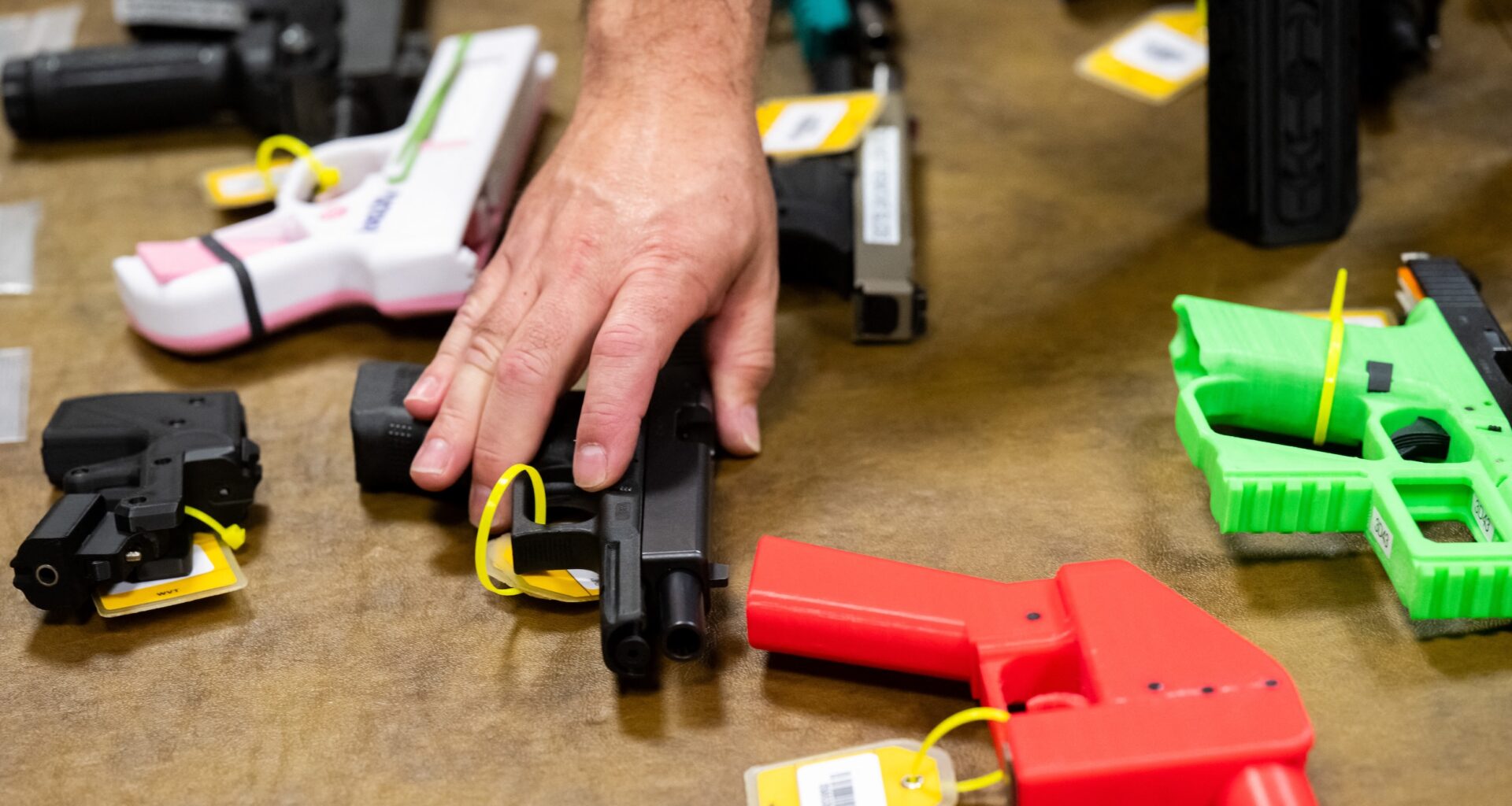
Police in the nation’s biggest city are recovering a growing number of 3D-printed guns, law enforcement officials said. The trend reflects a shift in America’s problem with homemade, untraceable “ghost guns” — from weapons assembled with commercial kits to firearms produced on increasingly affordable printers.
Five years ago, the New York Police Department recovered a single 3D-printed gun, according to data provided to The Trace by the Manhattan District Attorney’s Office. In 2024, the latest year available, that number jumped to 109.
“We have talked so much about the Iron Pipeline,” Manhattan District Attorney Alvin Bragg told reporters on March 31, referring to trafficking routes that funnel guns from states with looser laws to Northeastern cities. “But we have moved from the Iron Pipeline to the kitchen table pipeline. You can sit in the comfort of your own home, at your kitchen table, with polymer and print out a gun.”
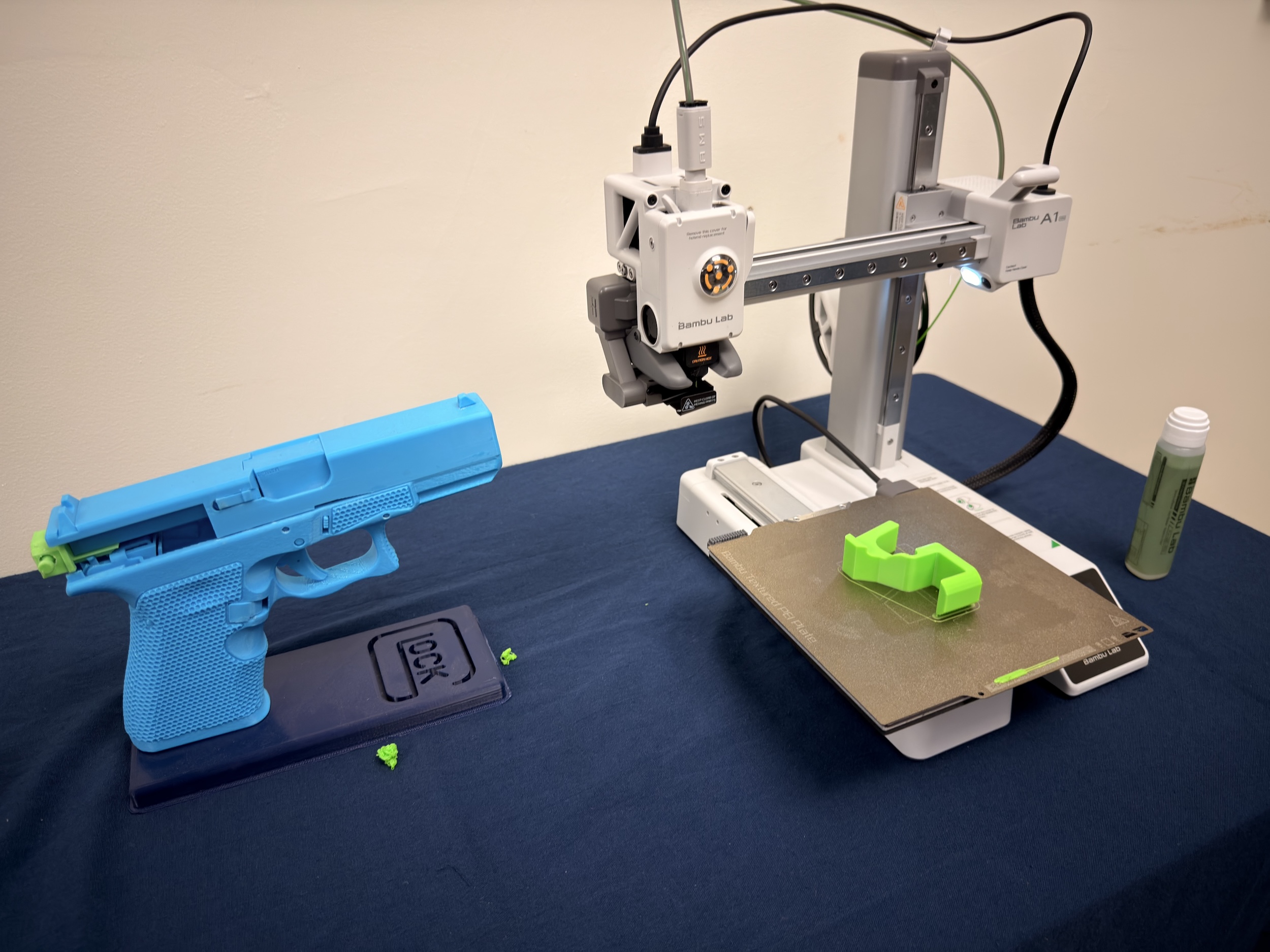 An oversized model of a 3D-printed gun stands next to a 3D-printer at Manhattan District Attorney Alvin Bragg’s office on March 31.
Photo by Chip Brownlee for The Trace
The District Attorney’s Office provided the data after Bragg publicly pressed New York state lawmakers to pass legislation imposing criminal penalties for manufacturing 3D-printed weapons and weapon parts. The bill, proposed by Democratic Governor Kathy Hochul, would also prohibit sharing digital designs for 3D-printed guns.
Ghost guns and 3D-printed guns often overlap, but there are distinctions. Ghost guns can refer to any firearm that’s unserialized and largely untraceable by law enforcement. They have increasingly turned up at crime scenes over the past decade. Between 2017 and 2023, law enforcement nationwide reported a 1,588 percent increase in homemade ghost guns recovered in criminal investigations, many connected to homicides and other violent crimes.
Most ghost guns are assembled at home using commercially manufactured “80 percent” kits. These kits include nearly complete gun components and require minimal technical know-how and just a few hours to be converted into a functional gun.
In 2022, the Biden administration required sellers to serialize kits that could be easily converted into functional weapons and treat them like other firearms. That meant background checks and recordkeeping. The regulations prompted the largest manufacturer of those kits, Polymer80, to shut down, and ghost gun recoveries subsequently dwindled in some cities
Before now, 3D-printed guns made up a small percentage of all ghost guns. Most are assembled from a combination of 3D-printed parts and traditional, commercially sold parts. Fully or predominantly 3D-printed guns are rare and face functional limitations.
New York’s data suggest that 3D-printed gun components could be replacing the now-regulated “80 percent” kits. In 2022, for example, when the NYPD recovered the most ghost guns on record, at 585, just four recovered weapons were identified as 3D-printed. But in 2024, when police recovered 438 ghost guns, the office identified nearly a quarter — 109 — as 3D-printed.
“We’ve seen these weapons recovered in numerous search warrants across the city, along with evidence that they were being manufactured using 3D printers,” said David Stuart, the chief of the Manhattan District Attorney’s Counterterrorism Unit. “We’ve moved beyond the risk that these weapons can be used, and now we see them used in shootings and homicides across the city.”
The increase in 3D-printed guns in New York is the result of technology advancing, Stuart said. “Technology has gotten to a point where 3D-printed guns and ghost guns are just as reliable and operable as any other commercial firearm — and just as dangerous and capable of killing.”
Cody Wilson, who invented the first fully 3D-printed gun and founded and runs an online repository of 3D-gun design files, disputed the notion that the technology has grown more sophisticated and said the increase is more likely the result of 3D-printers becoming more widely available. “It’s not that it’s that much better,” he said. “It’s just that more people can afford it now.” Today, a 3D printer capable of producing gun parts and accessories costs around $200.
But Wilson said the biggest factor is probably the federal regulations. “There’s a reverse psychology to it,” he said. “They banned the Polymer80 kits, and so of course, 3D-printed guns are going to go up because that’s the new avenue.”
3D-printed guns were rarely used in crimes until recently. But in the past few years, they’ve been involved in several high-profile and deadly cases. In 2024, a shooter allegedly used a partially 3D-printed gun and a 3D-printed silencer to kill UnitedHealthcare CEO Brian Thompson in Midtown Manhattan.
Bragg said prosecutors are typically only able to charge defendants with illegal gun possession or violating the state’s assault weapons ban because there is no law against 3D-printing guns generally. “Right now, we are doing a workaround,” Bragg said. “If you print out a hundred of them, we’ll charge you with possession a hundred times.”
Being able to charge defendants with manufacturing 3D-printed weapons, and impose increased penalties, could discourage the behavior, he said.
Bragg said his office has worked with manufacturers of 3D-printers to add safeguards, including voluntary restrictions on uploading gun designs to their online platforms. But gun-specific databases like Wilson’s are a more common source of those files. The New York bill would ban sharing or downloading digital gun designs generally, including from sites like Wilson’s.
“We’ll comply,” Wilson said, adding that his site has adhered to similar laws in states like California, Delaware, and Rhode Island. “That doesn’t mean that I think the law is constitutional.”
Law enforcement agencies nationwide have also reported increases in 3D-printed accessories like auto sears — devices that can boost a semiautomatic weapon’s rate of fire to near that of a fully automatic machine gun. Under federal law, guns equipped with auto sears or switches are treated as machine guns, possession of which carries federal prison time.