

Sixty years ago this summer, 17-year-old Philip Terrie, a counselor at Adirondack Wilderness Camp on Long Lake, summited his first Adirondack high peak, a bushwhack up the lowest and arguably least impressive of the 46 High Peaks: Couchsachraga.
Fortunately for him and for the rest of us, his day hike continued on to neighboring Panther Peak. In his latest book, published in his 78th year, Terrie memorializes the view as “jaw dropping,” “deeply emotionally compelling” and “soul stirring and unforgettable.”
Those adjectives will resonate with any Adirondack peak-bagger and wilderness lover, even if the 46er number Terrie earned three years later, #772, sets him apart in an era with nearly that many finishers in a single year. But in “Wild Forest Lands: Finding History and Meaning in the Adirondacks” (Syracuse University Press, 2025), which Terrie says is likely the capstone volume in a decades-long body of work that establishes him as the preeminent environmental historian of the Adirondacks, the journey he documents since that unforgettable day hike roams far beyond a typical outburst of wilderness appreciation.
The “meaning” referred to in the book’s subtitle says it all. Terrie grapples with capital-W Wilderness—the land classification protected by the state constitution’s “forever wild” provision, in which he’s played a critical role in the courts—as well as his personal devotion to small-W wilderness, starting with what he calls the center of his “spiritual geography” at the northern, undeveloped end of Long Lake. It’s there he and his family have kept a lakeside camp since 1980 that features one of the cabins from the summer camp that introduced Terrie to the region.
That personal thread, interwoven with the history of “forever wild” protections and the various stabs at defining wilderness in public policy, sets this book apart from others in Terrie’s bibliography.
On a frigid but sunny day in February, Terrie sat down with the Explorer at his home in Ithaca to discuss why, since his 1979 doctoral thesis, he has devoted so much research and thought to discovering the meaning of wilderness in the Adirondacks—and how he finds ways to reconcile two sets of tensions: between wilderness protection and economic interests, and between a recognition that European-Americans were relative late-comers to the region while maintaining a sense of wonder, as Terrie puts it, about “a place that looks like it used to, or at least like what we think it used to.”
The conversation has been edited for length and clarity.
You’ve been telling essentially the same story from various angles your entire working life.
(Laughs) That is true. That is very true.
And that’s, like, half a century. What about it fascinates you?
I think part of the appeal is the things that are obvious. I love being in the woods. I love watching nature work. I like the thrill of climbing up a mountain. I like the views. I like the adventure.
I think another factor is that my attachment to the Adirondacks began when I was an adolescent. It’s like first love. And I’ve had the great good fortune to stay with it all that time. I think the fact that my career enabled me to maintain this connection in the way that I have is a good piece of luck. You know, what if I’d become a lawyer? It wouldn’t have worked out this way.
You could say that I’ve written the same book five times.
But they’re really not.
No, they’re not, but there’s a cumulative drive here. And part of that is because other people are writing things that I find really interesting, and they make me look at primary documents in a different way, make me understand historical trends in ways that I missed the first time through.
Did you take offense that Curt Stager and David Kanietakeron Fadden in their new book used your claims in “Contested Terrain” to rebut the notion that year-round residents were unlikely?
I did not take offense. I found it embarrassing. As I said to Curt [Stager], if you make sweeping statements and generalizations, and somebody finds out that they’re wrong, you can do two things. You can dig yourself in deeper and deeper and make a fool of yourself, or you could admit that we know more now. And I hope that’s what I’m trying to do here.
You know, I was already heading that way. Melissa Otis’ book really got me going on that. It’s a really good book. It’s called “Rural Indigenousness” and it was published about six or seven years ago. She makes a lot of the same points that Fadden and Stager do.
I met her when she was just starting the project. There was a meeting on New York history at Plattsburgh, and she came up to me and wanted to talk about this, and I pretty much said, “There’s no topic there. There’s nothing to write about.”
That was about 20 years ago. I think that was a little bit too quick on my part.
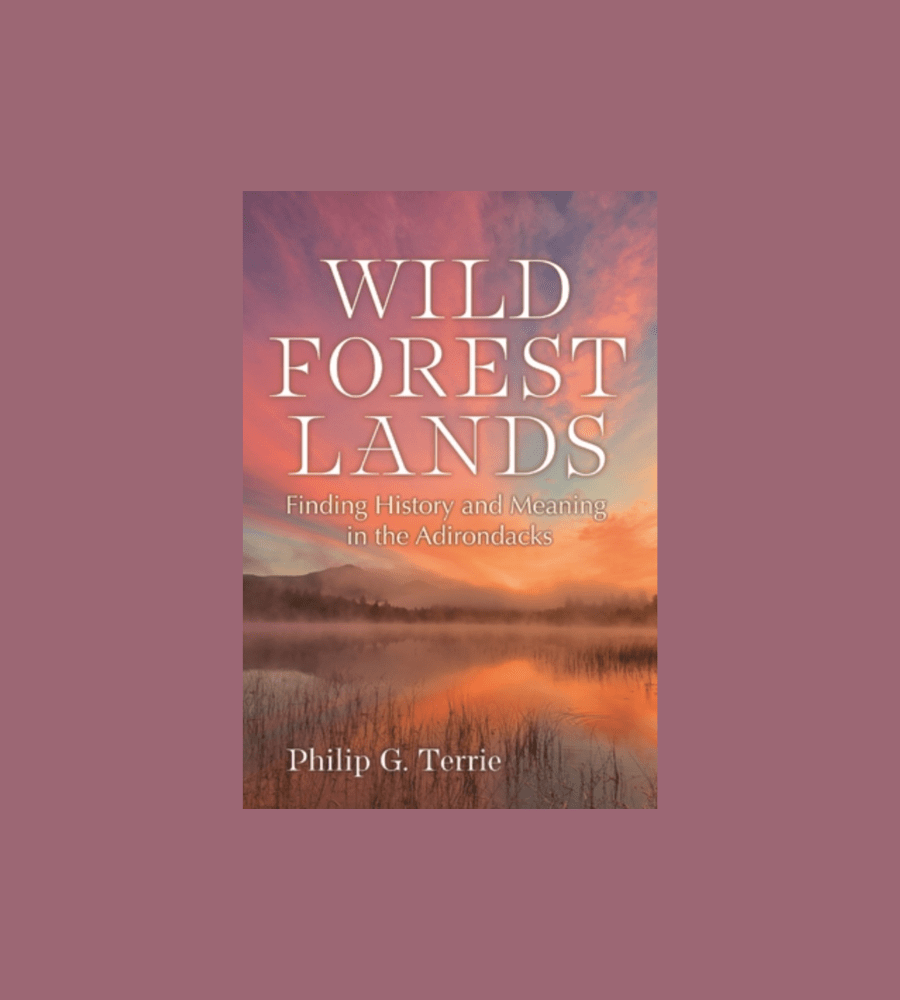
Phil Terrie’s latest book
‘Wild Forest Lands’ blends memoir, philosophy and constitutional history of Adirondacks
What’s the most important realization you want us to get from your new book?
I think that the unifying theme of the book is a search for meaning, in many different places. What does timber mean? What does wild forest mean? What is the meaning of wilderness? What is the meaning of scholarship on wilderness? How does this provide meaning to people’s lives, the spiritual meaning? And so I think that’s the thread that ties it together.
If there’s a message, which is probably a little bit different from theme, it is that this is a treasure, and it is always vulnerable in so many ways. Somebody once said to me that in environmental contests, we never win. The best we get is a tie, because the other side will be back. But if you have a loss, you can’t go back.
So what we have in the Adirondacks is basically a series of ties, which seem like victories at the time, but you never know. Nothing is permanent. Even the Constitution can be changed or ignored. So, it’s eternal: the need to watch out for the park, in all that that means, and for the forest preserve, which is a little bit smaller than that, and for wilderness itself, as such. All those demand constant vigor.
Why is it so hard to define wilderness? There’s no single definition, is there?
No, there isn’t. There are working definitions, like in the National Wilderness Act, and in the state land master plan. There are dictionary definitions, which are inevitably vague. I think one of the main reasons it’s so hard to define is because it is, in fact, a cultural construction. You know, not all cultures even think about this. Ours does, and that is a reflection of centuries of values projected onto the land. So, it is a very personal thing.
Another thing is that we ask wilderness to do so much. We ask it to be habitat for certain species that need uncorrupted places. We ask it to serve as a place for adventure. We ask it to be scenery. We ask it to be church. And so all those things, they add up to a sense of what it is. But I don’t think you’re ever going to get to an absolute airtight definition.
In the book you describe your reactions to William Cronon’s thesis, that wilderness is a cultural construct, which at first struck you as denying its specialness; merely a state of mind instead of something real. Eventually, you decided that you can accept his argument and still appreciate something called wilderness. Can you unpack that a little? How do you juggle those two?
Like a lot of people, I thought that he was saying that a cultural construct means it’s a lie. That you’re being deceived somehow.
To say a thing is a cultural construct is not to say it doesn’t exist. You know, democracy, gender, race, love—so many things are projections of cultural values, or personal experience, or how those things all mix together. So, it just took me a while to get there.
I think that it has been misread by so many people. I’ve talked to students who just want to dismiss the whole idea. “Ah, this is elitist bullshit. Wilderness, you know, only white people say that.” That’s part of the story, and it’s a very important part of the story, and we must not fail to acknowledge that. But it’s not the whole story.
And because you’ve trod those grounds in the backwoods enough, you have more of an appreciation than just the purely academic one.
I think so. I hope so. That’s what I’m trying to do.
One thing I hadn’t thought much about until I read your book was the extreme effect on the environment of natural occurrences, like the 1950 blowdown that you write about. You make the point that these things will always happen. That’s part of the changes that the wilderness undergoes. It doesn’t necessarily take away the point that it’s still wilderness.
I don’t think it does at all. I think that the issue of change is very hard to put your finger on this exactly. And I try to talk about that, the difference between anthropogenic change and natural change. It’s kind of hard to make [the distinction] sometimes, because blowdown is knocking trees over, and so is logging. But, obviously, there’s a philosophical, essential difference there that can’t be escaped.
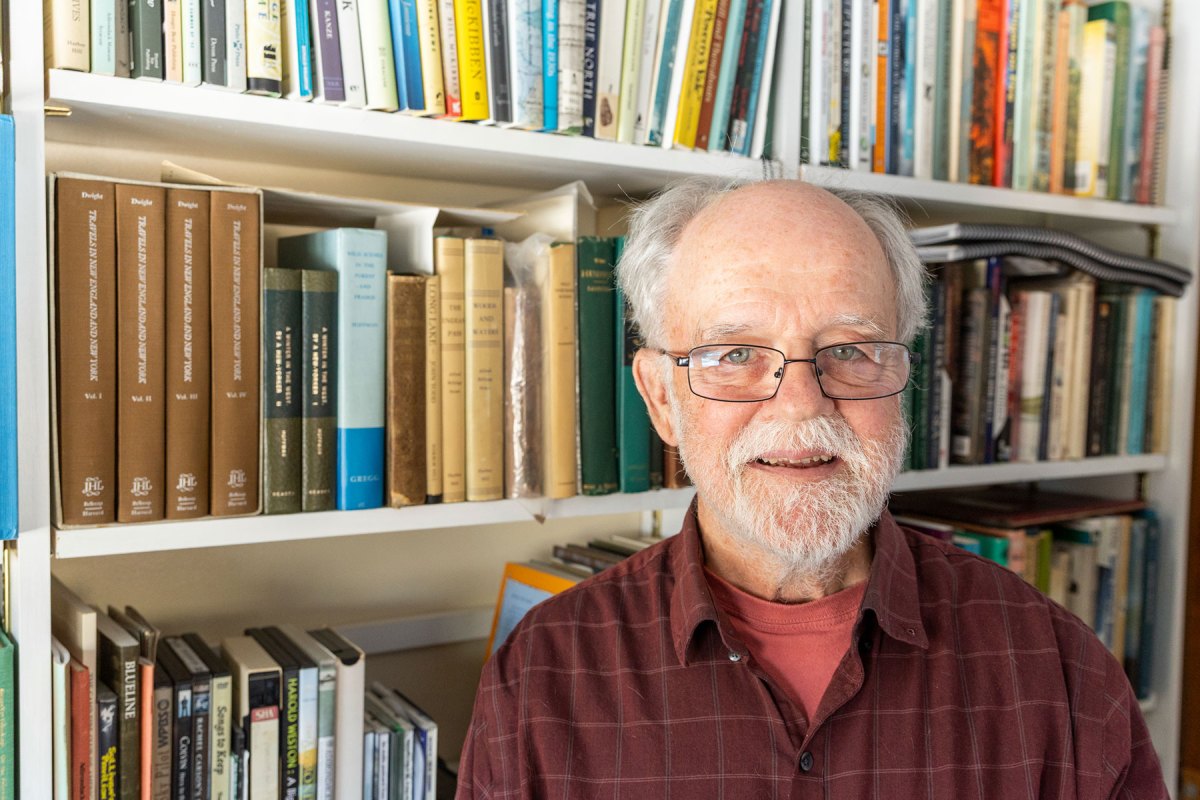 Author and historian Phil Terrie at his home in Ithaca. Photo by Simon Wheeler
You write about starting your 46er quest with a bushwhack up Couchsachraga, which would not be most people’s first choice.
I didn’t know what I was doing.
But it was Panther, as you relate in the book, that really grabbed you.
It did. That was on the same day in July in 1966. It was just an incredible day. It was blue sky. It was like a day in September.
It doesn’t sound like you’re down on the whole 46er concept, which some people have said encourages overuse of delicate wilderness.
No, I don’t think so. I think I was 25 years ago. I think we do have an overcrowding problem in the Eastern High Peaks. But it’s not a crisis of huge dimensions, the way some people make it out to be. You could go to Johns Brook and walk three-fourths of a mile perpendicular to the trail and you’d be absolutely surrounded by wilderness, and nobody’s around.
I used to be more critical of it than I am now. I think it’s perfectly benign, and I think it’s a great introduction. I think an awful lot of people, they’re probably going through the same process I did of being just into the scenery, and then you get more and more thoughtful about what it is you’re doing here. And then you start exploring other places.
When’s the last time you climbed Panther or Cooch?
Oh, my goodness.
And will you again?
I don’t think I will again. I climbed Noonmark last September. I was exhausted. But I wasn’t sore the next day, so I’m in pretty good shape. But I don’t like to sleep on the ground. I think this business of 46ers doing all these hikes in day hikes is so different from what it was for me.
I so agree.
I don’t understand that, at all. Because the whole joy of it, to me, was being out in the woods for three or four days. (As for Panther and Cooch,) the last one I climbed was Cooch, which I did with some friends. Early ’90s, probably.
OK, it’s been a while.
Yeah, it’s been a long time. The only High Peak I’ve climbed recently is Cascade, and that was probably 15 years ago. I’m trying to do a lot of the mountains that are not High Peaks. You know, my wife and I really like Hurricane. We pretty much do that every year. Late September, early October. I love the view from there.
I think some of the best views are from the ones slightly lower, like Mount Adams. I love the view from there.
Anything else you want to add?
We need to know history. And that’s particularly important right now when we have a climate of trying to destroy, erase it, hide it. I think every museum exhibit, every book that’s written on history, the underlying message is that history matters. History is an important part of being human, and of being Americans.
And so we must always remember that. History matters.