
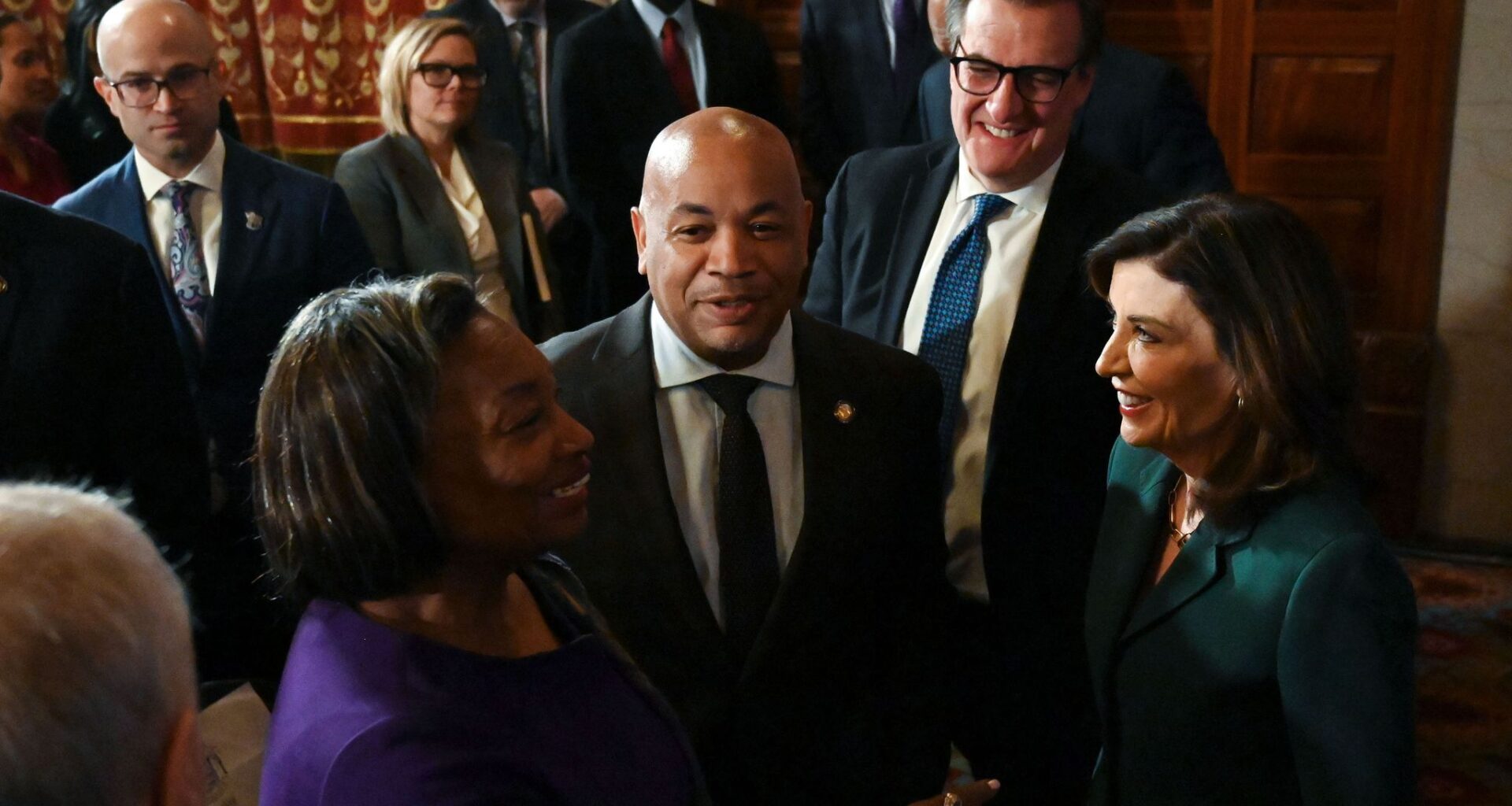
Senate Majority Leader Andrea Stewart-Cousins, left, and Assembly Speaker Carl E. Heastie, center, have both said Democrats in their respective chambers aren’t aligned with Hochul’s proposals intended to lower the cost of car insurance.
Will Waldron/Times Union
Gov. Kathy Hochul proposed auto insurance changes as part of her state budget this year. They remain one of the top sticking points in discussions with state lawmakers.
Lori Van Buren/Times Union
The governor has rallied repeatedly in recent weeks in support of her state budget proposals, including her package of car insurance measures.
Mike Groll/Mike Groll/Office of Governor Ka
Assemblywoman Jennifer Lunsford opposes Gov. Kathy Hochul’s proposals, saying the state should enact tighter scrutiny on auto insurance companies instead of changing the state’s laws around litigation.
Lori Van Buren/Times Union
Ashley Ranslow, New York director at the National Federation of Independent Business, supports Gov. Kathy Hochul’s insurance proposals, saying they would reduce costs for businesses.
Mike Groll/Mike Groll/Office of Governor Ka
ALBANY — Gov. Kathy Hochul has yet to convince Democrats in the state Legislature that a slate of proposals she’s pushing for in state budget negotiations to reduce auto insurance rates will do just that.

She’s seeking to cut costs for auto insurance companies by placing new limits on the amounts paid out to certain drivers after a crash, in hopes those savings will be passed on to policy holders.
Article continues below this ad
Those changes would amend sections of state law that, Hochul has argued, can incentivize staged car crashes. Those incidents, which have become an underground criminal industry, can result in litigation that seeks to secure hefty payouts from auto insurers.
“People are making money off of staged crashes and the penalties are not severe enough to stop,” Hochul said at a news conference in Broome County. “There’s a whole ring going on.”
The general idea has broad support, including from those companies, who’ve lobbied Democrats in the state Legislature for their passage in recent months. There has also been support from trade groups that represent small and large businesses across New York.
Make the Times Union a Preferred Source on Google to see more of our journalism when you search.
Add Preferred Source
“The only way to make insurance more affordable is to make it more available by addressing the root causes driving the cost of insurance,” said Cassandra Anderson, president of the New York Insurance Association.
Article continues below this ad
That idea has been met with resistance from Democrats in the state Legislature, who are skeptical insurance companies would choose to collect less from consumers if Hochul’s proposals benefit their bottom line.
“I want to make sure that if there’s things the insurance companies can do to help lower prices, that they’re doing that as well,” said state Senate Majority Leader Andrea Stewart-Cousins, a Democrat from Westchester County.
Yet few rank-and-file lawmakers have been willing to side against Hochul in public, instead offering their perspectives in private while negotiations around the state’s spending plan drag on.
Assemblywoman Jen Lunsford, a Democrat from Monroe County, was the lone member of the state Legislature who joined opponents of Hochul’s proposal this week during a rally at the state Capitol.
Article continues below this ad
“I simply do not see rates being returned to New Yorkers, at all, that they will feel, that will justify the loss that injured people will have,” Lunsford said.
Hochul’s proposed changes would overhaul how litigation seeking damages after a car crash is handled in state courts.
New York is currently what’s called a “no-fault” state. That means someone can receive a payout for economic damages, including medical bills and lost wages, regardless of whether they were at fault for a crash.
Hochul wants to prevent damages from being awarded to drivers who are found to be more at-fault for an accident, even if the other driver’s actions also contributed to the crash.
Article continues below this ad
Her proposal would also narrow the definition of what’s considered a serious injury for the sake of recovering non-economic damages, also known as pain and suffering, to largely exclude temporary injuries that don’t involve a fracture or the limitation of “a body function or system,” according to Hochul’s proposed legislation.
A third proposed change would also limit non-economic damages to $100,000 for drivers found to be driving while intoxicated, without insurance or using the vehicle to commit a felony at the time of the accident.
New York would not be the first state to make those kinds of changes in an effort to lower auto insurance rates.
“This has been done in other states,” said Ashley Ranslow, New York director at the National Federation of Independent Business. “It has proven to work.”
Article continues below this ad
Florida lawmakers approved a similar package of legislation in recent years as well. That state’s changes were initiated in 2022 and 2023, and have since led to requested rate reductions from auto insurers in the Sunshine State.
The five largest auto insurance companies in Florida, which represent more than three-quarters of the state’s market, implemented average rate reductions of more than 6% last year, according to the Insurance Information Institute.
That’s not guaranteed to happen in New York if Hochul’s proposals are approved by the state Legislature. It would not require auto insurance companies to reduce their rates.
New York has a law on the books that mandates auto insurers return excess profits to policy holders. But those earnings are viewed through a six-year window, meaning one year of large profits won’t necessarily result in a refund.
Article continues below this ad
Hochul is proposing to extend that law but isn’t seeking to change it. Democrats in the state Legislature have said they want tighter scrutiny on auto insurance companies if they’re going to reach an agreement on Hochul’s proposals.
They’re also concerned about the impact Hochul’s proposals could have on drivers who aren’t involved in staged crashes. Several Democrats oppose limiting damages for one party involved in a crash when both are partly at fault.
“That’s a pretty serious thing for people to accept,” said Assembly Speaker Carl E. Heastie, a Democrat from the Bronx.
“If I could just blink my eyes and insurance rates will go down, I’m sure my constituents will be happy,” Heastie said. “But that’s one of the issues we have to deal with.”
Article continues below this ad
Another issue lawmakers want to address as part of discussions with Hochul is how auto insurers determine the rates charged to different drivers.
Lunsford has introduced a bill that would prohibit insurance companies from charging drivers different rates based on a series of factors, including someone’s marital status, educational background and geographic location in New York.
“Those have nothing to do with our driving records, with the likelihood of us filing a claim — things that have an actuarial basis in reality for which someone might pay more,” Lunsford said.
Hochul has attributed the resistance from some lawmakers to the state’s trial lawyers, who have historically been influential with Democrats in the state Legislature. Her proposals are expected to cut into the business model of personal injury attorneys.
Article continues below this ad
She’s argued that lawmakers oppose her proposals out of an interest to protect those attorneys — not crash victims.
Tom Stebbins, executive director of the Lawsuit Reform Alliance of New York, which advocates against what it views as excessive litigation, said if that’s not the case, lawmakers should prove it.
“It’s time to shake the stink of past plaintiffs’ lawyer influence schemes and shenanigans and get on board with these reforms,” Stebbins said.
Article continues below this ad
Hochul and lawmakers are now beyond the April 1 deadline for the state budget and have begun to pass temporary extensions of spending as discussions continue in Albany.
An earlier version of this story misstated the definition of a “no-fault” state.