
This is New York.
Not just any city, but the capital of the world. And Brooklyn—our Brooklyn—is its heart.
So why are we being asked to settle for something so ordinary?
The proposed plan for the Brooklyn Marine Terminal isn’t bold. It isn’t visionary. And for a site of this importance, that’s not just disappointing—it’s unacceptable. What’s on the table feels less like a once-in-a-generation opportunity and more like a standard real estate deal—the kind of project that could be dropped anywhere, disconnected from the very thing that makes this place special: the waterfront itself.
We should be clear: we are not against change. We are not against development. And we are certainly not against growth.
But we are against mediocrity.
Because what’s being proposed does not reflect the ambition, creativity, or global leadership that New York is known for. It does not reflect the ingenuity of Brooklyn. It does not represent the spirit of the greatest borough in the most dynamic city in the world. And it does not come close to what this site could become.
Brooklyn deserves a world-class waterfront—nothing less.
And we know what that looks like.
Across the country and around the world, cities have transformed their waterfronts into places of identity, purpose, and pride. In Copenhagen, the harbor is clean enough to swim in and designed as a shared civic space. In Barcelona, the waterfront is seamlessly integrated into the life of the city—active, accessible, and alive. In Paris, the city made a deliberate choice to reclaim its riverbanks for people—closing sections to cars and turning the Seine into a place to gather, linger, and live.
And in San Francisco, the Embarcadero stands as one of the most powerful examples in the country—where a former highway was removed, the waterfront was reconnected to the city, and public space, commerce, and access to the water were prioritized over speed, traffic, and short-term gain.
These places didn’t happen by accident.
They happened because those cities refused to settle.
And here in New York, we have something even more powerful: a working harbor.
That’s what makes this site different.
And yet, instead of leaning into that strength, the current plan treats the waterfront like a backdrop—something to be built next to, not something to be experienced, protected, and elevated.
That’s not how great waterfronts work.
As the Social Life Project has shown through its global research, the most successful waterfronts are not defined by towers—they are defined by life. By activity. By people.
By purpose. By a mix of uses that create energy throughout the day and across seasons.
So we have to ask:
Are we really going to accept a walling off of our waterfront with dull luxury towers?
We shouldn’t.
We can not.
Because what makes this even more frustrating is that bold, innovative ideas already exist—right here in our own community.
We’ve seen maritime-forward visions like the Tom Fox City Club proposal, which reimagines the site as a hub in a revitalized Blue Highway network—taking trucks off our streets and putting freight back onto our waterways where it belongs. We’ve seen bold concepts like the Jim Tampakis plan, grounded in the reality that this is one of the last working waterfronts in New York and should be treated as critical infrastructure, not just real estate.
We’ve seen the Social Life Project bring global insight into how great waterfronts function—not just as places to live, but as places to gather, to work, to connect. We’ve seen innovative thinking from Portside New York, from the Community Energy Network Plan, and from Pratt students and independent visionaries like Adam Dore-Young—each offering pieces of something bigger, something better.
And these are just some of the ideas.
There are many more.
Yet time and again, the community has been treated as a bystander in decisions that will shape its future. The process has too often felt closed, predetermined, and dismissive of the very people who live here.
That cannot be the standard for a project of this magnitude.
Because this is Brooklyn.
We should not accept a future that falls short of what we know is possible.
Great cities are not shaped by playing it safe. They are shaped by bold decisions, by imagination, by a willingness to think beyond what is easy and reach for what is possible.
Look at our history. The Brooklyn Bridge. Central Park. The High Line. These were not small ideas. They were ambitious, even controversial at the time. But they endured because they aimed higher.
That is what this moment demands of us.
We should be asking: what would it look like to truly honor this waterfront?
A place where maritime industry and public access coexist. Where working piers and public spaces are not in conflict but in conversation. Where resilience, climate adaptation, and economic opportunity are built into the foundation—not treated as afterthoughts.
We can build housing anywhere.
But we only have one waterfront.
And once it’s overbuilt, privatized, or stripped of its purpose, we don’t get it back.
This is Brooklyn—we don’t accept mediocre or mundane. The EDC’s plan is the laziest, most unimaginative waterfront plan we’ve ever seen. Nothing that represents the spirit of the greatest borough in the most amazing city in the world.
Nah, not in BROOKLYN!
We demand a World Class Working Waterfront for All & nothing less!
Join us. Learn more. Get involved.
Visit ColumbiaStWaterfront.com and sign up to be part of building the future this community deserves.

John Leyva has lived in his two-bedroom apartment at 63 Tiffany Place in the Carroll Gardens neighborhood of Brooklyn for over 30 years. He moved into the building in 1994 under a tax agreement between the city and the landlord to maintain the apartment’s affordability for the next 30 years. But Leyva now says his home may soon become too expensive for him and many of the other tenants in the 70-unit structure. He formed SAVE 63Tiffany to advocate for the building, and from that has become a true community leader. He has recently been elected Vice President of the Columbia Street Waterfront Association and smoke Cuban cigars when he can get them.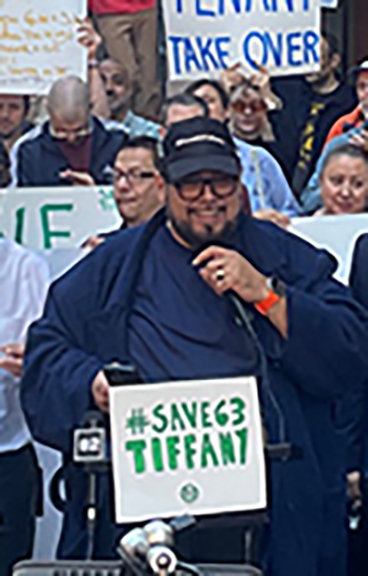
Discover more from Red Hook Star-Revue
Subscribe to get the latest posts sent to your email.