
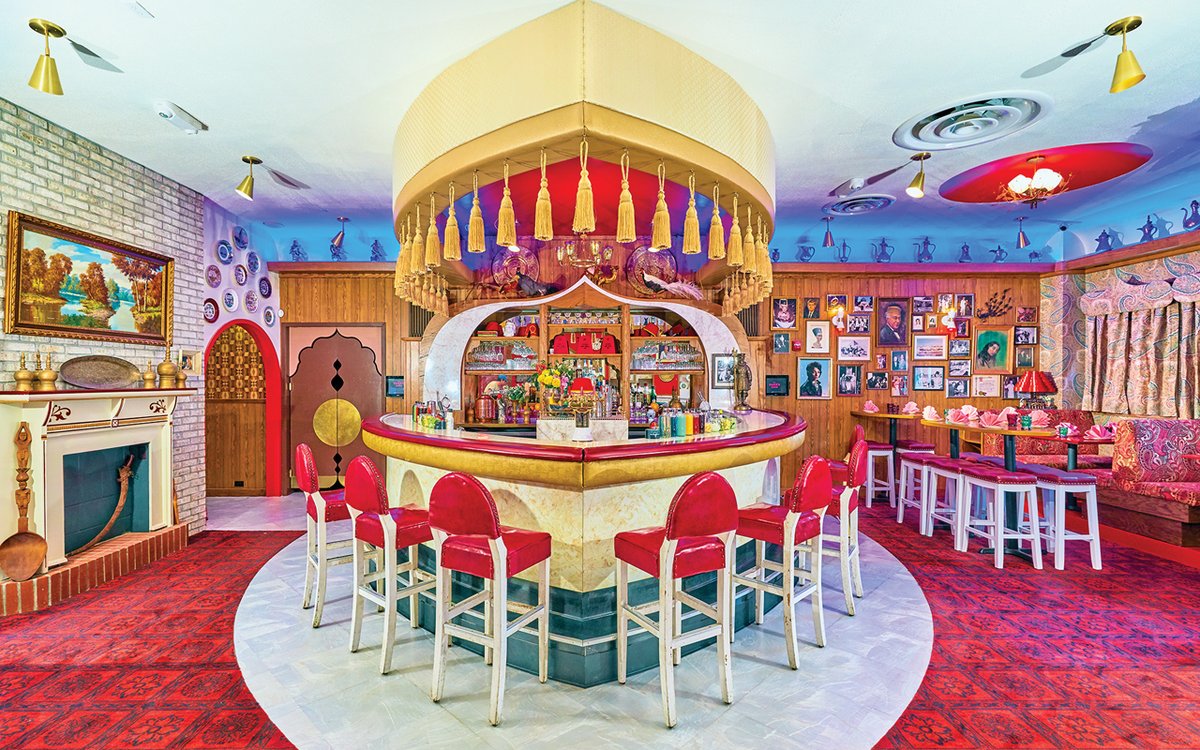
Little did he know it then, but summers spent in the Northwoods of Wisconsin gave a young Varun Kataria early and enduring doses of design inspiration. The surprising source? The Turk’s Inn, a legendary supper club filled with a trove of decorative treasures just north of Hayward on U.S. Highway 63, where he and best friend Tyler Erickson would often stop on the way to Erickson’s family cabin.
When The Turk’s Inn closed in 2013 after 75 years in business, Kataria—who was born and raised in Minneapolis and whose mother, Anju, owns the shop Khazana on Lyndale Avenue—was quick to purchase many of the restaurant’s effects at auction with Erickson, still his best friend and now his business partner. From there, the pair transported everything to the Bushwick neighborhood of Brooklyn, re-creating The Turk’s Inn as a nightlife destination. (Read more about it and Kataria’s other clubs on page 23.)
Today, his love of design in New York, where he has lived just shy of 10 years, fuels many of his creative pursuits. Here are his top picks—some familiar, others far off the beaten path.
Icons
Popular as they are, these perennial favorites lead off Kataria’s list, beginning with the Solomon R. Guggenheim Museum. “It’s a really special spot,” he says. “When you start at the top and move down the gently sloped ramp, you almost feel like a marble tumbling down, looking at art as you roll by. The slight slant plays with your sense of perspective and grounding.” Nearby and worth multiple visits throughout a lifetime, The Metropolitan Museum of Art is what Kataria describes as “a temple to beauty and grand beyond imagining—a repository of human creativity and beauty across cultures and time spans.”
Yet another New York touchpoint, Grand Central Terminal, also makes the cut. “Anybody would recognize the grand hall with the constellation patterns on the ceiling,” Kataria says. But his favorite part might just be the oyster bar a flight of stairs down. “It feels frozen in time—arches, tile work, even the graphic design of the menus and plates and the way people dress,” he says.
Kataria finds inspiration in the city’s streetscapes, too, starting just outside Grand Central. “I have a convertible here, and from time to time I find myself driving up or down Madison and Park Avenues, top down,” Kataria says. “It’s such an iconic experience—Gotham all around you.” At a more intimate scale, he points to Doyers Street, a “quirky little L-shaped alleyway” in Chinatown. “It looks like a movie backdrop,” he says. “If you had to film a gangster movie in Chinatown, this is the street you’d shoot it on.”
Restaurants and Bars
Kataria starts with a restaurant in Queens called Zum Stammtisch, which he describes as New York’s equivalent of the Black Forest Inn on Nicollet in Minneapolis— a sort of Bavarian time and space capsule. “You walk in and you’re like, ‘We’re not in New York anymore.’ It’s very decorated, and everybody dresses the part.”
On the subject of transporting you someplace else, Xiang Hotpot in Brooklyn transports you to “some sort of quaint rural Chinese hot pot spot,” Kataria says. “The setting, the plating—everything is fantastical. It’s one of those places that reminds you New York is a city unlike any other.” Another Chinese food favorite, but in the East Village, Mountain House “feels like you’re in a little mountainside somewhere in the boonies of China,” Kataria says. “It takes you completely out of the urban jungle of New York.”
So does Keens Steakhouse. “It could have come out of Revolutionary-era America—it’s got the feel of an old tavern, and there are hundreds, maybe thousands, of smoking pipes hanging from the ceiling,” Kataria says. “They’re famous for their mutton chop, and I don’t know anywhere else in the city you can get a mutton chop.”
On an entirely different plane, the “minimalistic yet opulent” interior of The Grill—the restaurant in the space that long housed The Four Seasons Restaurant in Mies van der Rohe’s Seagram Building—wows Kataria every time. “They have these metallic curtains that shimmer and an incredible centerpiece chandelier with a similar metallic, threadlike structure,” he says. “It’s not an everyday experience, but a grand one.” He also loves Bemelmans Bar, the piano bar at The Carlyle Hotel wrapped with storied murals by Ludwig Bemelmans. “Old waiters wearing red blazers serve you $30 martinis with little snack trays,” he says. “It’s a perfectly styled place and a great prelude to whatever the rest of your night will be.”
Russ and Daughters—what’s called an appetizing store, Kataria notes—combines a fish-forward deli with beautifully displayed groceries. “When you walk in, the way they display their wares—whether it’s smoked fish or candy and prunes—it’s so artfully displayed that it almost feels like it’s set up by an interior designer,” Kataria says. He points to another smart design twist at Dimes, “basically a hippie health food restaurant, but done in the most sophisticated way.” The simple white interior provides a backdrop to tables in unique shapes—not rectangles—and in different colors of laminate. “The simple and humble materials highlight the creativity and health of the food itself,” Kataria says.
Music and Nightlife
It’s impossible to overlook Radio City Music Hall, Kataria says. “To me, it’s the grand, iconic New York performance space theater. The backdrop seems to be the inspiration for the Looney Tunes graphic circle in the back—I’m just guessing on that—but that’s what it feels like. It’s recognizable across different cultural touchpoints.”
More on the gilded end of the spectrum is Kings Theatre in Brooklyn. “It’s just so incredibly detailed and ornate,” Kataria says. “It’s hard to fathom they achieved that amount of density of decoration in such a vast space.” Also in Brooklyn, but at an entirely different scale, Pete’s Candy Store is one of Kataria’s favorite places to catch a show. “They nailed the essence of tiny cabaret—miniature but iconic,” he says.
A little off the beaten path but familiar to Kataria is Knockdown Center in Brooklyn, a cavernous industrial building turned flexible performing arts spaces and nightclub. “The aesthetic of industrial club [music] is really exemplified by Knockdown Center,” he says. A club within the club, called Basement, “is even harder and more serious and heavy in the music and heavy in its décor,” Kataria says. “It’s reminiscent of the industrial techno clubs of Berlin—it’s New York’s version of that.”
For a quirky “wacky circus vibe,” Kataria can’t help but mention Rubulad. “It’s a space that has been holding down the fringe art, circus, DIY, outsider art aesthetic and programming for a really long time now,” he says. “It’s the kind of place you stumble into and feel you found a pocket of magic and mischief.”
A dive bar in Brooklyn called 101 Wilson, just down the street from where Kataria used to live, may seem odd for a design list “because it’s one of the crappiest-looking places on the planet,” he laughs. “But they took the aesthetic of a graffitied-out bathroom and made a whole establishment out of it. There isn’t one square centimeter of this place that isn’t covered in pen markings and graffiti.”
Right on the border of Brooklyn and Queens, a small wine bar/techno club called Mansions resembles Grandma’s basement with wood-paneled walls and carpet—even on the dance floor, Kataria says. “They bring in some of the most forward-thinking DJs I’ve heard in the city. The juxtaposition of electronic music with Grandma’s basement is irresistible.”
Tatiana, a Russian nightclub in Brighton Beach, Brooklyn, complete with vodka and caviar, feels straight out of the ’80s, Kataria says, and that’s why he’s drawn to it. “The black marble and even the concept of the music and the show feels frozen in time—not old enough to be vintage but definitely not new anymore,” he says.
Innovative Art Spaces
Pioneer Works in Red Hook, Brooklyn, is one of Kataria’s favorite examples of an industrial building recast for art. One of its founders, Dustin Yellin, creates sculptural work that Kataria says “creates the visual effect of 3D objects by collaging images between panes of glass,” and his personal studio sits right next door. Across the river in SoHo, another art space—The New York Earth Room—has fascinated Kataria since he was in his teens. “It’s a display space for one art piece, which is a giant mound of earth,” he says. “You’re in a clean, white gallery, and you have the mustiness, scent, and moisture of dirt. It makes no sense, and I think that’s why it exists. It’s one of the oddities of New York—an example of New York’s historical weirdness.”
Shops
Kataria never tires of this trio, starting with Coming Soon, a home-goods boutique on the Lower East Side, which sells “whimsical, colorful, and artistic versions of common objects” such as shower curtains, place mats, and vases. In Chelsea, Mantiques Modern focuses on antique furniture and fixtures. “It’s a great place to buy a chandelier, with an incredible selection and tight aesthetic,” Kataria says. And for clothes, he loves to check out the latest at Dover Street Market in Murray Hill, the New York flagship of a small global chain of high-concept department stores with high-fashion labels. “Every inch of that place feels designed and artistic,” he says. “And while what they sell is quite expensive, you can still find great deals, and it’s an art and design experience.”
R&R
For Kataria, Wall Street Bath and Spa 88 is as much about fascinating aesthetics as anything. “To be in Wall Street and step into a basement and be taken to a very gaudy marble-adorned spa is a really wild experience,” he says. “There are jars of vodka, beets, and pickles—an odd mixing of spa services and basically a Russian bar lounge.”
Varun Kataria’s Portfolio
The Turk’s Inn
After visiting The Turk’s Inn shortly after it opened in 2019, The New York Times said, “It’s hard to resist the exuberant silliness of the atmosphere.” And that was exactly what Varun Kataria wanted with the re-creation of the Hayward, Wisconsin, supper club in Brooklyn. “We actually took the original bar itself and then pretty much the entire interior so that when you walk into the space in Bushwick, you’re effectively walking into The Turk’s Inn. We were as meticulous as humanly possible—even the carpet pattern matches the original. So it’s that level of deep re-creation.” The rooftop bar includes the original neon sign that hung for decades at the supper club’s original site on Highway 63.
The Sultan Room
Next to The Turk’s Inn, this music venue with a style Kataria describes as “Las Vegas by way of Beirut” is finished with interior elements from the old Nye’s supper club in Minneapolis, including a tufted door and upholstered booths. “The hallmark of The Sultan Room is this really beautiful stage backdrop—a geometric light wall made out of old technology with strips of light diffused through acrylic panels,” Kataria says.
Xanadu Roller Arts
In 2024, just down the street from The Turk’s Inn and The Sultan Room, Kataria and best friend and business partner Tyler Erickson opened Xanadu Roller Arts—a roller rink that also serves as a music and performing arts venue. “You leave Bushwick and enter this uncanny fantasy space,” Kataria says. “It feels like the roller rinks of your childhood with nostalgic touches, yet also like no rink you’ve ever seen before.” The hand-painted motif on the 60-by-120-foot rink floor is by Minneapolis artist Eric Carlson.