
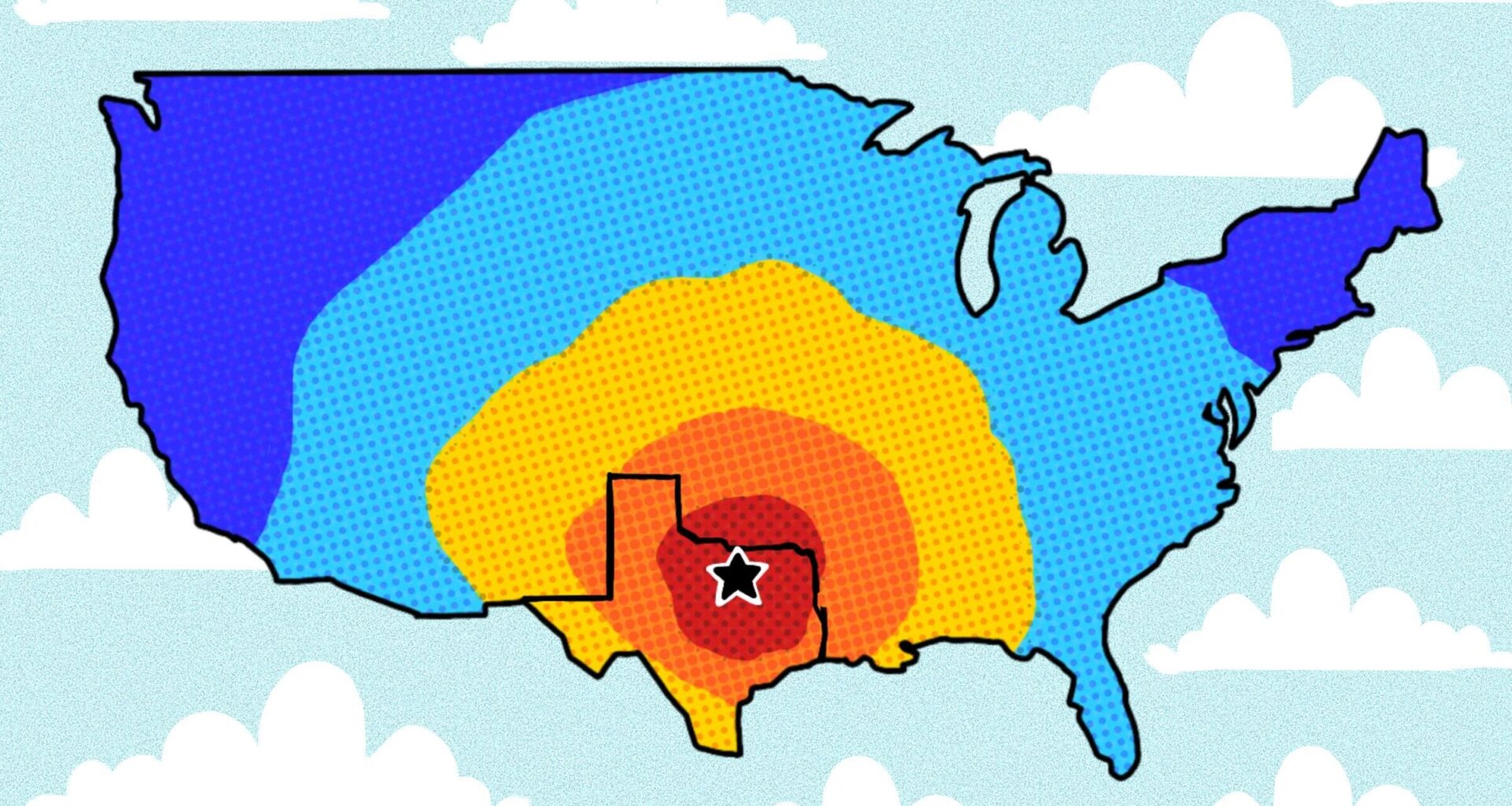
Last Saturday, after a heated debate over whether drinking water out of a bottle without touching it to your lips is called “waterfalling” or an “air sip” (the correct answer is “waterfalling,” in my opinion), my friends and I decided to take The New York Times U.S. Dialect Test. Our group is scattered across the country — from Wisconsin in the Midwest, to New Jersey on the East Coast, to me in Texas in the South. While I don’t have a prominent Southern accent besides occasionally saying “y’all,” I was confident the test wouldn’t be able to guess I was from the South.
The first question the test asked was, “How would you address a group of two or more people?” This question made me laugh, as my friends in Michigan often tease me for saying “y’all,” claiming that I pronounce it with an inherently Southern drawl. I argue that people all over the United States use “y’all,” and that a test cannot determine my location based solely on that phrase.
Other questions included: “What do you call the rubber-soled shoes worn in gym class or for athletic activities?” (Tennis shoes), “How do you pronounce aunt?” (To sound like ant) and “What do you call the small freshwater lobster often found in lakes and streams?” (Crawfish). Interestingly, that last question pinpointed me to the Dallas area and parts of South Louisiana.
Well, of course, I was wrong about it not being able to guess I am from Texas. Not only did the test correctly identify that I’m from Texas, it even correctly guessed which suburb I’m from — Plano. I was shocked that this test was not only able to recognize that I’m from the South, but narrowed in on my exact hometown. While Plano is a relatively large suburb of Dallas, not many people who aren’t from North Texas know of it. Additionally, Plano consists of an extremely diverse population, so there is a mix of speech patterns from around the country and world, so it’s strange to think that it has a specific dialect.
According to the test, the question that placed me in Plano was, “What do you call an easy high school or college class?” to which I replied, “blow-off.” According to a Reddit thread, blow-off is a word commonly used in the South; however, others note that it has a somewhat dated meaning. When I was younger, I definitely used that word a lot, and when I think about its origin, I realize that it likely came from my white peers and the older American movies I had been exposed to.
The test also guessed my friends’ origins accurately, but their regions are known for distinct dialects. My friend from New Jersey says she stands “on” the line instead of “in” line and “air sips” rather than “water-falling” from a water bottle, which is apparently a New Jersey thing. My Wisconsin friend uses terms like “bubbler” for a water fountain and “kitty corner” for something diagonal. In contrast, my own Texan accent is more subtle, shaped by immigrant parents and living in a culturally diverse city, so I didn’t expect the test to succeed.
For context, a strong Texan dialect includes a slow, melodic drawl, where vowels are stretched and words can sound slightly elongated. For example, “time” may sound more like “tahm,” and “ride” like “rahd.” Texans also use unique phrases that are less common elsewhere, such as “y’all” for addressing a group of people and “fixin’ to” to indicate planning or preparing to do something. Even everyday words may sound different: “pen” and “pin” often sound the same, and the “g” in words ending in “-ing” may be dropped — “going” becomes “goin’.”
Curious to see how the test was able to determine where I’m from, even though I don’t have a strong Texan dialect, I looked into how the test works. The test was created by Josh Katz in 2013 and uses more than 350,000 survey responses to predict a user’s location. It asks 25 questions from a bank of 50 questions about word pronunciation and vocabulary. An example of a vocabulary question on the test is “What do you call a wild cat native to America?” to which the answer choices are cougar, panther, puma or mountain lion, among other options.
After you answer all 25 questions, the test uses statistical analysis to match where in the U.S. your dialect most closely corresponds. The results show a few guesses of what cities you may be from, with a heat map radiating from certain areas. In fact, its accuracy was so striking that it became the most popular interaction feature in The New York Times.
I was shocked by my results because, while Texas has a distinct dialect, I don’t think I reflect it. Growing up with immigrant parents in Plano, a diverse suburb of Dallas-Fort Worth, I wasn’t exposed to the traditional Southern dialect in my household. I expected my dialect to reflect a more neutral “American” accent because my speech carries influence from multiple sources, such as my parents’ non-regional English, the voices of classmates from various parts of the world and the general American English media I grew up consuming. These layers combine to create an accent that doesn’t fit neatly into any regional category, making it distinctly mine, but far from the stereotypical Texan drawl I thought I might have inherited just by living here.
In that sense, I don’t feel connected to the stereotypical Texan identity. However, I do feel like I reflect Plano specifically because of how culturally diverse it is. For example, I’m used to being around people who speak many different languages and celebrating a variety of cultural holidays, which has made me more open to other cultures. This differs from the typical rural Texan experience, which is often less influenced by such a wide range of backgrounds and traditions. This is part of what makes my connection to Plano distinct from the broader stereotypes of Texas.
Additionally, the spread of social media and the rise of Generation Z slang have made dialects more uniform, flattening regional differences across the country. Research has found that, since the 1960s, Southern accents have been declining. Younger generations are exposed to a wider variety of speech through television, the internet and social media, and many consciously or unconsciously adopt more neutral or blended ways of speaking.
Because of this, I assumed that my own speech, a mix influenced by a diverse suburban environment and my immigrant family background, would be too neutral to reflect a recognizable Texan dialect. It was surprising to discover that, despite these influences, my accent still carries markers that can pinpoint me to a region as specific as Plano.
Further research reveals that Texas itself has multiple dialects shaped by regional settlement patterns and urban versus rural areas. For example, North Texas, which is where I live, is more suburban and diverse. The dialect is described as “watered down” Southern, blending a Southern twang with more of a neutral American dialect. South Texas, on the other hand, reflects strong Spanish and Mexican influences on pronunciation and cadence. Central Texas was settled by German and Czech immigrants, which gives rise to unique speech patterns such as Texan German. East Texas carries the stereotypical Southern drawl often associated with Texan movies, while West Texas has slightly different vowel sounds than other regions, as it’s influenced by cowboy culture.
Among the distinct Texas dialects, the test pinned me to North Texas. But I’m still in shock over the fact that, through just 25 questions, the test guessed Plano. When I tried to find out what the “Plano dialect” consists of, I found that Plano doesn’t have an exclusive dialect. It is instead likened to the North Texan dialect.
So, upon doing more research, I found that another possibility for the quiz’s accuracy is the fact that it uses a bank of cities. While the quiz doesn’t literally guess from every possible city in the U.S., it uses a built-in set of cities from the survey’s data to identify where your dialect patterns are most prevalent. My top city results were Plano, followed by Irving, which is another suburb of Dallas. As Plano and Irving are about 25 miles away from each other, I would consider the dialect of both cities to be similar. Since these are relatively larger cities in the Dallas-Fort Worth Metroplex, it makes sense that the quiz favors major cities in its database, and it just happened to match the city that I actually live in.
I wasn’t expecting the test to place me in Plano, and at first, I laughed at the idea that a few questions about words I use could pinpoint my hometown so precisely. But reflecting on it now, I realize that even subtle patterns in my speech, like using “blow-off” or saying “y’all,” carry traces of my upbringing in this particular community. Growing up in Plano with immigrant parents and friends from diverse backgrounds didn’t give me the stereotypical Southern drawl, yet the test suggests that regional influences are still present in ways I hadn’t noticed. I may not feel like the “classic” Texan, but my language and experiences are tied to this place more than I had acknowledged.
Statement Correspondent Sarayu Bongale can be reached at sarayub@umich.edu.
Related articles