
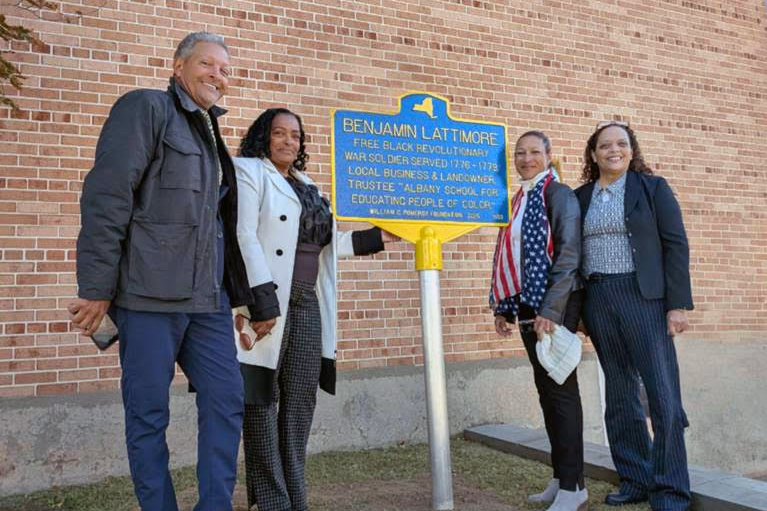
Benjamin Lattimore’s descendants at the historic marker celebrating him. From left, Terry Jackson, JoAnn Ellis, Stacy Rose and Sharon Jackson.
Courtesy of the Mohawk chapter of the Daughters of the American Revolution
In 2022, an official with the Albany Rural Cemetery contacted the Mohawk chapter of the Daughters of the American Revolution to help them research and mark the sites of veterans of the war who were buried there. That is one of the DAR’s stated missions, and chapter members Nancy Newkirk, Laurel Andrews and Kristi Dariano took the project on.

One of those soldiers was a man named Benjamin Lattimore. His headstone was never located, but the group did uncover a fascinating story about one of Albany’s earliest African American civic leaders.
Article continues below this ad
“He was a real visionary,” Andrews said. “I kept looking into what he did in Albany, and he did a lot.”
Foremost, Lattimore was a leader in founding the first known school and church for the city’s African American population, an extraordinary achievement for a free but likely illiterate Black man born to a formerly enslaved father at the dawn of America’s independence.
By combing through sources from the National Parks Service, the Albany County Hall of Records, the New York State Museum, old newspaper articles and church records, the research committee pieced together Lattimore’s life.
Make the Times Union a Preferred Source on Google to see more of our journalism when you search.
Add Preferred Source
He was born in 1761 or 1762 in Weathersfield, Conn., to Benoni Latimor — who was freed from slavery in about 1748 — and Mary Freeborn, both described as “mulatto” in marriage records. They lived in Newburgh, where his father operated Lattimore’s Ferry across the Hudson River. (Name spellings vary in the records.)
Article continues below this ad
In September 1776, Lattimore, described later in his life as “tall, thin and spare, with a light complexion and hazel eyes,” enlisted in the 3rd New York New Regiment of the Continental Army. Within days, his company was in New York City fighting with George Washington in the lost battle for Manhattan. They retreated from Manhattan by ferry and were reorganized into the 5th New York Regiment, assigned to the Highlands at Fort Montgomery.
The British captured the fort and Lattimore was taken to New York City as a house slave. Soon after, he was rescued by American forces, rejoined the Continental Army and fought in the Battle of New Town in 1779. He was discharged on Aug. 24 that year.
After the war, he owned a farm in Poughkeepsie, where he and his first wife, whose name is not known and who died sometime thereafter, had a son, Benjamin Jr., born in 1792.
By the late 1790s, Lattimore and his son were living in Albany. He joined and was baptized in the integrated Presbyterian church, remarried a former enslaved woman named Dina in 1804 and had three more children. He owned property near what is now South Pearl and State streets. And he became a licensed cartman.
Article continues below this ad
Despite the humble title, that was a significant job. According to the Friends of Albany History, “The role of cartmen was critical to commerce and the life of the city. They were the only individuals permitted to move goods through the streets. Everyone, Black and white, knew the cartmen.”
A responsible, honest cartman, according to the Friends, was “well-known and well-respected by both the Black and white community.”
A bill paid to Benjamin Lattimore for work done in 1811.
Albany County Hall of Records Archival Collection
The Albany African Society
Lattimore’s family was one of 50 to 60 comprising an emerging free Black middle class in Albany. The leaders of this community, including Lattimore, established the Albany African Society circa 1807-1811. It was modeled on the New York City African Society for Mutual Relief, founded in 1806, to collect money to help fund burial costs and aid widows and children, according to the Friends of Albany History.
Article continues below this ad
But it had more ambitious goals, too, including building an “African school and an African church,” according to the Friends.
Lattimore, now about 50, bought property from none other than Eliza Hamilton, Alexander’s recent widow, on Malcolm Street, now Broad Street. The Society then built and opened the first known school and church for African Americans in Albany. It cost $915, and while some of the funding came from the trustees and other Society members, “an astonishing 86% had been contributed by the citizens of Albany,” most of whom were white, according to the Friends.
That was remarkable, especially “from a city in which there were probably 200 individuals still enslaved.”
Andrews believes that Lattimore’s position as a cartman was critical for this.
Article continues below this ad
“He was vetted, he was trustworthy. He knew everybody because he worked for everybody,” she said. “I don’t think of him as a Black community leader; I think of him as a community leader who happened to be Black.”
Indeed, when Lattimore’s status as a freeman was questioned, in 1820, an attorney testified that he had known Lattimore for many years and that he was “a free man (of) irreproachable character for integrity and uprightness.” The judge declared him free.
The School for People of Color opened in 1813. It was also used for church services of the Albany African Church. The school was incorporated by the state Legislature in 1816, with Lattimore named as one of the trustees.
‘The people that built America’
Lattimore died on April 28, 1838. His legacy was largely forgotten.
Article continues below this ad
“A lot of Albany history has been just left in the past. The city doesn’t do a good job promoting its history,” Andrews said.
Forgotten, that is, until the DAR got involved. Though they never found a gravestone, they approached the Pomeroy Foundation for a New York State Historic Marker grant. Last October, the marker was dedicated at Giffen Elementary School. The site of the original school was on Malcolm Street, now 90-92 Broad St., two blocks from Schuyler Mansion and two blocks from Giffen School.
“It seemed fitting the marker should be placed at a current school,” Newkirk said. Andrews added, “Those were streets he would have walked.”
Newkirk, who chairs the Mohawk DAR chapter’s America 250 committee, said the organization is “very interested in recognizing patriots of color who are underrepresented in our patriot history.”
Article continues below this ad
Lattimore “was a remarkable man for his age, an illiterate Black man who probably came to Albany with almost nothing and became well respected as a cartman and a leader in his community,” she added. “Those are the people who built America. And 250 years later, we get to meet his descendants.”
Four of those descendants, siblings who are Lattimore’s fifth-great-grandchildren on their mother’s side, came to Albany from downstate to participate in the marker dedication. They had worked closely with the DAR committee to add to what they already knew about Lattimore.
“It was such a tribute, because so many people do not know that Black Americans fought on the side of the colonists in the Revolutionary War,” Stacey Rose, one of the attendees, said. “Benjamin was just the tip of the iceberg. There have to be so many more, but the families don’t know.”
Article continues below this ad
Her 18th-century family “knew freedom before the war; they knew from the experience of their father that they could be set free,” Rose added. “But Benjamin wanted us all to taste freedom.”