
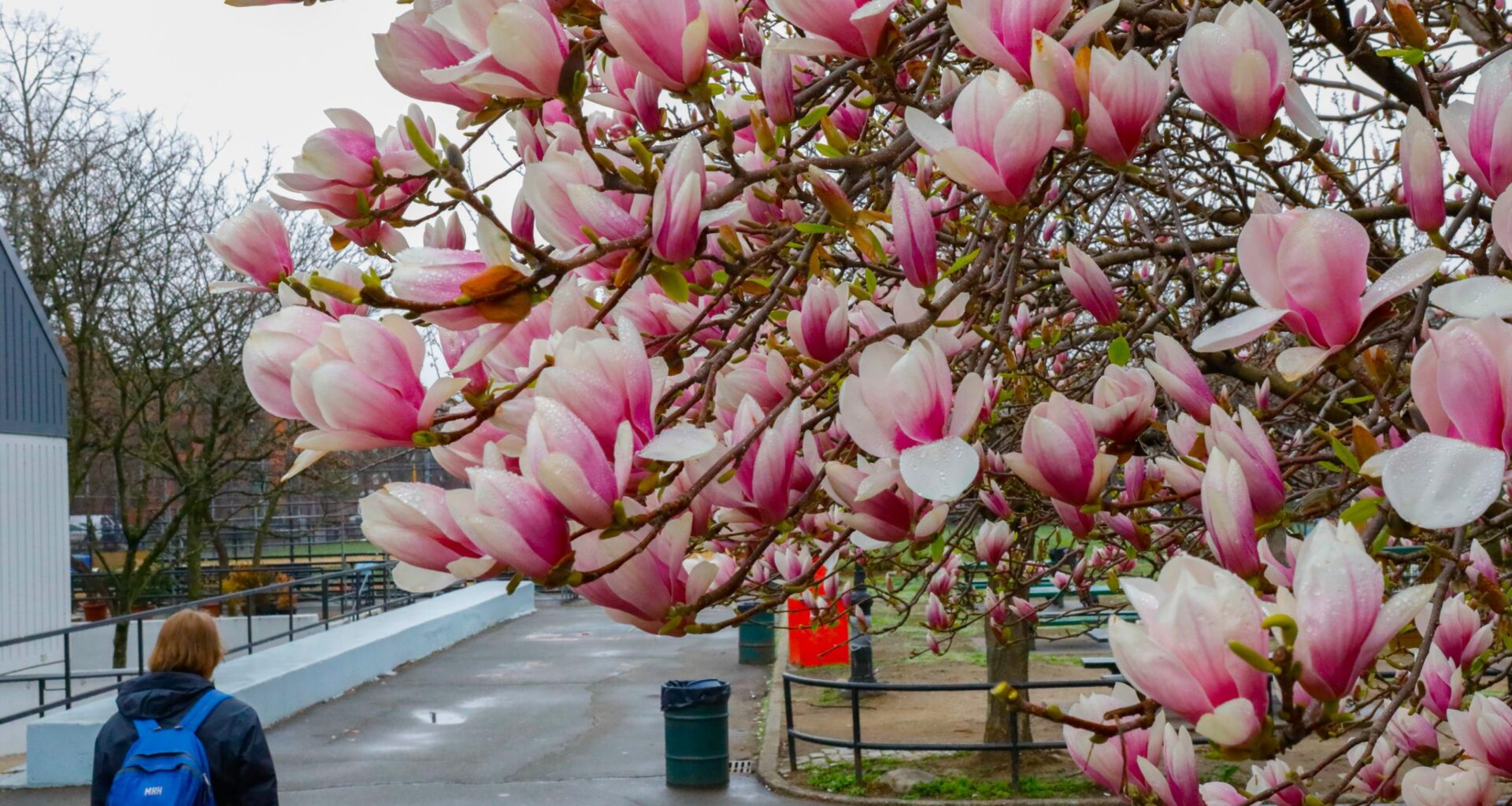
Springtime in New York City is always magical — but perhaps more now than ever after the coldest, sludgiest winter in years.
April showers are rejuvenating eager buds while the warmer weather invites them to open up. Blooming cherry blossoms and magnolias inspire awe and wonder as passersby stop to take in the ephemeral moment.
“They’re the first trees to bloom in spring, and they really tell us that spring has arrived,” said James Kaechele, the manager of the Parks Department’s Tree Time program and a certified master arborist.
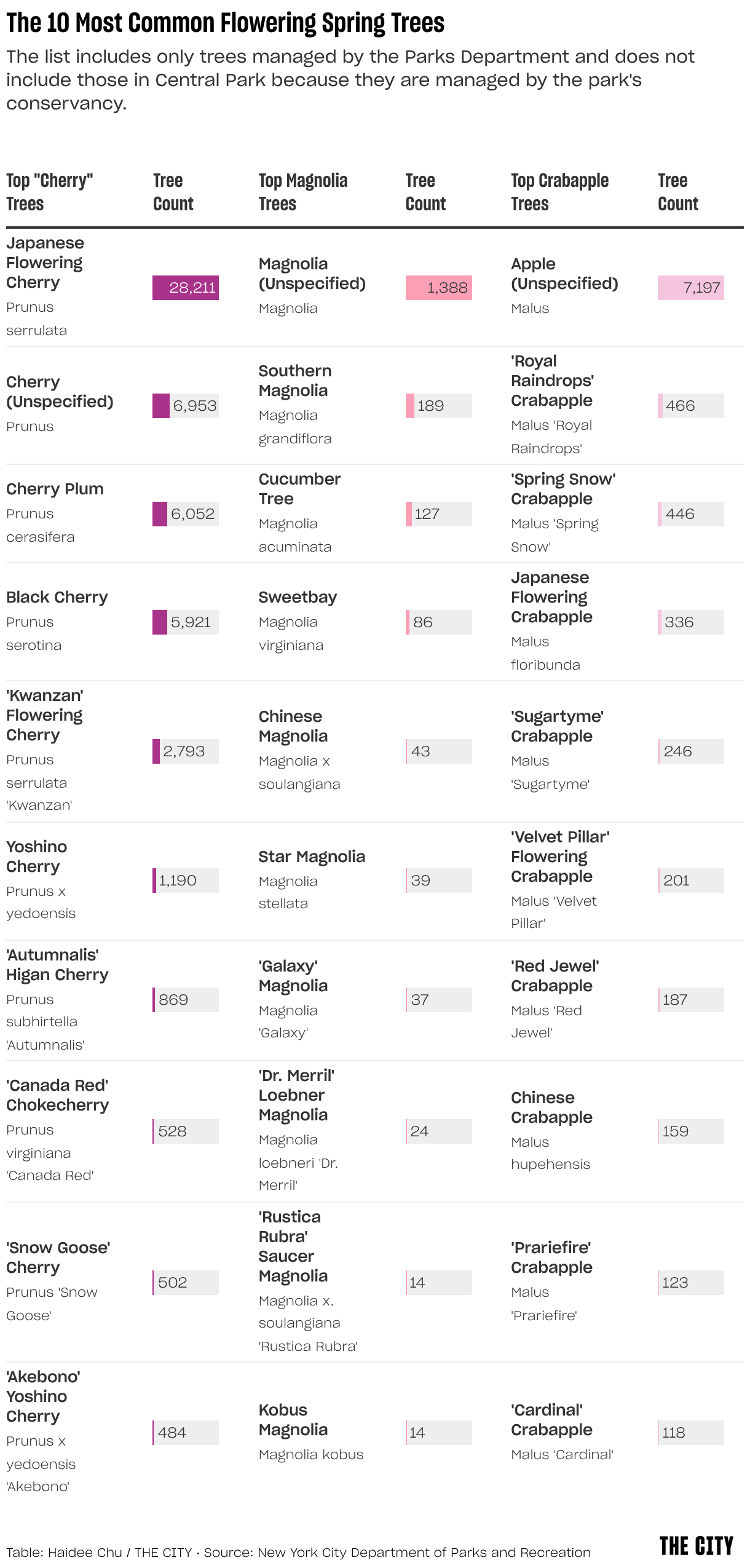
The five boroughs are home to at least 47 varieties of cherry and cherry-esque blossoms, 15 varieties of magnolias and 26 varieties of crabapples — accounting for more than 68,000 of these flowering spring trees across city parks and streets, according to Parks Department data. (Some of what people assume to be “cherry” blossoms aren’t actually cherries — but we’ll get into that later.)
The data only includes street and park trees managed by the Parks Department but does not include those in Central Park because they’re managed by the park’s conservancy. Still, the data shows that “cherry” blossoms by far dominate the city’s offerings of these flowering trees.
Overall, a high concentration of cherry, magnolia and crabapple trees live in city parks, including popular sighting destinations like Prospect Park, but also underrated hotspots like Flushing Meadows Corona Park, Bronx Park and Van Cortlandt Park.
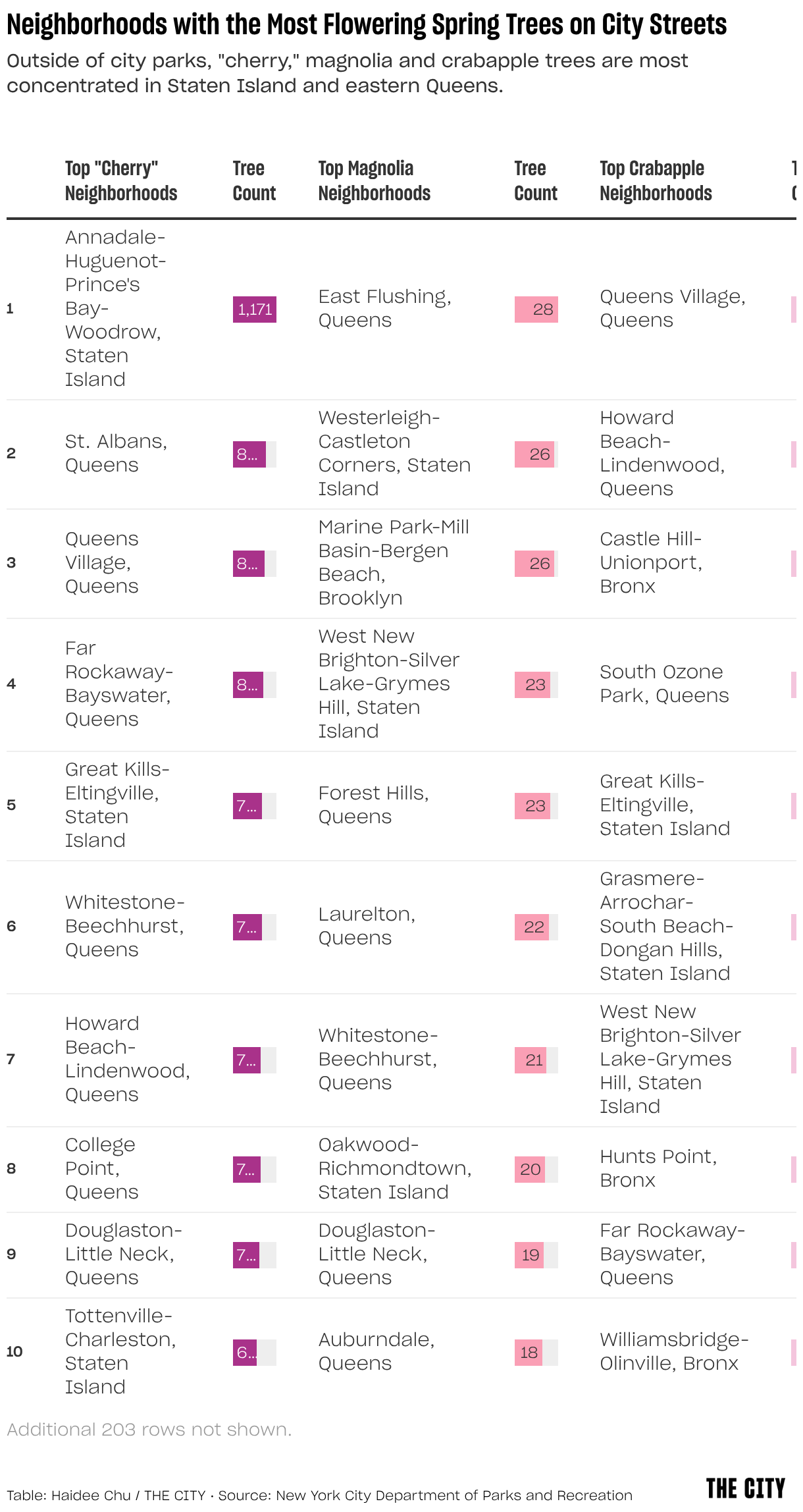
Outside of parks, these trees are most populous in more remote parts of the city: in the southern tip of Staten Island and in parts of eastern Queens bordering Long Island.
Explore the map below to see hotspots for these trees across the five boroughs:
First Things First: Not All Blossoms Are Cherries!
Some of what people commonly know as cherry blossoms are not technically cherry trees at all. They are instead part of the genus “prunus,” which includes stone fruit trees like plums and apricots with buds that can bloom to look like cherry flowers in spring.
The third-most common kind of these blossoms in New York City streets and parks, according to Parks data — the Prunus cerasifera, or cherry plum — is, in fact, a plum tree and not a cherry.
“Sometimes since there are several different flowering trees in that family, the blossoms can look similar,” said K Satterthwaite, the lead arborist and tree care manager for the Central Park Conservancy.
“There are a lot of ways to distinguish them, but the flowers can look similar, even though ornamental cherries really have characteristic longer blooms and have been bred for their ornamental characteristics.”
A good way to differentiate the different stone fruit trees is through the color and length of the leaves, Satterthwaite said. Plums, for instance, have purple leaves, while peaches have longer leaves than ornamental cherries.
Also Important: Be Good to the Trees
And please, do not shake the trees!
“It’s very tempting for your Instagram video, but it literally speeds up the decline of the blooms,” Satterthwaite said.
Instead, let nature run its course, and the petals fall on their own. When they do, Kaechele said there is still beauty to enjoy.
“Particularly at the end of the cherry season and in late April, after the Kwanzan cherries bloom, you end up with this pink carpet on the ground,” he said. “It’s a beautiful reflection over time of what was up in the tree is now on the ground, but it’s still this pink puddle. It’s so beautiful.”
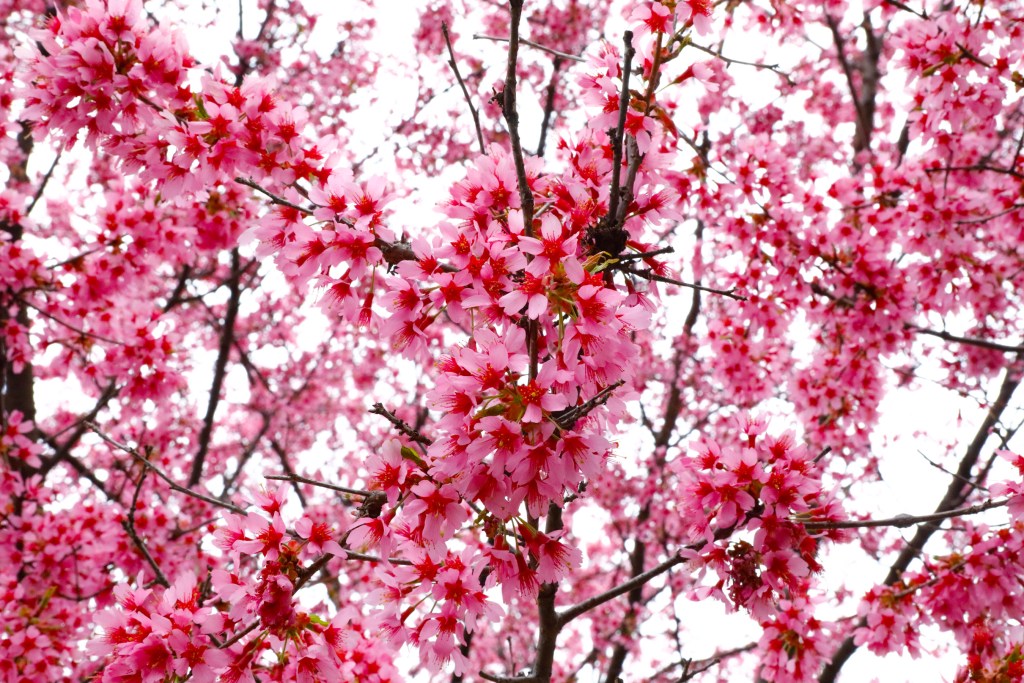 Cherry tree in full bloom at Herbert Von King park in Bed-Stuy, Brooklyn, April 3, 2026. Credit: Alex Krales/THE CITY
When Do Different Varieties Bloom?
Blossoms are the most abundant in April because of the sheer variety of “cherries,” magnolias and crabapples planted across the city. Even as one variety begins to fall, others begin to bloom.
“It’s the gentle time of year,” said Rowan Blaik, namesake of the Rowan tree and the head of the Brooklyn Botanic Garden’s living and non-living collections.
Unlike summertime, when flora suffers heat stress and pest infestations, during April “everything’s kind of lush and just perfect as flowers open up,” Blaik said. “It’s the perfect time to come and see.”
It’s the gentle time of year.
Rowan Blaik, Brooklyn Botanic Garden
Okame cherries — flashy and bright pink — are blooming right now, according to Kaechele. Yoshino cherries — white with pale pink — are the next to flourish, followed by Kwanzan Cherries and “many varieties in between” as the month progresses.
“So don’t worry, you didn’t miss it,” Kaechele said.
At Central Park, Satterthwaite has been keeping close watch as part of a team that updates the Cherry Blossom Tracker while buds grow throughout the day and then explode into color.
“In the morning it was like, ‘Oh, are they ready? Are they going to do it?’” they said. “The flower buds will get really big, and you’ll start to see a sliver of color. Then, in the afternoon, they were open.”
According to Satterthwaite, Yoshino cherries began blooming last week, following the Okame cherries that kicked off the bright season.
The forecasted weather also predicts warm days and cool nights — gentle temperatures that, according to Kaechele, are perfect for the petals to stay on the branches.
The flower buds will get really big, and you’ll start to see a sliver of color. Then, in the afternoon, they were open.
K Satterthwaite, Central Park Conservancy
Springtime weather has become inconsistent in recent decades however, experts told THE CITY, and blossoms have been arriving sooner than they used to in the past few years.
“While it’s really hard to look at a few years and make direct correlations, in general, we have been trending earlier in terms of blooming and basically springtime as we’ve seen average temperatures increase,” Satterthwaite said.
“Spring is less dependably on the same date,” Kaechele added. “Less dependable makes it harder for everybody to do their job when they’re caring for trees.”
Some years, warm spells in February have caused trees to come out of dormancy early, he said, while frigid temperatures and heavy snowfall this winter meant trees stayed inactive for longer to survive.
How Does the City Decide What to Plant and Where?
These spring blossoms are just a few of the 140 varieties of trees the Parks Department plants each year, according to Kaechele. Nurseries across the country, from Long Island and Western New York to Maryland and Missouri, grow trees specifically for the city’s parks.
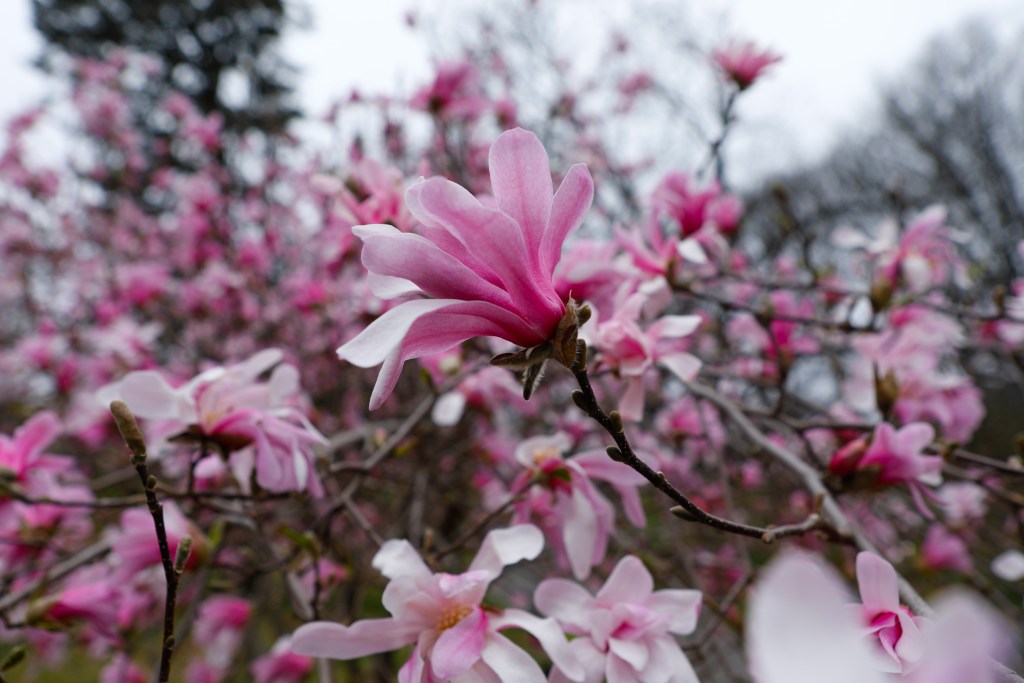 A Magnolia tree in Lincoln Terrace Park, Crown Heights, Brooklyn, April 2, 2026. Credit: Alex Krales/THE CITY
Parks foresters consider a variety of factors when planting trees, like what trees can survive a tough urban landscape, and the benefits each brings in terms of shade, cleaner air and capturing storm water.
But other measures are harder to quantify, Kaechele said. “Sometimes just straight-up beauty plays into this.”
The soothing effects of nature on a person’s nervous system are “just as important as these very measurable ecosystem services,” said Kaechele.
“We wouldn’t ask if you want a fire hydrant on your block. We do it because we know that we need it. It’s the same with trees.”
At Central Park, arborists consider how the trees suit the park’s history.
Places like Cherry Hill — home to Yoshino cherries gifted by Japan in 1912 — are “going to remain a place where cherries are featured,” Satterthwaite said. Paths along the Reservoir and the Conservatory Water Pond have also historically featured cherry blossoms.
“Cherries will always be an important part of those landscapes,” Satterthwaite told THE CITY. “It’s a very curated experience.”
Where Tree Experts Go to See the Blooms
Brooklyn Botanic Garden, a popular hub for cherry blossom revellers, boasts over 180 flowering cherry trees from more than 30 species and cultivars. The garden also has over 50 species and cultivars of Magnolia throughout its 52 acres, including yellow-flowering magnolias it bred in the 20th century, according to Blaik.
“We’ve got a lot of diversity in our cherry collection, from very kind of simple, plain looking flowers that are closer to the wild forms, then we’ve got the big, pom-pom like flowers of the Kanzan cherries,” also known as “Kwanzan” cherries, Blaik said.
“There’s something to love for all of them really,” he said. “It’s a magic time of year.”
Kaechele, for his part, loves watching the Yoshino Cherries bloom at Hunters Point South Park in Long Island City, Queens. “There’s something really spectacular about this ring of beautiful white Yoshino cherries and fantastic Manhattan skyline,” he said. “It just has such a clear sense of place.”
He also recommends Flushing Meadow Park in Corona, Queens, around the iconic Unisphere, and Sakura Park and Riverside Park in Upper Manhattan, which encompasses Cherry Walk, a path lined with cherry trees along the Hudson River.
In Central Park, in addition to Cherry Hill and the Reservoir, Satterthwaite said the Conservancy Water Pond next to the Alice in Wonderland statue will be a “hot spot for cherries for the next several weeks.”
“That’s one of my personal favorites,” she said. “It’s so beautiful outside, and everyone’s just happy.”
Don’t fret, however, if you miss the blooms this spring: “No matter what, spring happens every year,” Satterthwaite said.
Related