
Olivia Bannerman, a 28-year-old software designer and part-time model, was standing on a rock in Central Park with her statuesque golden retriever, Violet, waiting for a quorum to assemble. It was the first Sunday in March, and for the past month, Bannerman had been on a bright and photogenic one-woman crusade to address the city’s dog-poop situation. Now, she was hoping to turn it into a movement.
In the end, it was a small movement. Two of us were reporters. A third was Fern Watt, founder and president of New York Dog Parade, the city’s “premier dog-culture organization.” The fourth was a friend of Bannerman’s. Bannerman had worried about this. “One thing I’m running into,” she told me, “is that dog owners are saying, ‘I don’t want to pick up other people’s poop.’” She understood the feeling, but “if everyone had that sentiment about everything for the history of time, nothing would get done,” which is why she had taken to picking up stray shit herself.
We fanned out over Sheep Meadow, a place where dogs are theoretically not allowed at any time. “Here’s a turd!” Bannerman said cheerily. “I got a big one!” cried the reporter. A man exercising a spry Shiba Inu called out his thanks, and we explained that we were participating in a community event to pick up dog poop. “That’s very” — he hesitated for a long time — “thoughtful of you.”
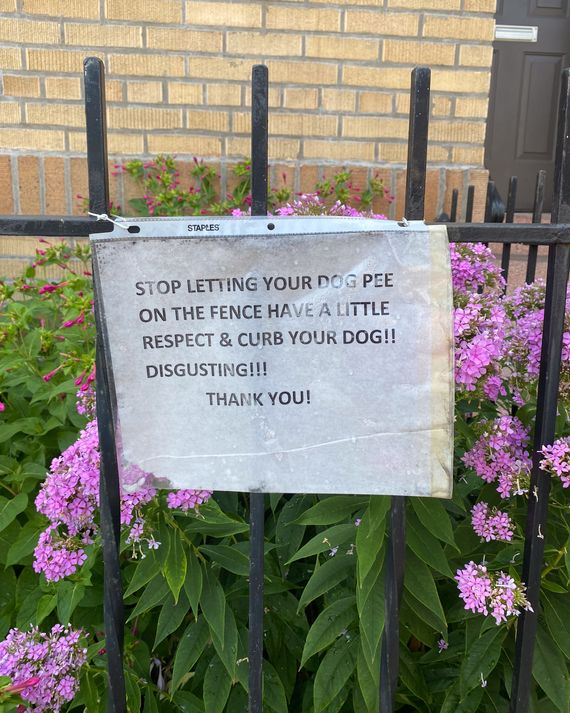
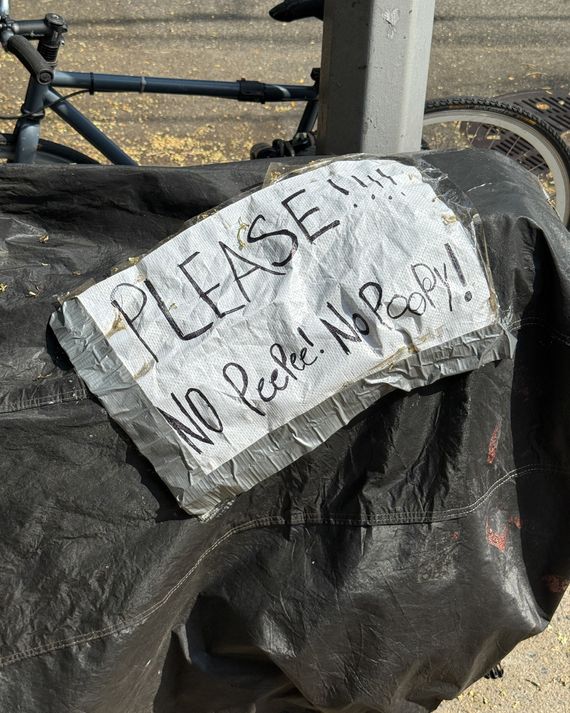
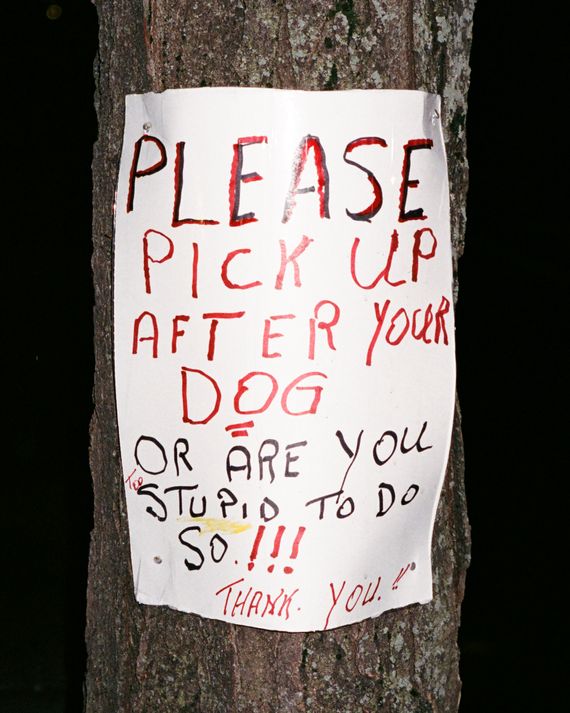
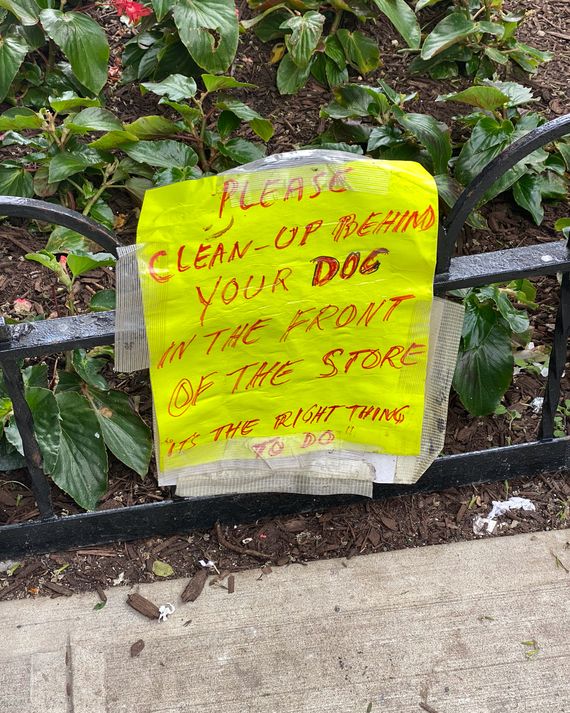
The situation had been exacerbated by the snow, everyone agreed. It had snowed before, but had it always been like this? “I’m just trying to get my kids to school, and we’re basically dodging dog shit on the entire walk,” a 38-year-old mother of two in Greenpoint told me, asking to remain anonymous. She had, in fact, tried to take action herself, creating the Instagram account @GreenpointPooPatrol for public shaming, but it had yet to catch on. On the Upper West Side, someone had taken to hanging posters: JUST BECAUSE YOU ARE ENTITLED AND IT’S COLD DOES NOT MEAN IT ISN’T RUDE DISGUSTING PATHETIC + ILLEGAL TO LEAVE YOUR DOG’S FECES ON THE SIDEWALK. They had splurged on color printing. Measured by complaints, tensions were escalating: At the end of February 2025, there had been 650 calls to 311 about dog poop. By the same time this year, the number of calls had already hit 1,541.
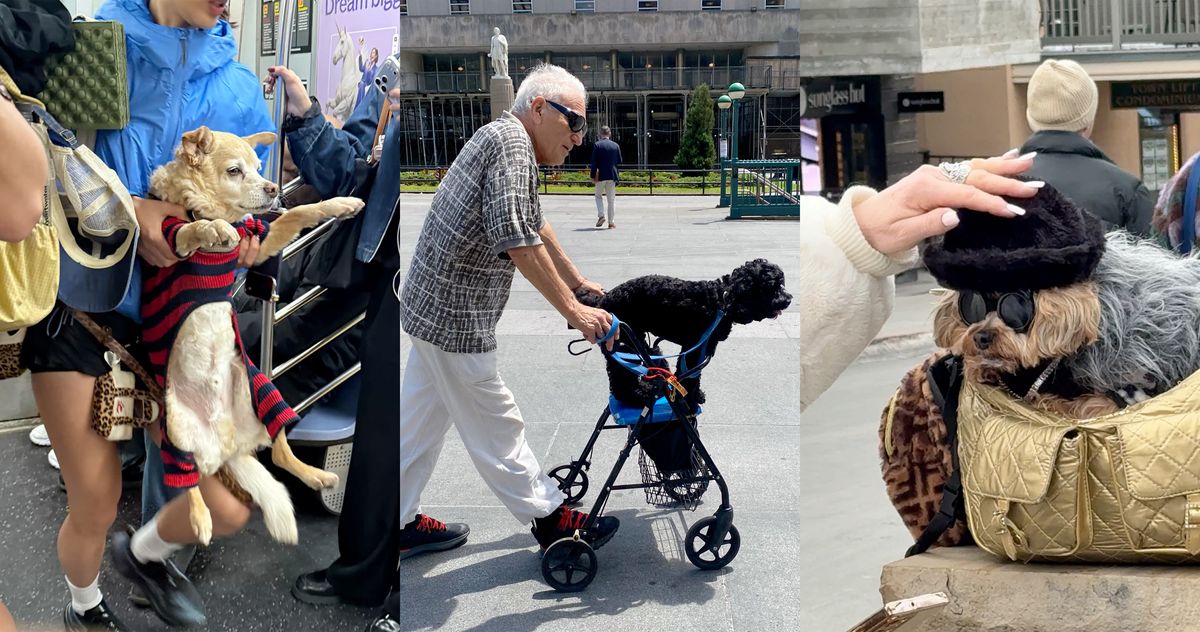
And it wasn’t just the shit: In the past two years, calls about animals in restaurants have more than doubled, and in the years since the pandemic, complaints about off-leash dogs have more than doubled too. In early February, a Chow Chow named Meatball broke free from his owner at Bowling Green, fell onto the subway tracks, hit the third rail, and died. This set off yet another wave of dog discourse, which had less to do with the specific circumstances of Meatball’s obviously tragic death, the details of which were not publicly disclosed, than with the general alleged entitlement of dog owners, who were apparently tearing apart the already fragile fabric of the city by putting dogs in places dogs do not belong. “Pet culture,” one extreme Gothamist commenter declared, “promotes disordered living.” Around this time, inside a Park Slope market, I watched a woman cradle a teacup Pomeranian and tried to determine whether it was nibbling on tiny samples of artisanal cheese.
The problem, if there is a problem, has less to do with the number of dogs than their shifting place in public life. “It seems like a kind of arms race,” says Jessica Pierce, a bioethicist studying human-dog relations. “You have people becoming more and more assertive about including dogs everywhere and then, on the other side, people becoming more and more assertive about their resistance to having dogs everywhere.”
On paper, the city’s dog laws are quite clear. Dogs are required at all times to be leashed in public, except in dog runs or during designated hours in particular locations inside certain public parks. Dogs are permitted on the subway but only in a bag. Service dogs — those that perform specific tasks to help people with disabilities — can go basically anywhere. Documentation is not required, but an establishment is allowed to ask two things: Is the dog required because of a disability? And what service does the dog provide? This does not apply to emotional-support animals, which, except in matters of housing and employment, are held to the same basic rules as pets.
“If there wasn’t dog shit all over the sidewalks, then I don’t think dogs would necessarily be coming to a boiling point,” one Greenpoint dog owner in his early 40s reflected. It wasn’t as though he had never pushed the boundaries with his 50-pound supermutt. Yet if he didn’t always follow the letter of the law, he believed he observed the spirit, though he understood that not everyone agreed. Recently, he’d been in Transmitter Park with his dog — who, yes, was off-leash, but people do that there — when a guy in the playground area with his kid leaned over the fence. “He was not even in the vicinity of where my dog was,” he says. “He said, ‘Excuse me, you see the sign? It says NO DOGS.’ And I kind of looked at him like, Hey, you must be new here.” Why did he feel so entitled, the guy wanted to know. “And so I told him, ‘Hey, man, you’re here with your family, and I’m here with my family.”
In seemingly every argument, someone brings up children. “Well, my dog,” someone inevitably says, “is better behaved and less disruptive and more pleasant than your disgusting child.” This is very likely true and generally irrelevant. Dogs are not children. Even people who treat their dogs like children, sociologist Andrea Laurent-Simpson tells me, are “quite aware that their dogs are not actually children.” But Laurent-Simpson, who studies family, fertility, and the relationships between people and their pets, argues dogs have become family nonetheless. “Family,” she emphasizes. “Not ‘like’ family but family.” According to a 2023 Pew poll, 97 percent of American pet owners agree, and more than 60 percent of urban pet owners say their pets are as much a part of the family as the human members. But does every member of your family need to be inside the grocery store?
Whatever your problem is with life in the city, there is probably some way to implicate the dogs. They are so visible, and there are so many of them. “Dogs are so numerous in New York, indeed, that they have already become a nuisance,” poet Charles Dawson Shanly observed in 1872, launching into an ethnographic survey of the local canine population. Then there was the question of whether dogs belonged in the city at all. “There is a place for the dog,” an irritated reader wrote the New York Times in 1903, “but that place is the country.”
Back then, stray dogs mingled with working dogs and beloved pets, roaming the city, eating abundant quantities of garbage, and becoming in the process a symptom of the growing city’s chaos. This impression was fostered by the fact that they were occasionally rabid. “However rare dog attacks and the incidence of rabies were in reality,” writes historian Catherine McNeur in Taming Manhattan: Environmental Battles in the Antebellum City, “the newspaper reports that built up their presence made them a larger symbol of the breakdown of civility.” When, in 1811, the city passed its “Law Concerning Dogs,” people were divided. In addition to imposing a $3 tax on dog owners, the law allowed a newly appointed “Dog Register and Collector” to kill any dog found roaming “at large,” but it wasn’t clear how exactly they would differentiate between strays and pets. “This was less a battle of class,” McNeur concludes, “than a battle between dog lovers and rabies fearers.” But then concerns about animal welfare rose, and the acute public-health risks faded. Killing dogs in the street became increasingly unacceptable, and rabies vaccines became available. No rabid dogs have been reported in New York since 1954.
By the early 1970s, the city was once again in chaos. “New York was on the verge of bankruptcy,” says Michael Brandow, author of New York’s Poop Scoop Law: Dogs, the Dirt, and Due Process. “Nothing worked. Police couldn’t protect people, we couldn’t pick up trash, we couldn’t keep the subways running. The streets were dirty. It was a harsh place to live.” In response, people turned to dogs, which offered some combination of protection and companionship. “It was a palliative measure,” he tells me. The city’s canine population at least doubled. “I think dogs are what got us through,” says Brandow. The trade-off: There were now several hundred thousand pounds of fresh dog feces appearing on city surfaces, and there was no law requiring it to be picked up. This was in itself disgusting but also came to represent the city’s problems. Attacking dog waste became an attack on blight. “If only we clean up the streets,” says Brandow, paraphrasing the logic, “we wouldn’t have an urban crisis.”
Still, what were you going to do about it — pick up your own dog’s poop? City street cleaners had once picked up horse manure, so wasn’t this their job? The idea of legally requiring a person to lean over and cradle feces was horrifying. “This is pet hysteria,” lamented one activist. It didn’t even make sense; how would you do it? “Look, if you know anyone who has tried it,” a founder of the Dog Owners’ Guild of Brooklyn Heights once asked a reporter covering the matter, “would you ask them how they manage?” Meanwhile, critics in the anti-dog camp, some of whom seemed to object to the very concept of urban dogs, argued the poop proposals did not go nearly far enough. Fran Lee, founder of the group Children Before Dogs, who insisted public pet feces posed a major public-health risk, proposed dogs ought to use their owners’ bathrooms. “There literally was a war between pro-dog and anti-dog people in New York back then,” Brandow says. In 1978, New York State finally passed the “pooper-scooper law” (more formally, New York State Public Health Law 1310) requiring owners in New York City to clean up after their dogs or face fines up to $100 (nearly $500 in 2026 dollars). There was some backlash. Eventually, most people did it.
“The poop-scoop law,” Brandow says, “made dogs socially acceptable for the first time.” They became strangely more like babies. There is not all that much difference, it turns out, between a dog-poop bag and a diaper; either way, it is an unseemly act of care. On its own, the law was unlikely to have transformed dogs’ status from “family pet” to “family,” but it didn’t need to.
Through the 1970s, the country saw an increasingly diverse array of family structures that “ushered in the foundation for the emergence of the multi-species family,” Laurent-Simpson argues in Just Like Family: How Companion Animals Joined the Household. Dogs were taking on “familial identities,” she writes, “that have historically been reserved for humans.” Families catered to their dogs’ tastes and preferences; their dogs had birthday parties and grandparents. In the backyards of suburbia, this might have been a mostly private evolution, but there is no privacy in the city.
How many dogs are there in New York? Nobody knows for sure. There were about 100,000 licensed dogs as of 2024, but that accounts for only a small fraction of the canine population, which is mostly composed of scofflaws. (An annual dog license costs $8.50 for dogs that have been spayed or neutered.) The latest New York City Housing and Vacancy Survey, from 2023, found about 15 percent of households had at least one dog, a fraction of the national average, which, according to 2025’s American Veterinary Medicine Pet Ownership and Demographics Sourcebook, was 42.6 percent. Still, the number that gets tossed around is about 600,000 — a lot of dogs.
But is it more dogs? The overarching narrative is that New York is now doggier than ever, a product of the pandemic puppy boom, or gentrification, or declining (human) birth rates, or the suburbanization of the city. “The athleisure and the dogs are taking over,” lamented Chloë Sevigny to Rolling Stone in 2024, setting off several days of dog-population discussion. “Everybody’s in Lululemon and has a fucking dog and it’s driving me crazy.” (Sevigny’s representative said she was unavailable to comment for this story.) Certainly, it seemed the population size had to be unprecedented. “It felt like everybody got a dog,” says Luis Perez, who owns a dog day-care and grooming business in Hoboken. “And if they had a dog, they got a second dog.”
The only complication is the numbers don’t seem to add up. Dog adoptions here may actually have declined in 2020. “The pandemic pet boom,” concluded Nick Paumgarten in The New Yorker, appeared “mainly to be one of increasing attention.” The same 600,000-dog estimate has been circulating for decades. I should think of it as a WAGNER number — “wild-ass guess not easily refuted” — advises Alan Beck, director of the city’s Bureau of Animal Affairs in the poop-scoop era and now a professor emeritus at Purdue. But still, people seem to agree, they personally have never seen so many dogs. “I am noticing more dogs in public,” says City Councilmember Chi Ossé, who represents parts of Bed-Stuy and northern Crown Heights and has been vocal about the post-blizzard dog-shit situation. “And I don’t think I want to comment about how I feel about that because I hope to have a long political career.”
But even if there aren’t more dogs, the dogs we have certainly seem to be taking up more space. We are living in a moment of rampant lawlessness or, more charitably, renegotiation. “People did not think about taking dogs to restaurants 30 years ago,” recalls W magazine’s Lynn Hirschberg, who is accompanied almost everywhere by a spaniel–Border-collie mix. “It didn’t happen.” Now, dogs are on line at the city’s coffee shops, in carts at Trader Joe’s, seated at the movies. “I definitely take him in every place until I get kicked out,” says Mackenzie Katz, a 32-year-old art handler and dance teacher in Chinatown, of his adopted 45-pound goldendoodle, Clover. “I know it’s a health concern in restaurants, I get it, but it’s the forgiveness-versus-permission thing.” He rarely needs forgiveness. Mostly, people just want to pet the dog. A few hours after we first spoke, Katz texted me a picture of himself and Clover on the Coney Island Wonder Wheel. “Might be pushing the boundaries of negligence,” he wrote. A café owner in her early 40s tells me guiltily about the time she smuggled her terrier into the Dead Rabbit. “I said he was a support animal when he’s clearly not,” she says, but he hates to be alone, and he barks, and … was it so bad? “I understand we live in a giant city and we have to have rules, and that’s what makes society society,” she says. “But I do have a feeling sometimes I’m just gonna make this one not apply to me. It’s not fair or appropriate. But I’m also like, He’s ten pounds.”
For business owners, effective dog management lies somewhere between awkward and impossible. “Those interactions rarely go positively,” says Kip Gleize, a restaurateur whose current projects include the Brooklyn spots Margot and Montague Diner. Once, she stopped someone from bringing in their dog, then watched as they left, studied their phone, and then marched back. “They’re like, ‘Actually, it’s a service dog, and you’re not allowed to ask us for proof.’” Restaurants could theoretically be fined by the New York City Health Department, but it rarely happens. In city parks, the designated off-leash hours don’t necessarily reflect unofficial norms. (Only while writing this story did I learn Prospect Park’s off-leash hours do not begin folksily “at dusk” but rather quite officially “at 9 p.m.”) It is normal, if not “legal,” to see uncontained dogs on the MTA. (In 2025, just 13 summonses were issued for “unauthorized animals” riding the subway, and the Department of Sanitation issued only two for uncollected dog waste.) “We’re brainstorming,” Ossé tells me of a possible policy solution. “We’re trying to craft it in a way that isn’t too Big Brother. We don’t want to completely turn New York City into a police state just because of dog shit on the streets.”
“If you see one dog on the subway, it’s like, What are you doing? ” says Sherman Ewing, who founded his dog-walking business, Club Pet NYC, in the early ’90s and has been immersed ever since. “But if all of a sudden everybody’s bringing them, then you don’t really know what the rule is.” Until recently, jaywalking was against the rules too, and everyone did that. “It’s not like I’m going to take her somewhere where I would automatically realize it wouldn’t be a good idea,” Hirschberg says of Zora, who was trained as a service dog but is not, strictly speaking, Hirschberg’s service dog.
Many people are following the rules: Restaurants are not filled with Labradoodles and it is mostly possible to navigate the streets. When people break the rules, it is usually fine. “I’ve never really seen a dog disrupt anyone’s service before,” says Sarah Morrissey, beverage director at Golden Age Hospitality and general manager at ACME and the Nines. She is an unequivocal fan of dogs in restaurants. “I will turn into a 5-year-old. I’m like, Oh my God, there’s a dog here! I’m going to stop everything and pet it.” (Once, a dog peed on the floor, “but it was really little, and we cleaned it up quickly.” Also, there was the time she had to intervene about a yappy German-shepherd puppy, but that’s it.) Yet even she understands the simmering dog-related rage.
“It’s not about whether people are following the rules,” says an exasperated Brooklyn lawyer when discussing the doggy state of Fort Greene Park. “Even if everyone is following the rules, there are just too many fucking people with dogs.” It surprised him to feel this way; until moving nearby, he’d considered himself “a dog boy.” But now what he sees are “all these really rich white people taking over the one green space that’s close by and having their big dogs shit all over it.” It felt emblematic: a historically Black neighborhood being obliviously, carelessly consumed by richer, whiter newcomers with their Trader Joe’s totes and their rescued Australian shepherds. He is also white and has no deep claim on the area (“I don’t even know if I have any entitlement to feel put off by other people’s sense of entitlement!”), but at least he thinks about it. “There’s something that feels particularly creepy and off-putting about it given the racial and socioeconomic context,” he says. While dog ownership cuts across demographic lines, it isn’t evenly distributed. On a population level, there are racial differences: Nationally, about two-thirds of white and Hispanic adults have a pet, according to the 2023 Pew data. For Black and Asian American adults, it hovers just above a third. And though dogs don’t require ultrawealth, specific types of dogs can represent a changing landscape. “As housing prices rise in an area,” the New York Times reported a few years ago, “dog breeds tend to skew smaller and more expensive.” Every new luxury development seemed to advertise a dog spa. Asad Dandia, a local historian and city tour guide who grew up in Brooklyn, says it has become a running joke among his friends: “You know you’re about to get kicked out of the neighborhood when you see a dog park getting built or a dog spa or a doggy day care.” We were walking along Atlantic Avenue when he said this. Within seconds, we had stumbled upon a doggy day care and “automated self-wash ‘spaw’” called Doggittude. I asked him what else he might consider a harbinger of yuppification.
“Certain venture-capital-owned cafés.”
I thought of a story Karl Steel, a CUNY medievalist, told me about a 13th-century French nobleman who apparently delighted in terrorizing the countryside with what he claimed was his pet wolf, a classic case of a rich and powerful person behaving with impunity. “I will say, very satisfyingly, he was killed in a revolt of his social and political inferiors.” He paused. “Probably some of the dynamics in the neighborhood are around that.”
Not everyone is afraid of being eaten, though that is one valid reason to dislike dogs. There are people who are afraid, based on instinct or experience, and people who are allergic; people who cannot tolerate the crotch sniffing; people who simply believe that dogs, regardless of their position in the family, should not encroach on indoor space. There are people who find dogs gross — the health risk posed by dogs in restaurants is low but not zero — and people whose grievance isn’t with the dogs per se but with the owners who willfully ignore the ways their furry beasts impose upon the world. Bobby Fijan, co-founder of the American Housing Corporation, a start-up developing family-friendly urban real estate, tells me this was his concern. He does not hate dogs; he personally has a dog. But we have to acknowledge there are costs, such as park maintenance and sanitation, and while he didn’t have an estimate, he says, “we should have a fair reckoning — they exist.” On X, I’d seen him hinting at something like a dog tax, but on the phone, Fijan, who lives in Texas, seemed careful not to use those terms. Once the costs had been calculated, we could “work backward on the fees,” which was also the way he thought about cars: Cities weren’t built for cars, yet they’re everywhere. It makes sense. But most people don’t think of cars as family.
A few weeks later, I sat at VC-backed Blank Street, writing emails and counting dogs. There had been 13 of them, five of which were doodles. “It’s so good to see you, sweetheart,” a barista squealed, rubbing the belly of a small silken-haired regular in a green puffer. “You’re so little!” I watched a fluffy black dog shaped like an ottoman and a pair of what I diagnosed as Maltipoos. With the exception of the barky ottoman, the dogs all struck me as quite self-possessed. During this time, I also observed two babies.
The café owner with the terrier told me she’d just the other day gone to a fancy French bakery and followed the rules and gone to significant lengths to leave her dog outside. “And then there’s a woman with her giant baby stroller in there FaceTiming with someone while she’s taking up this enormous amount of space,” she recalled. “To me, that is frustrating. Like, my dog is the thing I’m most responsible for in this life. And yet I have to leave him outside, and meanwhile this person is taking up all this space and being obnoxious about it?”
Almost immediately, I heard a version of the story in reverse, only now it was from a dogless Clinton Hill attorney with a baby. She’d been trying to maneuver her stroller into a store, only to find the entrance blocked by a woman with a dog, who did not, in her estimation, seem interested in either helping or moving. “I just had this sense of, Wow, this woman truly thinks of this dog as more important in this moment than this baby and my ability to enter this building,” she said. Why could these people who managed to marshal so much empathy for dogs, she wondered, not do the same for human beings?
There’s a line of thinking that insists people are channeling their love to French bulldogs with breathing problems instead of having the children who would carry on civilization, so perhaps dogs have become a symbol of the collapse of “family values”? I floated this by Katherine C. Grier, a social historian who has spent much of her career focused on the relationships between Americans and their pets. “Oh, this goes back to the 16th century!” she said. “There would be these scurrilous things written about aristocratic women who had lapdogs — that they love their dogs more than their children, or they’re using their dog as a child.” To drive home this point, they might take it to its logical extension: She was so depraved she’d allow the dog to nurse at her breast.
“These kinds of discourses, they rise, they fall, they rise, they fall,” she said. “It’s like there can only be so many themes.”
On a chilly weekday morning at the end of March, I strolled through Fort Greene Park. The dogs had another 45 minutes of relative freedom before they’d be back on their leashes, returning to their apartments. I watched a gallivanting Old English sheepdog with an exquisite man-bun, assorted walking pom-poms, a swarm of Shih Tzus, and several loping hounds. I stared at a contemplative Chihuahua as it stared into the void. For a weekday morning, the park was not especially crowded, yet there were an astounding number of dogs. “I don’t know,” a friend mused, as we watched her Jack Russell mix mouthing a tennis ball. “It’s so joyful. How can it not lift your spirits?”
The difficulty of dogs is exactly what makes them so appealing: They are deeply foreign, and they are, at the same time, just like us. They are family, and they are unknowable. New York is clearly not built for them, but the city’s expansive flexibility has always been a selling point. “I feel like having a dog in the city is pushing the boundaries a bit,” says Katz, the Chinatown art handler. “But living in the city as a human is also pushing the boundaries.”
Thank you for subscribing and supporting our journalism.
If you prefer to read in print, you can also find this article in the April 6, 2026, issue of
New York Magazine.
Want more stories like this one? Subscribe now
to support our journalism and get unlimited access to our coverage.
If you prefer to read in print, you can also find this article in the April 6, 2026, issue of
New York Magazine.