
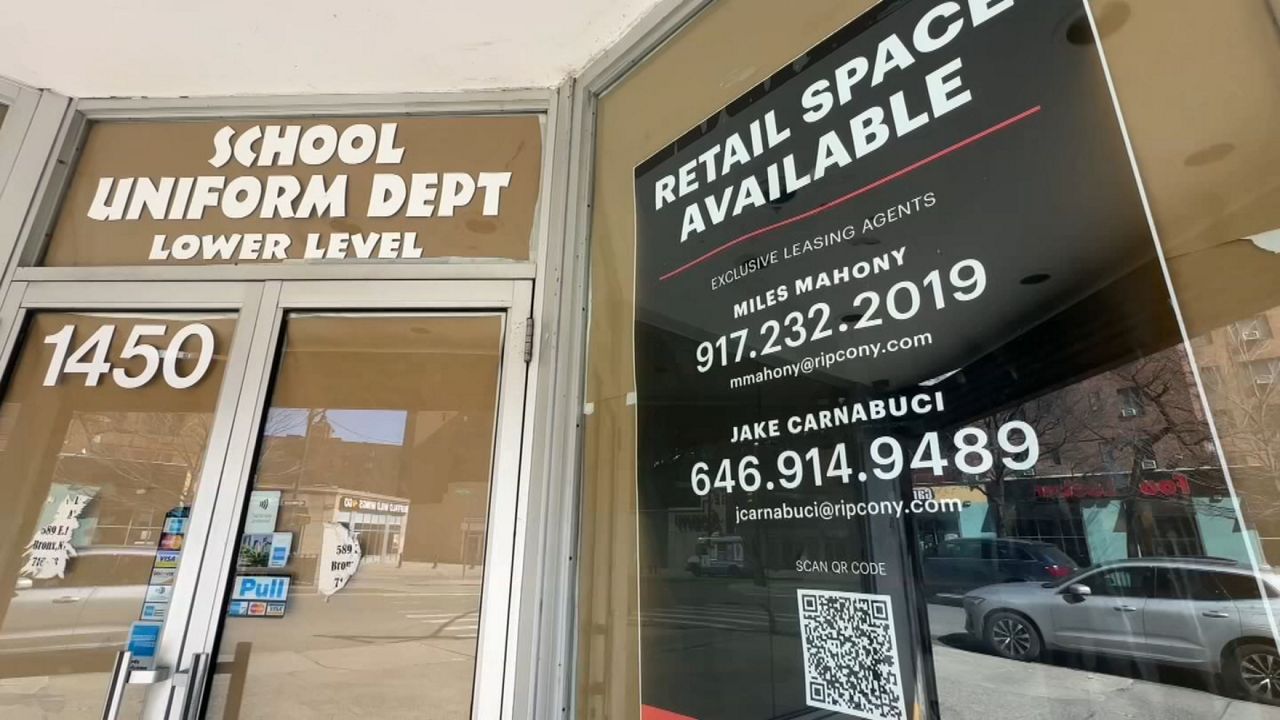
“Only thing that changed is the sign. Everything is the same,” said MD Khalilur Rahman of Parkchester.
Rahman said his name no longer appears on three restaurants he sold in recent years, though the new owners kept much of the original design.
“This glass,” he said. “I put there.”
Rahman said working seven days a week, combined with high rents, rising food costs and increases in the minimum wage, led to mounting losses that forced him to close his businesses.
What You Need To Know
A cluster near Metropolitan Avenue has more than a dozen vacant storefronts, with a 28% vacancy rate in a key retail stretch
Data shows the area had just one vacancy before the pandemic, rising to 16 by late 2025
Business owners cite high rents, rising costs and wage increases as major challenges
Local leaders say a coordinated plan is needed, warning recovery can’t wait for future transit improvements
“It is bad for me. Depression,” said Rahman. “The close, it has broken my heart. I have lost more than $3 million in this time. Every month, I’m losing the money, more than $100,000.”
Shuttered businesses are even more noticeable a few blocks away near a Macy’s department store on Metropolitan Avenue.
Live XYZ, a mapping and analytics company that tracks more than 160,000 storefront and retail spaces across the city, found a cluster of more than a dozen vacancies in the area.
“Part of the surprise was that it was such a thriving storefront economy before, whereas now, a 28% vacancy rate on 57 spaces is unusually high,” said Chris Bradicich, director of growth and partnerships at Live XYZ.
Bradicich said that in early 2020, just before the COVID-19 pandemic, only one of the 57 storefronts in the area was vacant.
By the third quarter of 2025, that number had grown to 16 vacant storefronts.
He said the 28.1% vacancy rate in the two blocks around Macy’s is significantly higher than what he considers a stable rate of 10.8% vacancies for all of Parkchester.
“It’s empty inside. Bolton’s was here for a really long time,” said Bronx Borough President Vanessa Gibson.
On Feb. 18, Gibson addressed the issue, saying it would require coordination among elected officials, community-based organizations, Community Board 9 and the Bronx Chamber of Commerce.
“We also have to come together and develop a plan,” Gibson said. “What does that plan look like, when it means identifying new opportunities, what does the vacancy rate look like, what does the space look like, how are we advertising and promoting Parkchester in a real way.”
Gibson’s office said the borough president held a private virtual meeting last week with elected officials and Parkchester management. Her office denied NY1 access, but said the meeting was productive.
“There is ongoing engagement to bring new businesses to the area, and we’ll be awaiting additional information,” her office said in a statement.
Mohammed Mujumder, chair of Bronx Community Board 9, said he was not aware of the meeting but urged leaders to act quickly.
He also cautioned against relying on the planned 2027 opening of a new Metro-North station in Parkchester as a solution.
“Everything is inter-related,” said Mujumder. “When the business, especially the middle-class business, small business goes down. Less people live here, less money generated.”
While reopening a business is not currently feasible for Rahman, he said he hopes to return in the future.
“Right now, no, but I will come back to this area!” said Rahman.