
How is it possible that New York could let its most fragile and rare three-story Greek Revival house museum be permanently damaged by a new adjacent nine-story office building? How is it possible that the city Landmarks Preservation Commission would jeopardize the 1832 Merchant’s House with its unique and unrepairable plaster work?
How is it possible to approve the adjacent property owner’s third attempt to build knowing the guaranteed damage and extraordinary costs to the owner, the city? How is it possible that the commission would rely on a proven unreliable monitoring system that detects vibration damage after it has occurred and has caused permanent damage to other less fragile landmarks?
And how is it possible for the commission to force the museum to close and put its original 1830s furniture in storage for at least two years of construction denying thousands of school children the opportunity to visit? And how is it possible to jeopardize the only known publicly accessible Underground Railroad entrance known to exist in Manhattan? The 2-foot by 2-foot entrance is beneath a built-in dresser.
The Merchant’s House at 23 E. 4th St. was built in 1832 by an ardent abolitionist and then occupied by the Seabury Treadwell family for nearly 100 years. It has been a museum since 1936, offering a glimpse into 19th century life. It contains not only original 19th century furnishings, personal possessions, clothing and household items.
The property owner next door has tried over several years first to build an eight-story hotel, then a seven-story office building and now a nine-story office building. Prior proposals were approved by the commission. One was overturned by the City Council. The second was contingent on a plaster study that was never done.
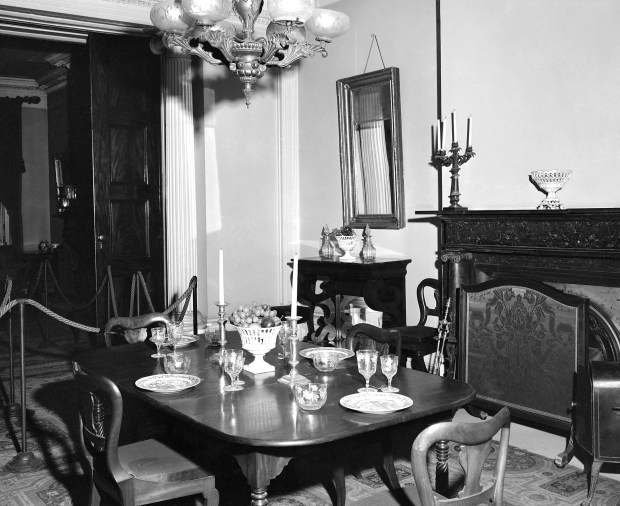 General view of back parlor of the Old Merchant’s House 29 E. 4th Street in New York on April 5, 1954. (AP Photo)
Now, studies by two highly respectable engineering firms have all but predicted plaster failure from the construction. This is not just ordinary plaster work; it is a rare and unrepairable style that is unknown today. It is unique because the plaster was created and then applied in ways that don’t exist today. If damaged, it cannot be repaired. The commission focused on this unusual historical feature during both earlier proposals, so it knows well what is at stake.
Sadly, at the commission’s March hearing, it was apparent that commissioners seemed inclined to accept the so-called safeguard of a monitoring system during construction.
With the unprecedented number of nine architects out of 11 commissioners on the panel — the law requires three, a landscape architect, a planner, a realtor, an historian — it is easy to understand their willingness to depend on a device they may have used successfully in their practice. However, the record here is not good. The problem when damage is caused to a brownstone next door to construction is that an inevitable lawsuit and subsequent repair works to some extent. That is not possible here.
The third iteration of the developer’s proposal is taller, bulkier and heavier than prior proposals. Reports from reputable geotechnical and structural engineers, as well as a plaster preservation expert, all state that the Merchant’s House would suffer irreversible damage. In fact, it is stated the plaster will — not might — be destroyed. One can’t get more direct than that. On top of that, the Underground Railroad entrance already makes the common wall less stable.
Demolition and excavation would kill the Merchant’s House. In prior instances of serious damage even while a monitoring system was in use, by the time the Department of Buildings issued a “stop work order,” the irreversible damage was done. Do we really need to let that happen to the most fragile landmark yet?
Gratz is an award-winning journalist and author of several books about cities.