
Search our comprehensive guide to things to do in Queens for more local events — or submit your own!
Inside Broadway, a New York City-based nonprofit that provides theater education to over 100 schools, has been bringing the magic of Broadway directly to students for over 44 years.
The nonprofit was founded in 1982 as a student ticket program, originally bringing schools to see the sensational Broadway production of Cats — which at the time broke a record for the longest-running show.
According to Michael Presser — the founder, CEO and president of Inside Broadway — the nonprofit has always sought to enrich students’ lives and bring theater culture to children who might not otherwise be exposed to it.
The nonprofit is supported by a Cultural After-School Adventures (CASA) grant awarded by the NYC Department of Cultural Affairs — ensuring free programming that continues its mission of making theater and Broadway accessible to students.
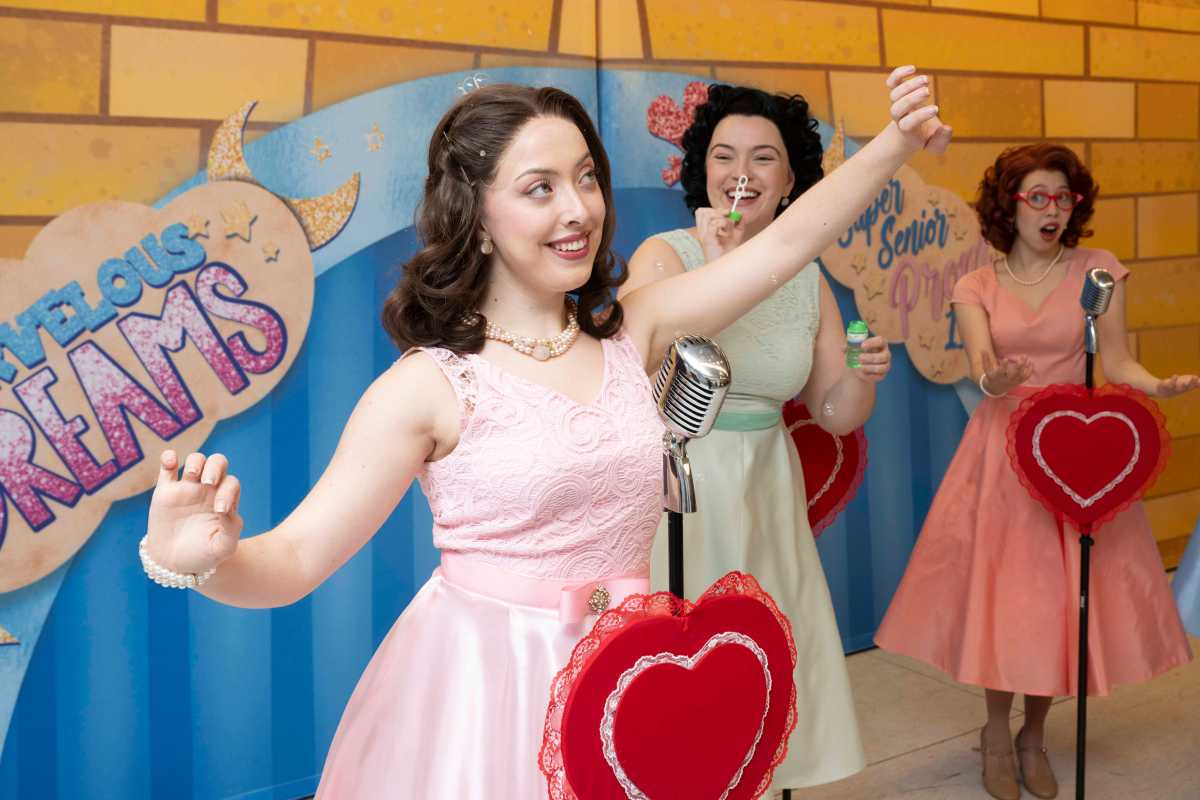
This year, Inside Broadway’s Theatre in Our Schools program brought a concert-style showcase of the off-Broadway smash hit The Marvelous Wonderettes, which is set in 1958 and centers around the Wonderettes — a singing group that is competing to be crowned Prom Queen.
The tour, which brought popular music hits from the ‘50s and ‘60s to students of all ages, spanned 45 school districts across NYC.
It wrapped up on March 27 after a 12-week stint, visiting students in Jamaica, Flushing and other Queens schools on the last leg of the tour.
Raising the curtain
 Theatre in Our Schools aims to expose children to Broadway shows not only by presenting entertaining productions to students, but by engaging in meaningful connections.Photo via Getty Images
The three of the actors from The Marvelous Wonderettes — Courtney Corso-Casiano, Charlotte Kunesh and Maggie Stephens — said they were all exposed to Broadway influences as children, which is why they love sharing it with children today.
Corso-Casiano grew up on Long Island with parents who love Broadway, and she began performing in theater productions when she was 12.
Stephens said she’s been performing for almost her entire life, and also had parents who love Broadway shows despite the family living over four hours north of NYC.
Kunesh, an Ohio-native who has spent her entire life singing and performing in choirs, said she discovered theater when she was in high school and fell in love with its storytelling elements.
All three actors, who also have a background in teaching or caring for children, said the show was an incredible opportunity for them to connect with students in ways that they weren’t expecting.
Corso-Casiano recalled some kids watching the actors setting up for the show before their first performance at a Brooklyn school, which she said was exciting because there was a lot of buzz among the students and teachers leading up to it.
Stephens said she was surprised kids were able to identify with the show despite it being set nearly 70 years ago.
“It’s been wonderful to see the kids’ reactions,” Stephens said. “I wasn’t sure if they were going to connect with the 1950s stuff. It’s so far removed from a lot of what they’ve experienced. The first song we sing is ‘Mr. Sandman,’ and we came to find out that this song was, in some way, used for ‘Stranger Things.’ So there’s these little kids in first or second grade with this huge reaction.”
Corso-Casiano said during their Q&A sessions after the show, kids asked a range of questions. Some kids just like speaking into the microphone, she said, laughing. But some kids, she continued, asked really great questions.
“We get to respond to these kids that are really tuned in,” Corso-Casiano said. “We get to give our personal answers, and it’s been fun. It’s been lovely to interact with them and sort of engage with them in that way.”
Performing for an audience of children with the lights completely on, Kunesh said, means the actors can see their reactions throughout the entire show.
However, she said many students are very engaged, and it’s been wonderful seeing their anticipation and excitement.
“I think that even if kids don’t want to pursue a career in this, it’s still so important from a young age to see that the arts are important, and that they matter,” Kunesh said. “There’s so much that can be gained from these stories and human connection.”
Connecting with students
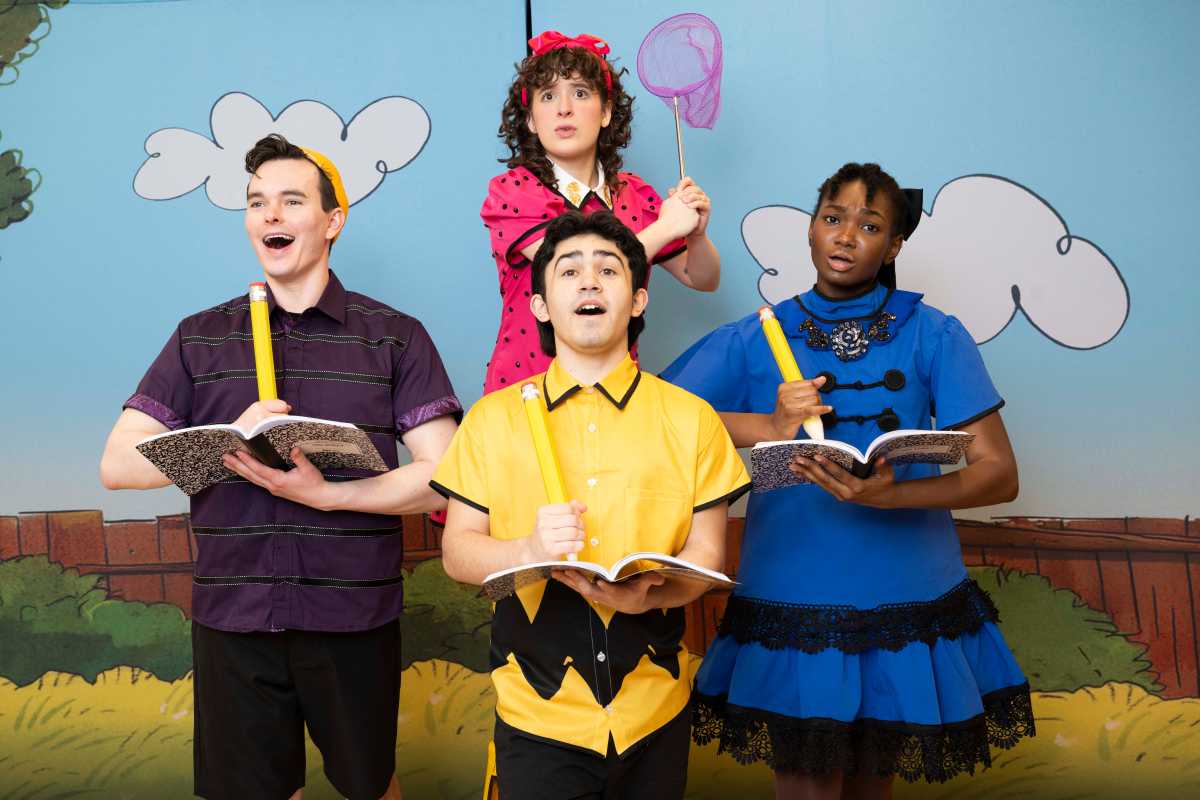 Theatre in Our Schools has previously toured public schools across NYC with productions including You’re a Good Man, Charlie Brown, which brought the classic Peanuts characters to the stage to learn important lessons (while having some fun, of course).Photos courtesy Inside Broadway
Mia and Joseph, two 5th grade students from P.S. 13Q in Elmhurst who attended the show, said the actors not only entertained them, but they inspired them.
Joseph said the show made him laugh, but it also taught him real life lessons, such as talking out problems instead of fighting.
He also said watching the actors speak loudly and move around a stage instead of on a screen made the experience more engaging.
“My favorite part was watching them sing,” Joseph said. “Singing was the most important part, because it’s what got me on the story.”
Mia said she also learned that even when friends fight, they can make up and become best friends again. “It was a message that you could forgive anybody,” she said.
She said that she appreciated the live performance because she could see interactions between the actors much better than she can on a screen.
“The thing about live shows is that you can recognize things that you don’t always recognize in movies,” she continued. “I think it’s a good thing because kids can see how the actors interact with each other.”
However, the most important piece Mia said she took away from the show is the inspiration to be more confident.
Corso-Casiano said watching kids actively participate in the show makes her emotional, recalling a moment when groups of kids danced to “Lollipop” as the actors performed.
“I actually had to bite my tongue,” she said. “I was getting teary eyed because not only were these kids eating it up, but we were the talk of the town that day. They clearly want to be up here on stage, they clearly love what we’re doing. I was literally getting emotional thinking about how these kids were impacted by what we were doing.”
Stephens said sometimes students give the actors little gifts, including a drawing of the girls in their costumes. Some kids even want autographs, she continued, or call them real-life princesses and Barbie dolls.
“I think it’s that you’re just reaching a child in some way,” she said. “We’re getting to do what we love everyday in front of these kids, and it makes their day in ways I couldn’t even fathom until I was actually doing it. It makes all the crazy stuff worth it. It’s really, really special.”
For Kunesh, the Q&A portion of the show is the most meaningful part. She said it’s as if she is witnessing Inside Broadway’s dream being realized.
“I didn’t really find theater until I was in eighth grade,” Kunesh said. “It’s so inspirational to see these kids from such a young age having this experience. Hopefully we get to empower them that yes, they can totally do this. This can totally be their future and you can follow your passion. This is what Inside Broadway is all about.”
A decades-long legacy
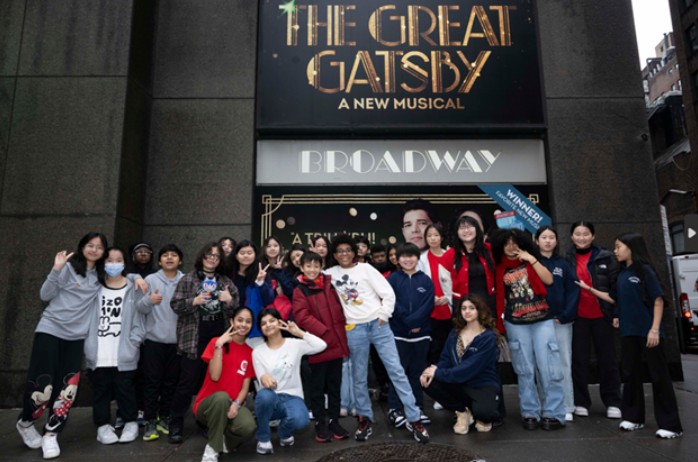 Students from JHS 189Q Daniel Carter Beard in Flushing get a behind-the-scenes look at The Great Gatsby musical through Inside Broadway’s “Creating the Magic” program in 2024.Photo by Elena Olivo
Presser said the idea for the program began with the intention of introducing students to theater and expanding the audience through education.
“Hundreds of thousands of children had the opportunity to come to Broadway, many for the first time, and see a major Broadway musical,” Presser said.
The Shubert Organization’s Winter Garden Theatre, the venue where Cats was performed, realized it had an enormous hit, Presser explained, so it was quite open to the idea of bringing children to see the production to encourage more families to attend the show.
Presser recalled when the ticket program was announced during a press conference hosted by then-mayor Ed Koch at City Hall.
“I think I had 35 messages on my answering machine of teachers that wanted tickets to Cats,” Presser said.
One of the underlying factors that Presser said he believes contributed to the massive success of the Inside Broadway programs is that at the time, it was not commonly accepted that students would be brought to see a Broadway show — but the show was perfect for children and families, so producers noticed they were tapping a new market to sell tickets to.
While the student ticket program ended when Cats wrapped up its historic 18-year run in 2000, Presser said it was important the company pivoted to other activities to ensure Broadway could maintain its presence in schools.
“We had, over the years, established ourselves as a company, and teachers in schools wanted us to continue,” he explained.
That’s when Inside Broadway began developing a teaching artist program, which it called “Build a Musical.” For this program, Broadway performers with educational training are brought to schools to work with children on a musical presentation to be performed in the school’s auditorium.
“It gives students the opportunity to perform in front of strangers, to know how to speak, how to present yourself, and how to work with your colleagues,” Presser said. “Build a Musical is very, very popular in all of our schools.”
Next, Inside Broadway began offering a program called “Creating the Magic” twice per year.
Presser explained while the nonprofit was running the ticket program, students would often ask if it was possible to go backstage.
While he said it wasn’t feasible to bring students backstage, this program brings students directly to the theaters for a demonstration of how Broadway productions are made.
Students are shown how lighting, costumes, makeup and stage management create the clean, polished show they see on the stage.
“I think a lot of the time, children think actors come on stage and then we turn the lights on and we have a show,” Presser said. “But there’s a whole army of people that you don’t see who are working behind the scenes, some of them in other buildings, making it possible for the actors to do their work.”
Last, Inside Broadway offers an acting program that, in collaboration with the Actors Equity Association and the American Federation of Musicians, hires actors and musicians to perform shortened, 45-minute versions of Broadway classics for the company’s Theatre in Our Schools program.
Presser said most schools opt in for the entire package, often beginning first with students viewing a live production, then visiting a theater to get a behind the scenes look at how a production is made, and lastly learning how to perform in a production themselves.
An ever-evolving art form
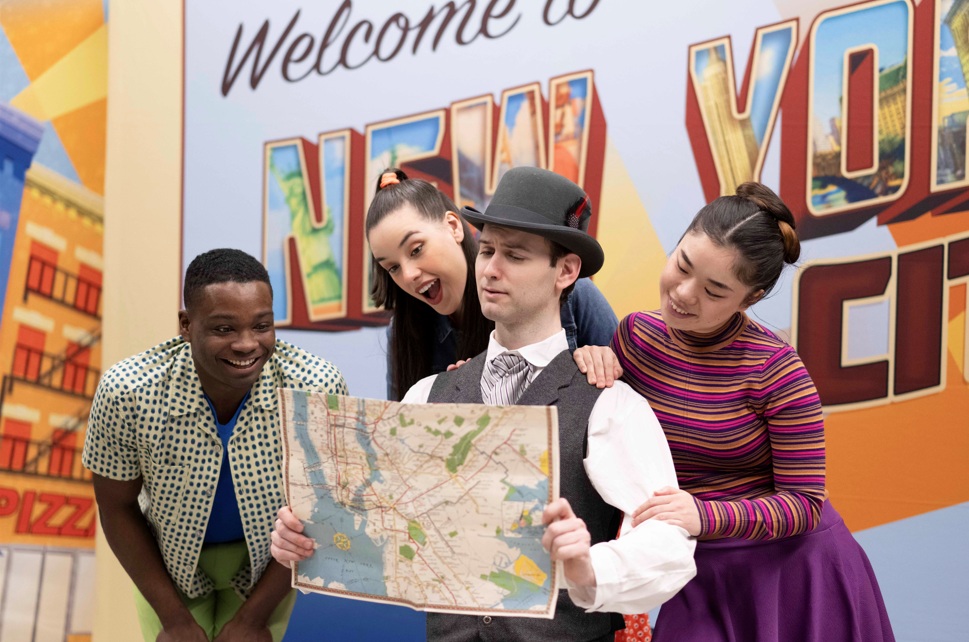 In 2024, the theater program brought a production of Land that I Love, a musical specifically created for NYC Public Schools that centers the immigrant experience.Photos courtesy Inside Broadway
Of course, Presser said, Inside Broadway has adapted over the years to reflect the changes and evolution of the industry.
Because theater is a performing art and not a museum, Presser explained, it’s something that changes to reflect the environment and the era in which it is presented.
For example, Presser said, a show like Buena Vista Social Club — which features Cuban music performed in Spanish — probably would not have been produced on Broadway 40 years ago, but has now been accepted as a reflection of the growing Latin population and culture in NYC.
Music for shows like Wicked and The Lion King, he continued, were written for electric instruments and are mostly pop-influenced.
And, Presser noted, the technology that is used for stage production has evolved greatly. Between sound design, speaker placement, machinery, trapdoors, video projections and much more, Presser said it’s a whole new experience.
“The things that can be done on stage now are remarkable,” he said. “It’s a reflection of the times we live in.”
These types of programs that educate students about these aspects of the theater industry are important for children’s development, Presser emphasized, no matter what their response to it is.
Sometimes children don’t like the shows, he said — but at least they tried and made their own decision.
For other students, he continued, it opens a door to a whole new world to play in.
“I can’t tell you how many letters we have in the file from children and teachers,” Presser said. “I think it’s a very interesting issue of the impact on theater and the impact on children… I think we contributed a great deal to making it understood that going to the theater while you’re in school is a wonderful opportunity that children should have.”
He said the company has moved past the idea that the arts should be used to help teach other subjects like science or math — rather, he said the arts is something that has value and impact on its own.
“I think it’s really important that we, in this country, understand and honor the role that culture plays in our society,” Presser said. “Culture is a way in which society defines itself. It’s a way in which we remember those societies that came before us, and how the societies that will come after us will define themselves.”
Presser said Inside Broadway will be celebrating its 45th anniversary with a special production this fall, which will reflect on the company’s longstanding legacy in NYC and look forward to its future.