
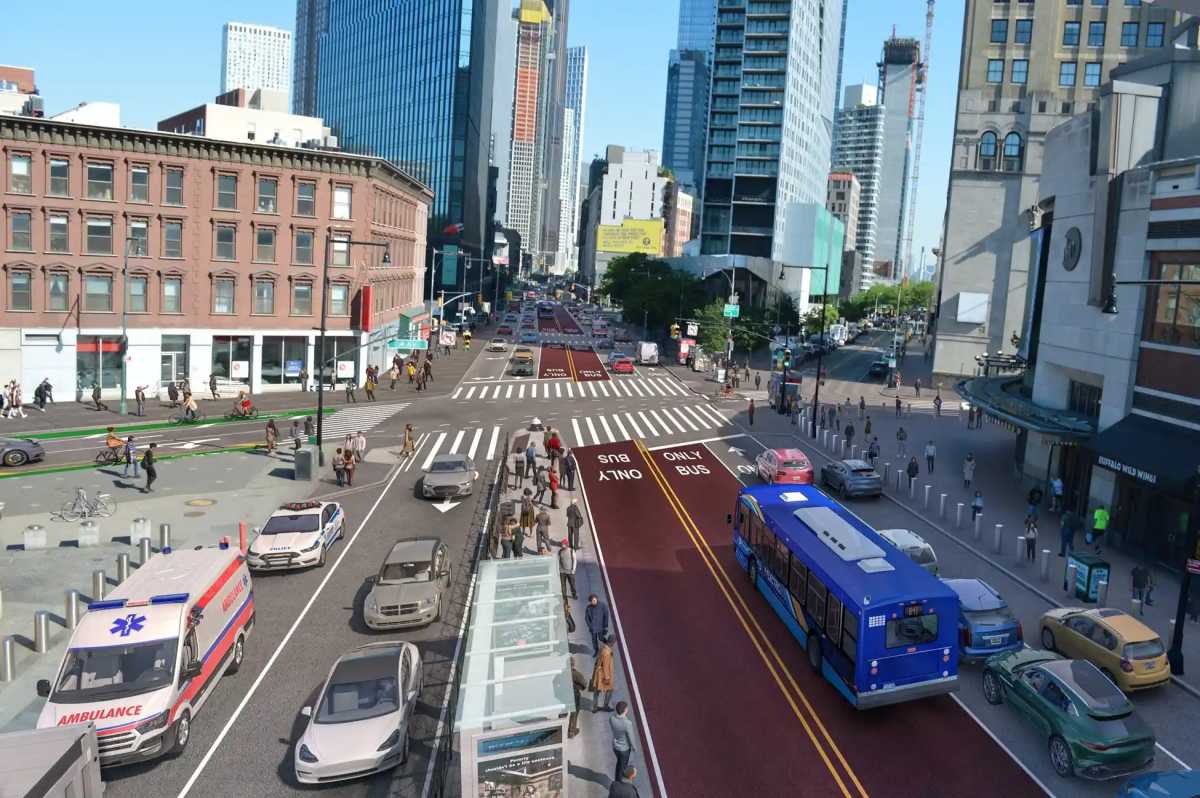
The city will continue construction of a new center-running bus lane on Flatbush Avenue this month.
Image courtesy of NYC DOT
The city Department of Transportation will resume construction on another long-gestating street redesign in the last week of April by continuing to install bus lanes down Flatbush Avenue.
The project, which was first floated by former Mayor Eric Adams’ administration in 2022, encompasses painting center-running bus lanes on the Brooklyn thoroughfare between Livingston Street and Grand Army Plaza. It will also see the city construct six concrete islands up and down the stretch of Flatbush Avenue where riders can wait to board the bus.
The redesign will also feature nearly 29,000 feet of new pedestrian space, eleven dedicated loading zones, and 14 bike parking areas.
DOT broke ground on the project last fall, between Livingston and State streets, but had to suspend work as the winter weather rolled in.
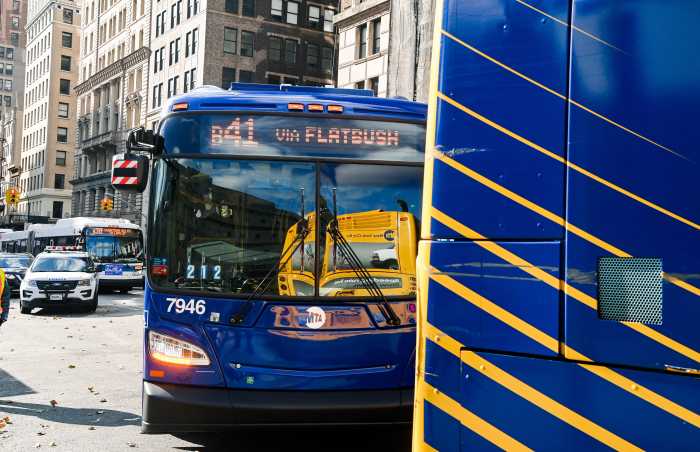 The undertaking is meant to speed up bus traffic and improve safety for all. File photo courtesy of Marc A. Hermann/MTA
The undertaking is designed to boost bus speeds on the corridor by giving them a dedicated lane, separated from private vehicle traffic, that will be enforced by bus-mounted and stationary cameras operated by the MTA and DOT, respectively.
“These center-running bus lanes will give New Yorkers back something precious: time with their families, time at work, time in their communities,” Mayor Zohran Mamdani said in a statement. “Long waits and unreliable service are not inevitable — they are the result of political choices. Today, we are choosing a system that puts bus riders first and builds safer streets for everyone.”
Bus speeds on the street can be as slow as four miles per hour, according to the city. A 2024 survey conducted by the advocacy group Riders Alliance found that 91% of riders experienced delays on Flatbush Avenue in 2023.
The redesign will primarily serve the B41, among the borough’s most crowded routes, as well as the B67, B69, B63, B45, and B103. Taken together, the buses on Flatbush Avenue move 132,000 daily riders.
“Often be as fast to walk as it is to take a bus on Flatbush Avenue — and with over 100,000 riders relying on the bus to get around, that must change,” DOT Commissioner Mike Flynn said. “The new Flatbush Avenue offers a bold blueprint to speed up buses and deliver safer streets.”
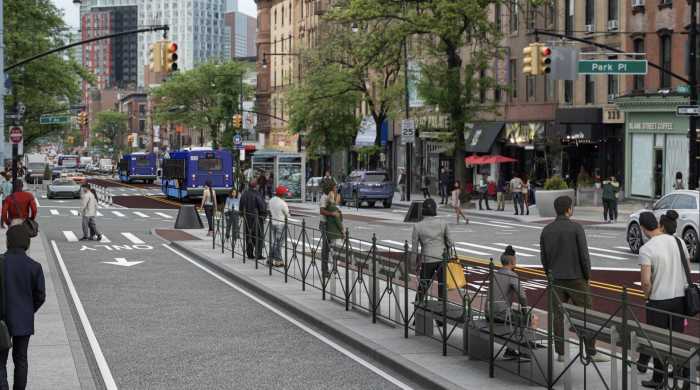 The project will include dedicated bus boarding zones and other safety improvements. Image courtesy of NYC DOT
The city expects construction to last through the summer and into the fall. The agency is encouraging drivers to use alternative routes, public transit, or allow for extra travel time.
The agency will conduct the project in four phases, which will allow for there to still be private vehicle traffic on the road during construction. It will reconstruct one side of the street at a time in order to permit two-way traffic on the other.
The redesign was applauded by transit advocates, who said it would not only speed up buses on Flatbush Avenue, but also make the street safer for all who use it.
“Dedicated lanes down the center of the spine of Brooklyn show us the respect and dignity we deserve,” said Riders Alliance Organizer Jolyse Race, in a statement.
“Boarding islands transform the street with demonstrated safety benefits and prove that much better buses are possible all across New York,” she added.
This story first appeared on Brooklyn Paper’s sister site amNewYork.