
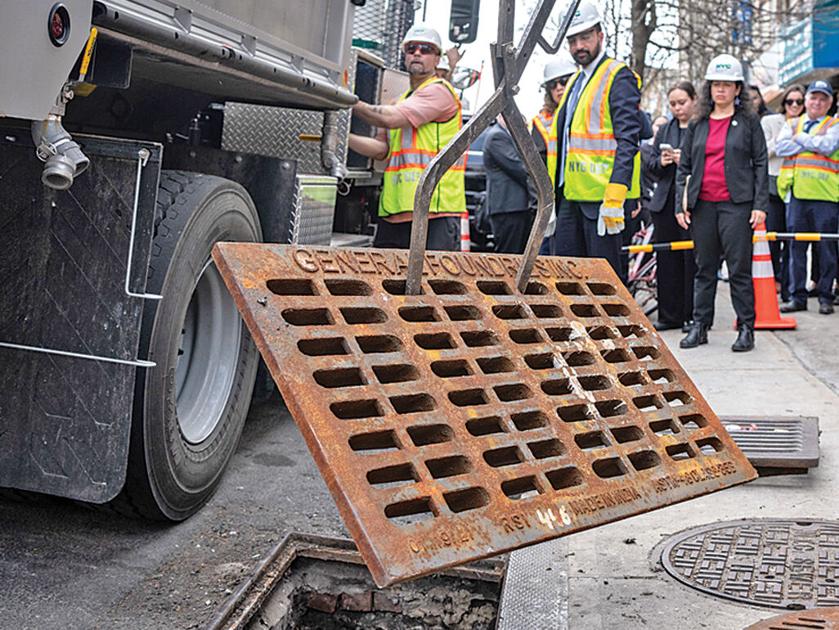
Work to replace storm drains and alleviate flooding in Queens is slated to begin in July, according to City Hall.
Mayor Mamdani on March 31 announced a $108 million investment to upgrade and replace more than 6,700 old catch basins across the city over the next decade. Channels below the curbside grates carry stormwater into underground pipes, which take it into waterways or a resource recovery facility run by the city Department of Environmental Protection.
“By investing in our sewer system, we’re protecting our neighborhoods from the destruction and devastation severe storms bring,” Mamdani said in a press release.
Per a DEP spokesperson, the first replacements will focus on neighborhoods within Community Districts 12, 13 and 14.
Borough President Donovan Richards, who hails from Southeast Queens, said in a statement that families there have seen their blocks flood from even a little rainfall for generations, and he “couldn’t be prouder” to have secured more than $2 billion for infrastructure improvements as the area’s City Council member.
But he noted that other neighborhoods including Flushing, East Elmhurst and Hollis also have become “hotspots for flooding” as climate change worsens.
“Ensuring our catch basins can better keep up with intense rainfall is a critical step toward floodproofing Queens, and I look forward to working with the city to ensure this work is done promptly and smoothly,” Richards said.
City Councilwoman Joann Ariola (R-Ozone Park) said the upgrades in CD 14, which includes Broad Channel and the Rockaway peninsula, are “long overdue.”
“For years, residents have dealt with street flooding, backed-up drains, and damage to homes and vehicles every time we get heavy rain, and my office is constantly contacting the DEP about catch basin problems in the area,” Ariola said in a statement.
She added that the new investment is a start, but more needs to be done, such as storm drain upgrades in the flood-prone areas of Howard and Hamilton Beach.
DEP Commissioner Lisa Garcia said at a news conference in Brooklyn last Tuesday that the agency will prioritize catch basins in need of immediate repairs and areas with chronic flooding, but “the goal is to get to all of them.”
The DEP spokesperson said storm drain replacements are guided by data-driven condition assessments. They will focus on basins that are failing, undersized or prone to chronic flooding, as identified through inspections, complaint history and field observations. The agency said it prioritizes total replacement only when issues can’t be resolved through repairs.
The DEP has modernized more than 3,200 catch basins since July 2024, per City Hall. It will invest $1.5 million a year to continue to do so, and it expects to have upgraded about 1,700 drains by June.
The upgrades involve installing improved basin grates in the road and slotted manhole covers on sidewalks, such that stormwater has an alternate path to the basin if a grate is blocked. The DEP already has made nearly 300 catch basins “bike-friendly,” meaning cyclists can ride smoothly over them rather than dipping downward.
The city also ordered dozens of new trucks to clean catch basins — they can’t drain properly, if blocked by litter or debris.
U.S. Rep. Grace Meng (D-Flushing) said in a statement that Queens needs relief from flooding, which has led to deaths and property damage. She said she has called for the city to improve its sewers for years.
Meng plans to seek more funding to address flooding in Queens, in addition to the $1 million she secured for the DEP to build a Cloudburst Management System somewhere in the borough. She said she also helped pass a law authorizing $190 million for Army Corps of Engineers drainage projects.
“Lives and property cannot continue to be put at risk,” Meng said.